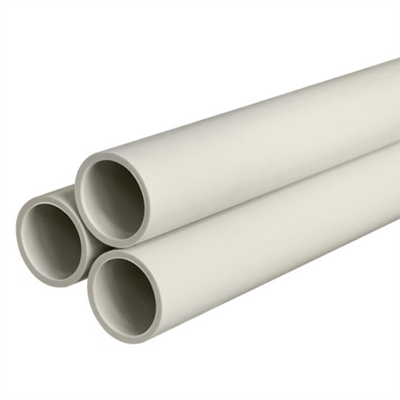
HDPE Ground source heat pump pipe
It can be simply understood as an "energy transportation pipeline" buried underground: In winter, the liquid flowing inside absorbs heat from the soil and delivers it to the heat pump unit in the building for heating; in summer, it works in the opposite way, sending the indoor heat through the pipeline into the soil, extracting heat or discharging heat only, without consuming groundwater.
Core standard: What material is the most suitable?
According to the national standard "Technical Specifications for Ground Source Heat Pump Systems" (GB50366-2005), the buried pipes must meet requirements such as good chemical stability, corrosion resistance, and high thermal conductivity. Currently, the most widely used and mature material in engineering is high-density polyethylene (HDPE), especially grades PE80 or PE100.
Why is it? There are mainly the following advantages:
- Long lifespan, corrosion-resistant: HDPE pipes are resistant to chemical corrosion and do not rust. Their designed service life can be on par with that of buildings, typically ranging from 50 to 60 years.
- Good flexibility: It can be coiled and bent, which can reduce the number of underground joints. This not only lowers the risk of leakage but also makes the construction process more convenient.
- Excellent thermal conductivity: Capable of efficiently transferring heat between the liquid inside the pipe and the soil outside the pipe.
Specification Parameters: How to Understand the Product?
During the procurement or design process, you will come across some key parameters:
- Common pipe diameters: They are mostly DN25 and DN32, and there are also specifications such as DN20, DN40, and DN50. Among them, DE25 is commonly used for single U-tubes, and DE32 is commonly used for double U-tubes.
- Pressure rating: The nominal pressure of the buried pipe should not be less than 1.0 MPa. In large-scale projects or deep wells, it is required to reach 1.6 MPa to ensure safety.
- Special pipe fittings: To ensure reliable system connection and efficient heat exchange, some special pipe fittings will be used, such as:
U-shaped elbow: Used to connect two pipes that are perpendicular to each other, forming a loop.
Five-hole card / fixed support: This is used to fix the two branch pipes of the U-shaped tube within the drilled hole, ensuring they maintain an appropriate distance from each other to prevent them from touching and affecting heat exchange.
Diverter valve: The key component that connects multiple circuits in parallel underground.
We adopt a dual-channel operation model of both online and offline. You can either come to our offline factory directly or contact us online via phone or email.
Our address
No. 4, Room 1501, North University Park Science and Technology Park, Luoyang City, Henan Province, China
Phone Number
(86)-15038689376
cnzjpipe@mtwkj.com

Hot Tags: hdpe ground source heat pump pipe, China hdpe ground source heat pump pipe factory