

What are the prominent advantages of HDPE water supply pipes?
Sturdy and durable
Its wear resistance is extremely good. Experimental results show that its wear resistance is four times that of steel pipes. At the same time, it has excellent resistance to stress cracking and corrosion resistance, and can withstand various chemical substances and electrochemical corrosion. Therefore, it can be safely used underground for a long time.


Long lifespan and healthy benefits
Under normal temperature and pressure conditions, the service life of HDPE water supply pipes can reach over 50 years. Moreover, no heavy metal salt stabilizers are added during the production process. The material itself is non-toxic, does not form scale, and does not breed bacteria. This effectively avoids secondary pollution of drinking water during transportation, ensuring the health of water usage.
High conveying efficiency
The inner wall of the pipeline is extremely smooth (with a Manning coefficient of 0.009), resulting in low water resistance. Therefore, it has a higher transportation capacity compared to traditional pipe materials, and also reduces energy consumption during the transportation process.

Some other application advantages
Flexible and earthquake-resistant
Its flexibility is excellent. Even at a low temperature of -60℃, it will not crack and is therefore very suitable for winter construction. This flexibility also brings about excellent seismic resistance, enabling it to adapt to complex geological conditions such as ground subsidence.
Convenient for construction
Due to its lightweight design, the pipeline is very convenient for transportation and installation, which can save manpower and equipment costs. Moreover, it can be bent and laid, easily bypassing obstacles, and even can be constructed using non-digging techniques, which is an excellent choice for places like urban roads where excavation is not allowed.
Key Specifications
|
Parameter |
Details |
|
SDR |
9 to 27 |
|
Pressure Rating |
0.8Mpa to 2.0Mpa |
|
Diameter Range |
DN20 - DN1600mm |
|
Material |
HDPE (PE80, PE100) |
|
Color |
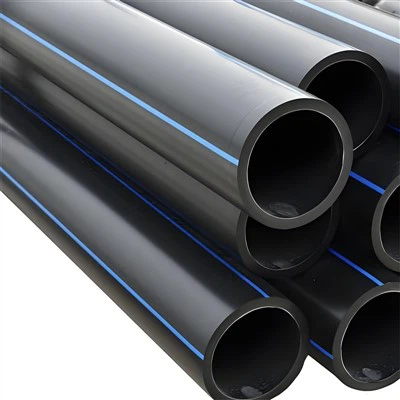
Black (with color stripes - like a secret code for application ID) |
Where are HDPE water supply pipes mainly used?
- Municipal engineering: such as urban water supply systems, renovation of water supply networks, outdoor buried water supply systems, etc.
- Construction field: The indoor water supply system of buildings.
- In the industrial and agricultural sectors: transportation of industrial raw materials (such as ores and slurries), agricultural irrigation pipelines, etc.
- Other fields: Pipeline repair, sewage treatment projects, landscaping, etc.
How are HDPE water supply pipes connected?
The connection method of HDPE pipes is very reliable. It mainly achieves this through hot-melt or electric-melt methods to connect the pipes into a single unit. The strength of the joints is even higher than that of the pipes themselves, effectively preventing leakage. Specifically, there are several common methods:
- Hot-melt butt joint connection: Suitable for situations with larger pipe diameters (typically DN ≥ 75). A dedicated butt welding machine is used to heat the pipe ends and then perform the butt joint.
- Electrical heat fusion connection: Suitable for situations with smaller pipe diameters (typically DN ≤ 63). It is achieved by using an electrical heat fusion welding machine to connect pipes and pipe fittings.
- Flange or threaded connection: Used for connecting to pipes or valves of other materials such as metal.
What are the points to be noted when using it?
Not applicable to hot water pipelines
HDPE pipes cannot be used for transporting hot water. Their operating temperature usually ranges from -60℃ to 60℃.
The pavement should be protected when laid outdoors.
If the pipeline needs to be installed in an outdoor open area exposed to direct sunlight, it is recommended to take protective measures. Although the material contains carbon black which can resist ultraviolet rays, prolonged exposure to the sun will still accelerate aging.
We're With You Every Step
Before You Buy
Need pressure drop calculations for long-distance lines? We've got the numbers. Confused about fusion equipment or training? Our team walks you through it - no jargon, just clear guidance.
After You Buy
• 15-year warranty on PE100 SDR13.6 pipes - we stand by our material.
• Stuck testing joint integrity? Our techs are a call away.
FAQs
Q: Natural gas transmission?
A: Nope - this hdpe pipe is strictly for water. Gas needs its own specialized HDPE.
Q: Weight of a 6m DN200mm SDR13.6 pipe?
A: Around 20kg - but ask for the full weight chart, and we'll send it over.
Hot Tags: hdpe water supply pipeline, China hdpe water supply pipeline factory