Introduction
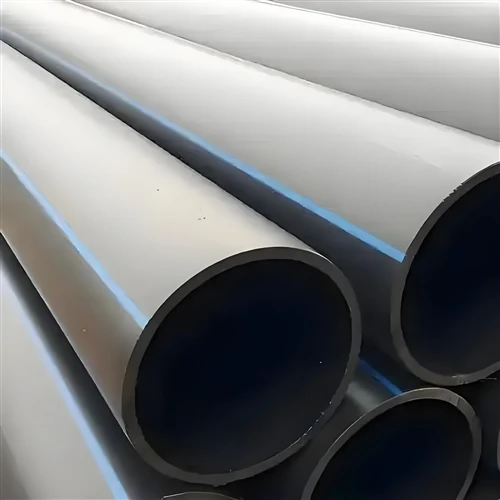
HDPE solid wall pipe is widely used in municipal water supply, raw water transmission and underground pressure pipelines. Its homogeneous wall structure provides reliable resistance to internal pressure, while its smooth inner surface supports efficient water transportation.
However, its applications are not limited to water supply. Depending on the pipe design and applicable standards, it can also be used for pressurized wastewater and underground gravity drainage. The key is to select the pipe according to both internal pressure and external soil loading requirements.
1. Material Structure and Mechanical Characteristics
1.1 Homogeneous Wall Construction
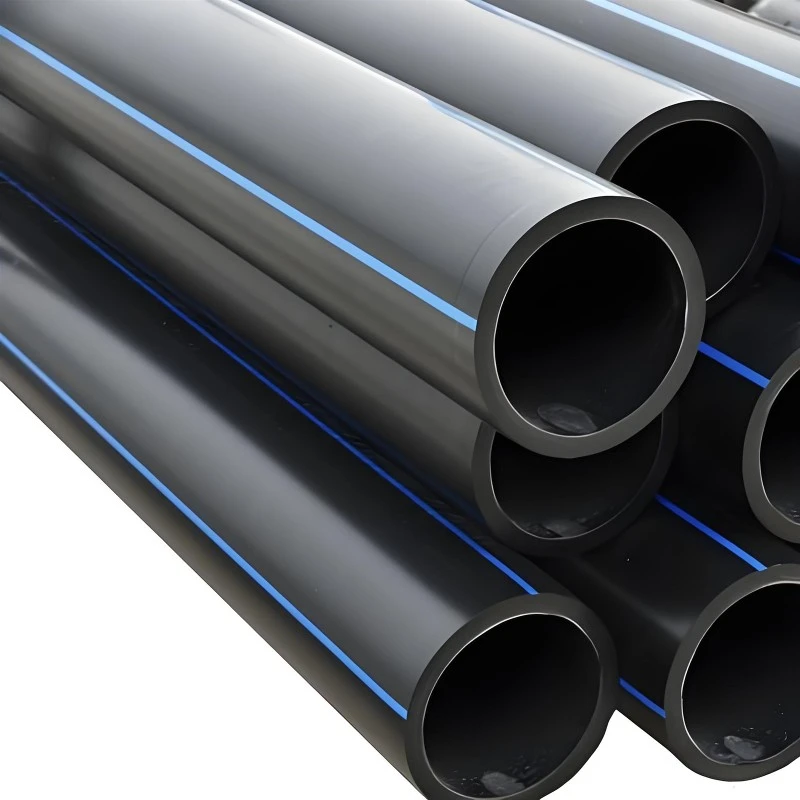
An HDPE solid wall pipe is manufactured by extrusion, forming a continuous polyethylene cross-section throughout the pipe wall.
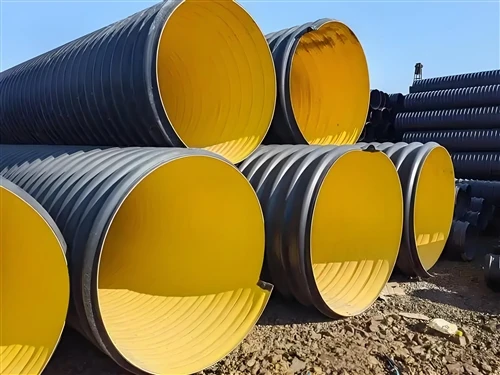
Unlike double-wall corrugated pipes, hollow-wall winding pipes and steel-reinforced composite pipes, it does not rely on a hollow profile or an embedded reinforcement layer to achieve its structural performance.
The pipe's mechanical properties are primarily determined by:
Polyethylene material classification.
Long-term hydrostatic strength.
Nominal outside diameter.
Minimum and nominal wall thickness.
Manufacturing consistency.
Operating temperature and design life.
PE100 is a commonly specified material for pressure water pipelines. According to the polyethylene material classification system, PE100 has a Minimum Required Strength (MRS) of 10 MPa.
MRS is a long-term material strength classification derived from hydrostatic strength data. It should not be confused with the allowable design stress of a finished pipe.
For example, when a design coefficient of 1.25 is applied:
sigma_s= MRS / C
sigma_s = 10 / 1.25 = 8 MPa
Here, sigma_s represents the reference design stress under the stated design assumptions.
The actual pipe design must follow the applicable product standard, material qualification and service conditions.
1.2 Why Wall Thickness Determines Pressure Capacity
When water is contained inside a pressurized pipe, internal pressure generates circumferential stress in the pipe wall.
For a given material grade, the wall thickness relative to the outside diameter determines how much stress develops under a particular operating pressure.
This is why two PE100 pipes with the same outside diameter can have different pressure ratings.
A thicker wall provides a greater load-bearing section and generally results in a higher pressure class.
A simplified pressure-design relationship is:
PN ≈ (2 × sigma_s) / (SDR - 1)
Where:
PN = nominal pressure in MPa
sigma_s = design stress in MPa
SDR = standard dimension ratio
For PE100 with a design coefficient of 1.25, the reference design stress is 8 MPa.
For SDR11:
PN = (2 × 8) / (11 - 1) = 1.6 MPa
This corresponds to PN16 under the standard reference conditions.
The equation explains the relationship between material strength, wall thickness and nominal pressure. Actual conformity must be checked against the dimensional and pressure-rating tables of the relevant standard.
2. Why HDPE Solid Wall Pipe Is Suitable for Water Supply
2.1 Long-Term Hydrostatic Performance
A water supply pipeline is expected to remain in service for decades. Its design therefore cannot be based only on short-term tensile strength or a single hydrostatic pressure test.
Polyethylene pressure pipes are classified using long-term hydrostatic strength data. Material qualification considers how the material behaves under sustained internal pressure over time.
This is particularly important for buried municipal pipelines, where replacing a failed section may require excavation, road closure and interruption of water supply.
The PE100 material classification provides a basis for designing the pipe wall according to the required pressure and service conditions.
However, the expected design life is not guaranteed by the PE100 designation alone. Temperature, pressure fluctuations, installation quality, chemical exposure and operating conditions must also be considered.
2.2 Flexibility and Resistance to Ground Movement
A buried pipeline is not supported uniformly along its entire length.
Changes in soil conditions, localized settlement and movement around road crossings can introduce additional strain into the pipeline.
HDPE has good ductility compared with many rigid pipe materials. Its ability to deform within an appropriate design range can help it accommodate ground movement without immediate brittle fracture.
This property is useful for underground water distribution networks and pipelines installed in areas with variable ground conditions.
Nevertheless, HDPE remains a buried flexible pipe system. The interaction between the pipe and surrounding soil is important.
Proper bedding, haunch support, sidefill compaction and backfilling are necessary to control deformation and maintain long-term performance.
2.3 Fusion Joining and Pipeline Integrity
Joint performance is a major consideration in long-distance water supply projects.
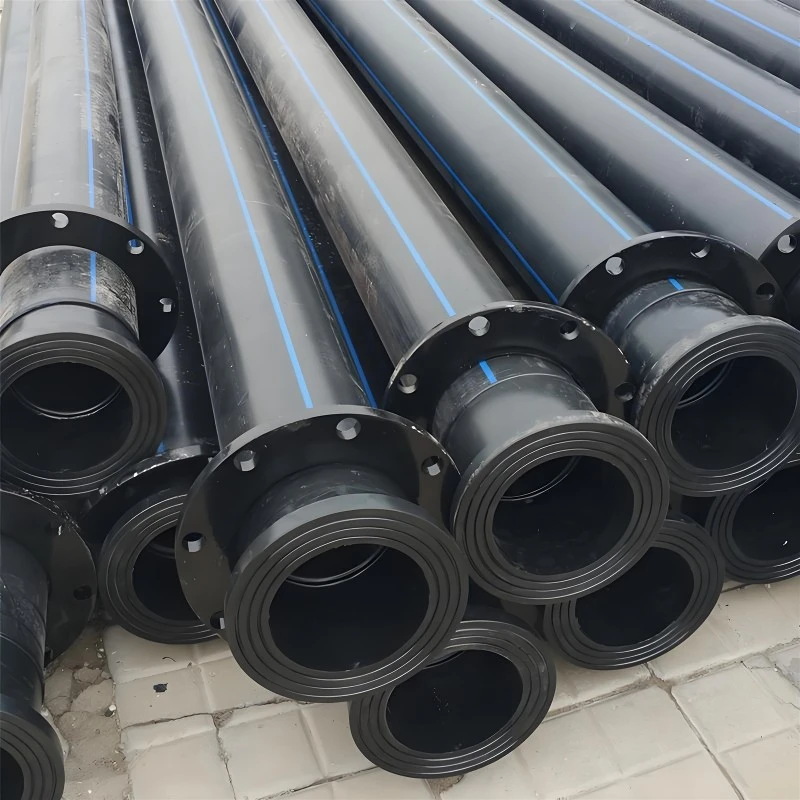
HDPE solid wall pipes are commonly connected using butt fusion or electrofusion.
During butt fusion, the prepared pipe ends are heated to the specified fusion temperature and brought together under controlled pressure. The joint is then held until the required cooling period has been completed.
Electrofusion uses a fitting containing an electrical heating element. The controlled heating process melts the contact surfaces of the fitting and pipe, forming a fused connection.
A properly executed fusion joint can provide a continuous connection without relying on conventional rubber sealing rings at the joint interface.
However, joint reliability is dependent on several process variables:
Pipe-end preparation and cleanliness.
Correct alignment and clamping.
Heating temperature and time.
Fusion pressure.
Environmental conditions.
Cooling time before handling or testing.
For project quality control, welding records and qualified operator procedures should be maintained.
2.4 Hydraulic Characteristics and Internal Surface
The internal surface of an HDPE solid wall pipe is generally smooth. This helps limit friction losses during water transportation.
For long transmission pipelines, friction loss can affect pump selection, operating pressure and energy consumption.
A hydraulic calculation should therefore consider:
Internal diameter rather than nominal outside diameter alone.
Design flow rate.
Water velocity.
Pipeline length.
Pipe roughness assumption.
Fittings, valves and elevation differences.
A larger outside diameter does not automatically mean a more efficient pipeline. The actual internal diameter depends on wall thickness and SDR.
This is particularly important when comparing SDR11 and SDR17 pipes with the same nominal outside diameter.
3. Detailed Technical Specifications of HDPE Solid Wall Pipe
The following specifications represent commonly available PE100 pressure pipe configurations. The actual product range must be confirmed with the manufacturer.
3.1 General Product Data
|
Technical Item |
Specification |
|
Product |
HDPE Solid Wall Pipe |
|
Material grade |
PE100 |
|
Material classification |
MRS 10 MPa |
|
Pipe construction |
Homogeneous solid wall |
|
Manufacturing process |
Extrusion |
|
External surface |
Smooth |
|
Internal surface |
Smooth |
|
Common pipe color |
Black |
|
Water supply identification |
Blue stripes, subject to local requirements |
|
Typical diameter range |
OD20–OD1200 mm, depending on manufacturer |
|
Common SDR series |
SDR9, SDR11, SDR13.6, SDR17, SDR21, SDR26 |
|
Common pressure classes |
PN6.3–PN20, depending on SDR |
|
Reference design temperature |
20°C |
|
Standard lengths |
6 m, 9 m, 12 m or customized |
|
Joining methods |
Butt fusion, electrofusion |
|
Installation |
Buried or above ground, subject to engineering design |
|
Main applications |
Water supply, raw water, industrial water, pressure drainage |
|
Main standards |
ISO 4427, EN 12201 |
3.2 PE100 Pressure Classification and SDR
The relationship between SDR and pressure rating is fundamental to HDPE pipe selection.
SDR = OD / e
Where:
OD = nominal outside diameter (mm)
e = nominal wall thickness (mm)
For PE100 at 20°C with a design coefficient of 1.25, the following pressure ratings are commonly used:
|
Material |
SDR |
Nominal Pressure |
Design Stress Reference |
|
PE100 |
SDR26 |
PN6.3 |
8 MPa |
|
PE100 |
SDR21 |
PN8 |
8 MPa |
|
PE100 |
SDR17 |
PN10 |
8 MPa |
|
PE100 |
SDR13.6 |
PN12.5 |
8 MPa |
|
PE100 |
SDR11 |
PN16 |
8 MPa |
|
PE100 |
SDR9 |
PN20 |
8 MPa |
The PN values are reference classifications at 20°C. The permitted operating pressure may need to be reduced when the operating temperature increases or when other design limitations apply.
3.3 Outside Diameter and Wall Thickness Reference Table
The following table provides representative nominal dimensions for PE100 pipes.
|
OD (mm) |
SDR11 (mm) |
SDR17 (mm) |
SDR26 (mm) |
|
110 |
10.0 |
6.6 |
4.2 |
|
160 |
14.6 |
9.5 |
6.2 |
|
200 |
18.2 |
11.9 |
7.7 |
|
250 |
22.7 |
14.8 |
9.6 |
|
315 |
28.6 |
18.7 |
12.1 |
|
400 |
36.3 |
23.7 |
15.3 |
|
500 |
45.4 |
29.7 |
19.1 |
|
630 |
57.2 |
37.4 |
24.1 |
These are reference nominal dimensions. The applicable ISO or EN dimensional tables, including their rounding rules, minimum wall thickness and manufacturing tolerances, take precedence for production and acceptance.
3.4 How SDR Changes the Internal Diameter
For hydraulic design, the internal diameter is just as important as the outside diameter.
The approximate internal diameter can be calculated as:
ID = OD - (2 × e)
Consider a PE100 pipe with an outside diameter of 315 mm.
|
Parameter |
SDR11 |
SDR17 |
|
Outside diameter |
315 mm |
315 mm |
|
Nominal wall thickness |
28.6 mm |
18.7 mm |
|
Approximate internal diameter |
257.8 mm |
277.6 mm |
|
Reference pressure class |
PN16 |
PN10 |
The SDR11 pipe has a thicker wall and a higher pressure rating, but its internal diameter is smaller.
This difference affects flow velocity and hydraulic capacity.
Consequently, the choice between SDR11 and SDR17 should not be made on pressure rating alone. Both pressure requirements and hydraulic calculations must be considered.
4. Engineering Considerations for HDPE Water Supply Pipelines
A technically suitable pipe can still fail prematurely if the operating conditions are not properly assessed.
Before finalizing a water supply specification, the following factors should be reviewed.
Operating Pressure and Surge Pressure
The design pressure should include the normal operating condition and relevant transient pressure effects.
Pump starting and stopping, rapid valve closure and changes in flow conditions may produce pressure surges.
The selected pressure class should be checked against the maximum design pressure rather than only the normal operating pressure.
Operating Temperature
PE pressure ratings are generally referenced to 20°C.
At higher operating temperatures, the allowable pressure may need to be reduced according to the relevant standard and manufacturer's design data.
A PN16 pipe should therefore not automatically be assumed to operate continuously at 16 bar at every temperature.
Installation Conditions
Underground installation requires suitable trench dimensions, bedding material, side support and controlled backfilling.
For above-ground installation, support spacing, thermal expansion, pipe movement and exposure conditions need to be considered.
Water Quality and Certification
For drinking water applications, the pipe material and finished product may need to comply with specific national hygiene or potable-water approval requirements.
A PE100 pressure classification does not, by itself, demonstrate that a pipe is certified for drinking water.
5. Can HDPE Solid Wall Pipe Be Used for Drainage?
The answer depends on the drainage system.
The term solid wall describes the physical construction of the pipe. It does not define whether the pipe must be used for water supply or drainage.
Two drainage conditions need to be considered separately.
5.1 Non-Pressure Gravity Drainage
In gravity drainage, the flow is driven primarily by elevation difference rather than continuous internal pressure.
The pipe's structural performance is therefore strongly influenced by external loading.
For a buried gravity drainage system, the main design considerations include:
Ring stiffness.
Pipe deformation and deflection.
Burial depth.
Soil type and compaction.
Traffic loading.
Groundwater conditions.
Joint watertightness and infiltration control.
HDPE solid wall pipes can be used for underground non-pressure drainage when the product complies with the relevant drainage standard and project requirements.
EN 12666-1 is a relevant standard for polyethylene piping systems used in non-pressure underground drainage and sewerage.
For this type of application, the pipe must be assessed according to its structural performance under external loading. A high internal pressure rating does not automatically establish adequate resistance to soil pressure.
5.2 Pressurized Drainage and Sewerage
In some wastewater systems, gravity flow is not sufficient.
Wastewater is collected at a pumping station and transferred through a pressure pipeline to a treatment plant or another collection point.
Here, the pipeline is exposed to internal pressure, and PE100 solid wall pressure pipes may be suitable.
ISO 4427 specifically covers polyethylene pressure systems for water supply and drainage and sewerage under pressure. The 2019 edition is the published reference edition while the 2026 revision is currently under development.
https://www.iso.org/standard/72183.html
The specification should include:
Design operating pressure.
Surge pressure.
Wastewater temperature.
Chemical composition and concentration.
Required design life.
Pipe material compatibility.
Joint performance.
The chemical compatibility of the material must be evaluated for the actual wastewater. Suitability for drinking water does not automatically establish suitability for all industrial effluents.
6. PN and SN: Two Different Structural Design Parameters
One of the most important distinctions in pipe selection is the difference between pressure rating and ring stiffness.
|
Parameter |
PN |
SN |
|
Full name |
Nominal Pressure |
Nominal Ring Stiffness |
|
Main purpose |
Internal pressure classification |
Resistance to external ring deformation |
|
Typical unit |
bar or MPa |
kN/m² |
|
Main application |
Pressure pipelines |
Non-pressure buried drainage |
|
Influencing factors |
Material strength, SDR, design coefficient |
Wall geometry, material modulus, pipe structure |
|
Typical design concern |
Internal water pressure |
Soil load, traffic load and pipe deflection |
SN4 and SN8, for example, refer to nominal ring stiffness classes of 4 kN/m² and 8 kN/m² respectively.
They are not pressure ratings.
Likewise, PN10 does not mean SN10.
For a gravity drainage project, the required ring stiffness should be determined from the installation conditions and structural design. For a pressure water supply project, the pressure class should be determined from the hydraulic design.
Some projects require assessment of both internal pressure and external loads.
7. Solid Wall Pipe vs. Structured Wall Drainage Pipe
Although both product families can use polyethylene, their structural designs serve different engineering purposes.
|
Comparison |
HDPE Solid Wall Pipe |
HDPE Structured Wall Pipe |
|
Cross-section |
Homogeneous solid wall |
Hollow or shaped wall |
|
Internal surface |
Smooth |
Usually smooth |
|
External surface |
Smooth |
Corrugated or structured |
|
Pressure design |
Commonly available in pressure-rated series |
Depends on specific product design |
|
Structural design |
Wall thickness and material strength |
Wall geometry and structural profile |
|
Typical application |
Water supply and pressure drainage |
Gravity drainage and sewerage |
|
Representative products |
PE100 solid wall pipe |
Double-wall corrugated, steel-reinforced corrugated, Krah pipe |
For a pressurized water supply project, the solid wall pressure pipe is generally the more direct selection.
For large-diameter gravity drainage, structured wall products are frequently considered because their geometry can provide the required ring stiffness without using a uniformly thick solid wall.
This does not mean one construction is universally better. The product must match the design load, hydraulic requirements, installation method and applicable standard.
8. Manufacturing and Quality Control Requirements
The performance of an HDPE solid wall pipe depends on more than the raw material grade.
During production, dimensional consistency and material stability are important.
The following properties are commonly relevant to product quality assessment:
|
Inspection Item |
Engineering Purpose |
|
Outside diameter |
Dimensional conformity |
|
Wall thickness |
Pressure-bearing geometry |
|
Ovality |
Dimensional consistency and joint preparation |
|
Material identification |
Verification of PE grade |
|
Melt mass-flow rate |
Material processing consistency |
|
Oxidation induction time |
Thermal oxidation stability |
|
Carbon black content and dispersion |
UV protection for black pipe |
|
Hydrostatic pressure test |
Resistance to internal pressure under specified test conditions |
|
Appearance and surface quality |
Detection of visible production defects |
For pressure pipes, hydrostatic testing is particularly important. Testing should be conducted using the applicable product standard and test method, such as ISO 1167, with the specified test temperature, pressure and duration.
For fusion-jointed systems, the pipe and fitting combination must also meet the relevant system performance requirements.
A manufacturer's inspection report should identify the actual production batch and the tests performed. Where a project requires independent verification, third-party inspection and sampling can be included in the quality plan.
9. Relevant International Standards
|
Standard |
Scope |
|
ISO 4427-1 to ISO 4427-5 |
PE systems for water supply and pressure drainage/sewerage |
|
EN 12201 series |
PE pressure systems for water supply and pressure drains and sewers |
|
EN 12666-1 |
PE systems for non-pressure underground drainage and sewerage |
|
ISO 12162 |
Thermoplastics for pipes and fittings - Classification and designation of materials |
|
ISO 1167 series |
Determination of resistance to internal pressure |
|
ISO 9969 |
Determination of ring stiffness of thermoplastics pipes |
ISO 4427:2019 remains the published reference edition, with a new ISO/DIS 4427 revision under development in 2026. EN 12201:2024 is the current European edition in the relevant national adoptions. The precise edition and national implementation should be confirmed in the project specification.
10. Frequently Asked Questions
Q1. Are HDPE solid wall pipes exclusively used for water supply?
No. Solid wall refers to the pipe's cross-sectional construction, not its exclusive application.
Depending on the product standard and design, HDPE solid wall pipes can be used for pressure water supply, pressurized wastewater transportation and underground non-pressure drainage.
Q2. Can a PE100 water supply pipe be used for gravity drainage?
Not automatically.
Although the material may be suitable, the finished pipe must also satisfy the structural requirements for buried non-pressure drainage.
Ring stiffness, deformation, external loading and joint performance must be verified against the applicable drainage standard.
Q3. Why are structured wall pipes often selected for large-diameter drainage?
A structured wall pipe uses its cross-sectional geometry to resist external ring deformation.
This allows the designer to obtain a required ring stiffness without making the entire wall uniformly thick.
For large-diameter gravity drainage, this can provide an efficient balance between structural performance and material consumption.
Q4. Does a lower SDR always mean a better pipe?
No. A lower SDR means a thicker wall relative to the outside diameter and generally a higher pressure rating for the same material grade and design coefficient.
However, the additional wall thickness also reduces the internal diameter and increases material consumption.
The correct SDR should be determined through pressure design and hydraulic calculations.
Q5. Can HDPE solid wall pipes transport industrial wastewater?
They can be suitable for many industrial wastewater applications, but chemical compatibility must be evaluated.
The actual chemical composition, concentration, temperature and exposure duration should be considered before selecting the material.
Q6. Which standards should be specified for HDPE solid wall pipes?
For pressure water supply and pressurized drainage, ISO 4427 and EN 12201 are relevant standards.
For underground non-pressure drainage, EN 12666-1 is a relevant product standard.
The selected standard must match the intended service condition and project requirements.
Conclusion
HDPE solid wall pipe is widely used in water supply because its homogeneous wall structure can be dimensioned for sustained internal pressure. Its long-term hydrostatic strength, flexibility, smooth internal surface and fusion-joint technology make it suitable for buried water distribution and transmission networks.
However, the term solid wall should never be treated as a synonym for water supply.
The same basic pipe construction can serve different applications when the material, dimensions and performance requirements are properly specified.
For pressure water supply, the critical parameters are material classification, SDR, wall thickness, PN, operating temperature and pressure transients.
For gravity drainage, the critical parameters shift towards ring stiffness, external loading, burial depth, deformation and joint tightness.
For pressurized sewage, both pressure resistance and chemical compatibility must be considered.
A technically correct pipe selection begins with the actual hydraulic and structural conditions of the project, followed by verification against the appropriate product standard.
Request an HDPE Solid Wall Pipe Quotation
| Step | Process |
|---|---|
| 1 | Send Requirements - Pipe diameter, SDR / pressure rating, pipe length, quantity and water supply application |
| 2 | Specification Confirmation - Material grade, OD, wall thickness, ID, SDR, pressure rating (PN), applicable standard and connection method |
| 3 | Quotation - Unit price, production lead time, packing details and shipping terms |
| 4 | Order & Production - Contract confirmation, payment arrangement and manufacturing |
| 5 | Inspection & Delivery - Quality inspection, product documentation and shipment |
For HDPE Solid Wall Pipes, PE100 Water Supply Pipes and HDPE Solid Wall Pipe Fittings, please send us the following information:
Pipe Type + OD + SDR / Wall Thickness + Pressure Rating (PN) + Pipe Length + Applicable Standard + Connection Method + Water Supply Application + Quantity + Delivery Destination
Our factory can provide HDPE solid wall pipe solutions for municipal water supply networks, drinking water transmission, raw water transportation, industrial water supply and underground pressurized pipeline projects.
Available specifications can be selected according to project requirements, including pipe diameter, PE material grade, SDR series, pressure rating, length and customized fittings.
Send us your project requirements to receive a suitable product recommendation and quotation directly from our factory.
Luoyang Zhengju New Materials Technology Co., Ltd.
WhatsApp: +86 19937270645
Email: baibaili456@gmail.com
WeChat: +86 19937270645
Get Best Price for Your HDPE Solid Wall Water Supply Pipe Project.