Introduction
A drainage pipe can pass the initial installation inspection and still develop problems after several months of service. In many cases, the problem is not the pipe itself. It may come from an uneven trench bottom, poorly compacted soil beneath the pipe, or backfill that was placed too quickly.
This is particularly important for buried HDPE drainage pipes. HDPE is a flexible material, so the pipe and the surrounding soil work together to resist external loads. The soil around the pipe is part of the structural system, not simply material used to cover it.
For contractors, this means that pipe installation needs attention at several stages. Trench preparation, bedding, jointing, haunch support and backfilling all affect the final result.
The following guide looks at these operations from a construction perspective, with reference to commonly used Chinese and international standards.

1. Standards Used for Buried HDPE Drainage Pipe Installation
There is no single installation standard used in every country. A project in China may follow GB requirements, while projects in Europe, Germany, the United States or Australia may refer to different installation specifications.
The standards below are commonly relevant to buried drainage pipelines. They do not all cover exactly the same subject, so product requirements and construction requirements should be checked separately.
|
Country / Region |
Standard |
Main Scope |
|
China |
GB 50268-2008 |
Construction and acceptance of water supply and drainage pipeline engineering |
|
China |
GB/T 19472.1 |
Buried polyethylene double-wall corrugated pipes |
|
China |
GB/T 19472.2 |
Buried polyethylene structural-wall pipes |
|
Europe |
EN 1610:2015 |
Construction and testing of drains and sewers |
|
Germany |
DIN EN 1610 |
Installation and testing of drainage and sewer systems |
|
Germany |
DWA-A 139 |
Installation and testing of drainage pipelines |
|
USA |
ASTM D2321 |
Underground installation of thermoplastic pipe for sewers and other gravity-flow applications |
|
Australia |
AS/NZS 2566.2 |
Installation of buried flexible pipelines |
|
Australia / New Zealand |
AS/NZS 2033 |
Installation of polyethylene pipe systems |
One point worth checking before construction is the difference between a pipe product standard and an installation standard.
For example, GB/T 19472.1 and GB/T 19472.2 deal mainly with the product and its structural requirements. EN 1610 and ASTM D2321 provide guidance on the construction and installation of underground drainage pipes.
A project specification may also impose requirements that are more restrictive than the general standard. The applicable edition, design drawings and contract documents should therefore be reviewed before work begins.

2. Trench Excavation: Width, Ground Conditions and Stability
The trench needs to be wide enough for workers to position the pipe, connect the joints and compact the material around both sides. If there is not enough working space, the haunch area can easily be left loose.
Making the trench wider than necessary is not a good solution either. It increases excavation and backfilling quantities and may create additional ground-support problems.
The required width depends on the pipe diameter, burial depth, soil conditions, trench support system and construction method. The figures below are indicative working dimensions for preliminary planning, not fixed requirements that apply to every project.
|
Pipe Outside Diameter |
Indicative Trench Width |
|
DN200 |
600–700 mm |
|
DN300 |
700–800 mm |
|
DN400 |
800–900 mm |
|
DN500 |
900–1,000 mm |
|
DN600 |
1,000–1,100 mm |
|
DN800 |
1,200–1,400 mm |
|
DN1000 |
1,500–1,700 mm |
After excavation, the trench bottom should be checked before bedding material is placed. Loose soil, sharp stones, construction waste and hard projections should be removed.
A trench that looks level from above may still contain soft patches. If these areas are not treated, the pipe can settle unevenly after backfilling.
Groundwater creates another problem. Water entering the trench can soften the bottom soil and make it difficult to maintain the designed pipe level. Where necessary, dewatering should be carried out before bedding and pipe installation.
For deep excavations or unstable ground, trench slopes and support systems must be designed according to the actual site conditions and applicable safety requirements.
3. Bedding Preparation and Haunch Support
The bedding layer is intended to give the pipe a reasonably uniform foundation. It should not contain isolated hard points that place excessive loads on a small area of the pipe wall.
Sand, fine gravel or other suitable granular materials are commonly used, depending on the design and local construction requirements.
For ordinary ground conditions, a bedding thickness of approximately 100–150 mm is often used as a reference. This is not a universal value. Soft ground, rock excavation and uneven trench bottoms may require a different foundation arrangement.
|
Construction Item |
Typical Reference |
Purpose |
|
Ordinary bedding thickness |
100–150 mm |
Provides relatively uniform support |
|
Bedding material |
Sand or suitable granular material |
Reduces concentrated loading |
|
Haunch filling |
Both lower sides of the pipe |
Provides lateral support |
|
Initial backfill |
Selected suitable material |
Protects the pipe during backfilling |
The bedding surface should follow the required pipe alignment. Where socket joints are used, small recesses may be needed at the joints so that the socket does not carry the pipe load.
There is another area that deserves more attention than it usually receives: the haunch.
The haunch is the space beneath the lower sides of the pipe, extending up towards the springline. If this area remains empty or loosely filled, the pipe has less support when soil pressure acts from above.
This is why workers should not simply pour bedding material around the pipe and move on. The material needs to be worked into the lower side spaces and compacted using a method suitable for the pipe diameter and material.
For flexible pipes, poor haunch support can become a deformation problem later, even when the pipe appeared correctly positioned during installation.
4. Jointing Methods for HDPE Drainage Pipes
The jointing method should be selected according to the pipe structure and the manufacturer's installation instructions. A connection suitable for one type of HDPE pipe is not necessarily suitable for another.
Rubber Ring Joint
Rubber ring connections are commonly used for gravity drainage pipes. Before assembly, the socket, spigot and sealing ring should be checked. Dirt, sand or a twisted sealing ring can affect the seal.
The ring must be fitted in the correct position, and an approved lubricant should be used where required. The spigot should then be inserted to the specified depth.
During installation, workers should also check that the pipe has not been pushed too far into the socket or left with insufficient insertion depth.
Electrofusion Jointing
Electrofusion uses a fitting with an embedded heating element. When connected to a compatible electrofusion control unit, the fitting heats the joint area and fuses the pipe and fitting surfaces.
Surface preparation is particularly important. The oxidized layer on the pipe surface must be removed using a suitable scraping tool. The prepared area should be clean and dry before assembly.
If the pipe surface is not scraped properly, or if dirt and moisture remain in the joint area, the connection may not achieve the required fusion quality.
The welding voltage, time and cooling period must follow the fitting manufacturer's instructions. The joint should not be disturbed during the specified cooling period.
Butt Fusion Jointing
Butt fusion is commonly used for compatible solid-wall PE pipes and specially designed components. The pipe ends are aligned, heated with a controlled heating plate and joined under the specified pressure.
The heating time, changeover time, fusion pressure and cooling period need to follow the approved welding procedure.
It is important not to assume that every structured-wall drainage pipe can be butt-fused. Double-wall corrugated pipes and other structured-wall products may require their own connection systems.
5. Backfilling and Compaction
Backfilling is often where problems that were not visible during pipe installation begin to develop.
A flexible HDPE pipe relies on the surrounding soil for support. If the material around the pipe is unsuitable or poorly compacted, the pipe may deform when the soil above it begins to carry traffic or other external loads.
Backfill material in the pipe zone should be selected carefully. Large stones, sharp debris, construction waste and frozen soil should not be placed directly against the pipe.
The work is normally carried out in stages.
Haunch Backfill
The spaces beneath both sides of the pipe should be filled first. Workers need to make sure the material reaches the lower side of the pipe rather than remaining only at the top of the trench.
Initial Backfill
Material is then placed along both sides and above the pipe. It should be installed in suitable layers, with compaction equipment selected according to the available working space and the required cover.
Heavy equipment should not travel directly over the pipe before sufficient protective cover has been placed.
Final Backfill
The remaining trench is filled according to the requirements of the finished surface. A trench beneath a road may have different compaction requirements from one beneath a landscaped area.
There is no single compaction percentage that should be applied to every HDPE drainage project. The required value depends on the design, soil type, traffic loading and local specifications.
|
Backfill Area |
Construction Focus |
|
Haunch area |
Fill the spaces beneath both lower sides |
|
Pipe side zone |
Keep backfill reasonably even on both sides |
|
Initial backfill |
Avoid pipe movement and mechanical damage |
|
Final backfill |
Meet the required surface and compaction conditions |
One practical detail is easy to overlook: the two sides of the pipe should be backfilled in a balanced manner. If one side is filled much higher than the other, the pipe may shift from its intended position.
6. Pipe Deformation and Site Inspection
After backfilling, a flexible HDPE pipe may show some change in diameter. This does not automatically mean that the pipe has failed.
The important question is whether the measured deformation remains within the limit specified by the project design and the applicable standard.
Excessive deformation can be related to several installation problems, including insufficient haunch support, unsuitable backfill, uneven compaction, excessive construction loads or an inadequate foundation.
Inspection should not rely on appearance alone. Depending on the project, the following methods may be used.
Visual Inspection
Check the pipe alignment, joint positions, visible damage and installation records. Any movement during backfilling should be investigated before the trench is fully closed.
Diameter Deformation Measurement
Measure the internal diameter at the specified locations and compare it with the original or reference dimensions. The inspection timing and allowable deformation should follow the project documents.
CCTV Inspection
For longer or larger drainage systems, CCTV inspection can help identify joint displacement, internal obstructions, deformation and other defects that cannot be seen from the surface.
Leakage or Water-Tightness Testing
The test method depends on the pipeline design. Gravity drainage systems and pressure pipelines do not necessarily use the same testing procedure. Water tests, air tests or other methods should be selected according to the applicable standard and project requirements.
7. Selecting the Right HDPE Drainage Pipe Structure
Not all HDPE drainage pipes have the same structure. Selecting a pipe only by its nominal diameter is not enough, particularly for large buried drainage projects.
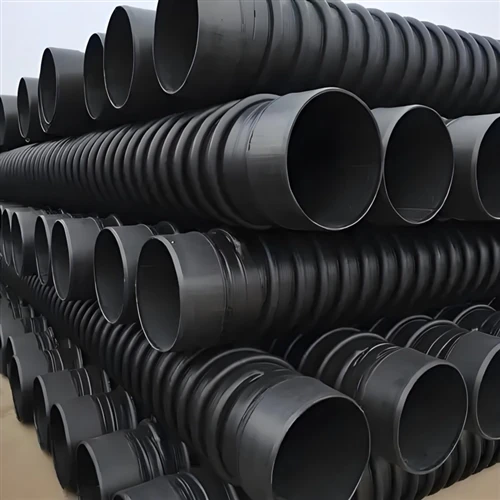
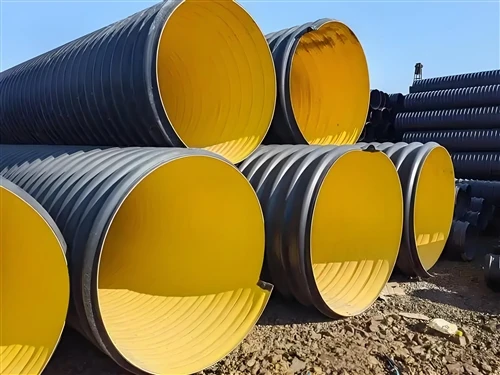
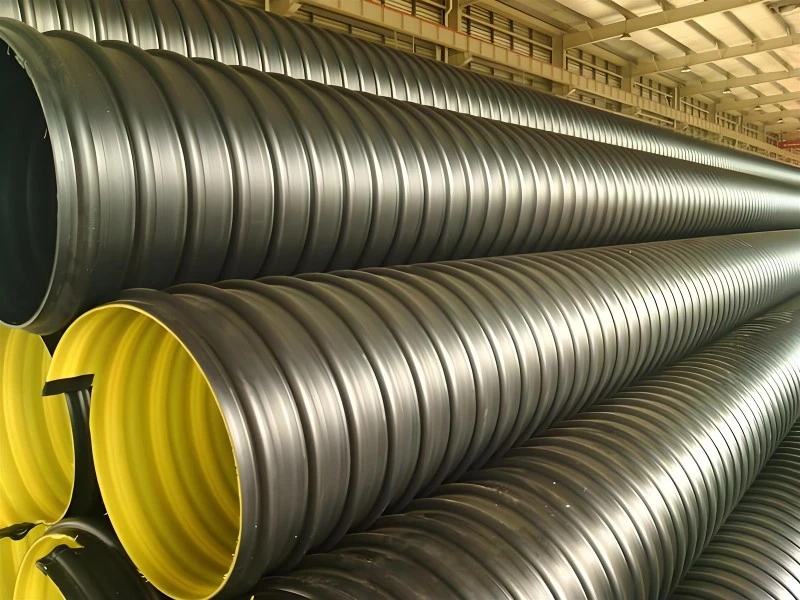
Three commonly used structural options are double-wall corrugated pipes, steel-reinforced corrugated pipes and structured-wall spiral-wound pipes such as Krah-type systems.
|
Pipe Type |
Structural Characteristics |
Typical Applications |
|
HDPE Double-Wall Corrugated Pipe |
Corrugated outer wall with a smooth inner wall |
Municipal drainage, rainwater collection and underground drainage |
|
Steel-Reinforced Corrugated Pipe |
Steel reinforcement combined with a polyethylene structure |
Larger drainage systems and projects requiring higher structural stiffness |
|
Krah-Type Structured-Wall Spiral-Wound Pipe |
Hollow structured wall with a smooth internal surface |
Large-diameter municipal drainage, industrial drainage and stormwater systems |
The selection should consider more than the pipe material. Ring stiffness, burial depth, soil conditions, traffic loads, groundwater level and installation quality all affect the final design.
For example, a large-diameter pipe installed beneath a heavily trafficked road may require a different structural design from a pipe used in a shallow landscaped drainage area.
Corrosion Resistance
HDPE offers good resistance to many common drainage environments. For industrial wastewater, the chemical composition and operating temperature should be checked before selecting the pipe material.
Smooth Internal Surface
The smooth inner wall helps reduce flow resistance and makes it less likely for deposits to accumulate under suitable operating conditions.
Flexibility and Impact Resistance
HDPE can accommodate certain ground movements and has good impact resistance. Its flexibility, however, makes correct soil support especially important.
Lightweight Handling
Compared with many traditional rigid pipe materials, HDPE is relatively lightweight, which can simplify transportation and on-site handling.
8. Frequently Asked Questions
Q1: Why is haunch backfilling so important for HDPE drainage pipes?
The lower sides of a flexible pipe need support from the surrounding soil. If the haunch area is left empty or poorly compacted, the pipe may deform more than expected under external loads.
Q2: Is 100–150 mm bedding thickness suitable for every project?
No. It is a common reference range for ordinary conditions, not a fixed requirement. The actual thickness depends on the soil, pipe size, foundation design and applicable installation standard.
Q3: Can excavated soil be reused as backfill?
Some excavated soil may be suitable, but it should be inspected first. Material containing large stones, sharp objects, organic matter or construction waste should not be used directly in the pipe zone.
Q4: Does every HDPE drainage pipeline require pressure testing?
No. A gravity drainage system does not necessarily use the same pressure test as a pressure pipeline. The required leakage or tightness test should be confirmed from the design and applicable standard.
Q5: What causes HDPE drainage pipes to deform after backfilling?
Common causes include inadequate haunch support, unsuitable backfill materials, insufficient compaction, uneven compaction on both sides and excessive construction loads.
Q6: How should the pipe structure be selected?
The choice between double-wall corrugated, steel-reinforced corrugated and Krah-type structured-wall pipes depends on diameter, ring stiffness, burial depth, external loads, ground conditions and project requirements.
Conclusion
When a buried HDPE drainage pipe develops problems, the cause is not always a defect in the pipe material. In many cases, the installation conditions need to be examined first.
An uneven foundation, an unsupported haunch area or poor backfill compaction can affect the pipeline long after the construction team has left the site.
For this reason, pipe selection and installation should be considered together. Choosing the appropriate pipe structure is only the first step; preparing the trench, making sound joints and controlling the backfill are equally important to the performance of the finished drainage system.
Request an HDPE Drainage Pipe Quotation
|
Step |
Process |
|
1 |
Send Requirements - Pipe diameter, pipe structure, ring stiffness, quantity and drainage application |
|
2 |
Specification Confirmation - Material, OD, ID, wall structure, ring stiffness class, applicable standard and connection method |
|
3 |
Quotation - Unit price, production lead time, packing details and shipping terms |
|
4 |
Order & Production - Contract confirmation, payment arrangement and manufacturing |
|
5 |
Inspection & Delivery - Quality inspection, product documentation and shipment |
For HDPE Double-Wall Corrugated Pipes, Steel-Reinforced Corrugated Pipes, Krah-Type Structured-Wall Pipes and HDPE Drainage Pipe Fittings, please send us the following information:
Pipe Type + OD / ID + Ring Stiffness (SN) + Pipe Length + Applicable Standard + Connection Method + Drainage Application + Quantity + Delivery Destination
Our factory can provide drainage pipe solutions for municipal sewage systems, stormwater drainage, industrial wastewater discharge, road drainage and large-diameter underground drainage projects.
Send us your project requirements to receive a suitable product recommendation and quotation directly from our factory.
Luoyang Zhengju New Materials Technology Co., Ltd.
WhatsApp: +86 19937270645
Email: baibaili456@gmail.com
WeChat: +86 19937270645
Get Best Price for Your PE Water Supply Pipeline Project.