Introduction
HDPE structured-wall drainage pipe is mainly used for buried gravity drainage, where the pipe is subjected to soil pressure, traffic loading and other external forces rather than continuous internal pressure.
The wall is therefore designed differently from a conventional solid-wall HDPE pipe. Instead of increasing the thickness of the entire wall, the material is formed into a corrugated, ribbed, hollow or reinforced profile. The result is a pipe that can achieve the required ring stiffness with a controlled amount of material.
There are three structures commonly encountered in HDPE structured-wall drainage:
Double-wall corrugated HDPE pipe
Steel-reinforced structured-wall pipe
Spiral-wound or profile-wall pipe
They may all be used for drainage, but the suitable project conditions are not the same.
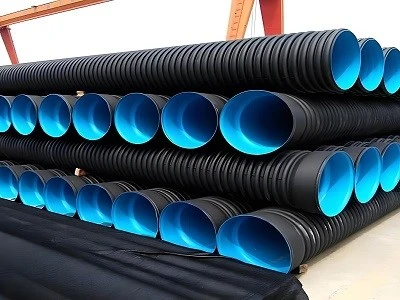
Double-Wall Corrugated HDPE Drainage Pipe
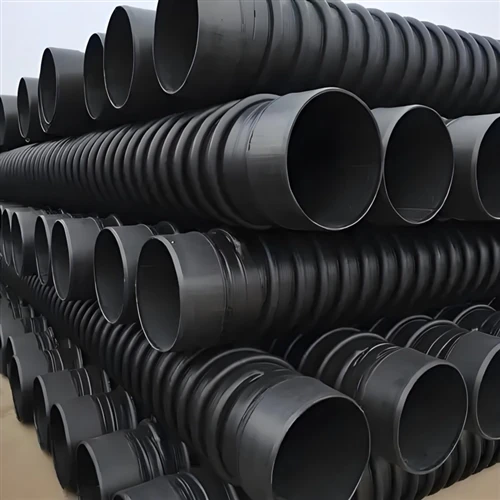
The double-wall corrugated pipe has a smooth inner wall and an annular corrugated outer wall.
The inner wall is kept smooth for water flow. The outer corrugation gives the pipe its structural form and improves resistance to external deformation.
This is a common choice for general buried drainage, particularly when the diameter is within the normal range of corrugated HDPE products and the project does not require steel reinforcement.
Typical Technical Parameters
|
Parameter |
Typical specification |
|
Material |
HDPE |
|
Wall structure |
Smooth inner wall + corrugated outer wall |
|
Typical diameter |
DN200–DN1200 |
|
Common ring stiffness |
SN4 / SN8 |
|
Common pipe length |
6 m |
|
Inner surface |
Smooth |
|
Outer surface |
Annular corrugated |
|
Joint |
Rubber-ring socket or project-specific joint |
|
Flow |
Gravity |
|
Typical feature |
Low pipe weight and convenient installation |
The actual size range is manufacturer-dependent. Some systems are available at larger diameters, while others use a smaller diameter range.
For a project specification, the required diameter should also be identified as ID or OD. This avoids a common problem during quotation, particularly when different manufacturers use different nominal-diameter conventions.
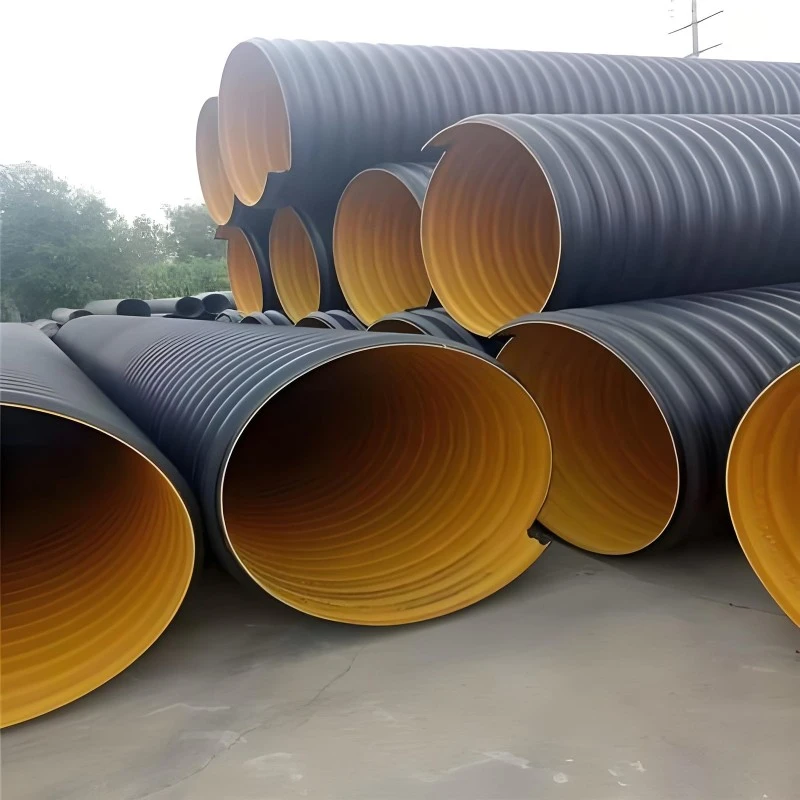
Steel-Reinforced Structured-Wall HDPE Pipe
Steel-reinforced pipe uses a shaped steel element within the HDPE wall.
The steel is not exposed directly to the conveyed water. The HDPE inner layer provides the flow surface, while the polymer structure and reinforcement work together to provide the required stiffness.
This design becomes more useful as the diameter and external loading increase.
Typical Technical Parameters
|
Parameter |
Typical specification |
|
Material |
HDPE + steel reinforcement |
|
Wall structure |
Structured HDPE wall with steel reinforcement |
|
Typical diameter |
DN300–DN2200+ |
|
Common ring stiffness |
SN8 / SN10 / SN12.5 / SN16 |
|
Common pipe length |
6 m or 9 m |
|
Inner surface |
Smooth HDPE |
|
Reinforcement |
Profiled steel belt or steel section |
|
Joint |
Rubber-ring or project-specific joint |
|
Flow |
Gravity |
|
Typical feature |
Higher structural stiffness for large-diameter applications |
The reinforcement configuration is not identical between manufacturers. Steel thickness, profile, protective polymer layer and ring-stiffness class should therefore be confirmed from the manufacturer's technical drawing rather than specified only by the product name.
This type of pipe is more commonly considered for large stormwater lines, large culverts, industrial drainage and municipal drainage where external loading is relatively high.
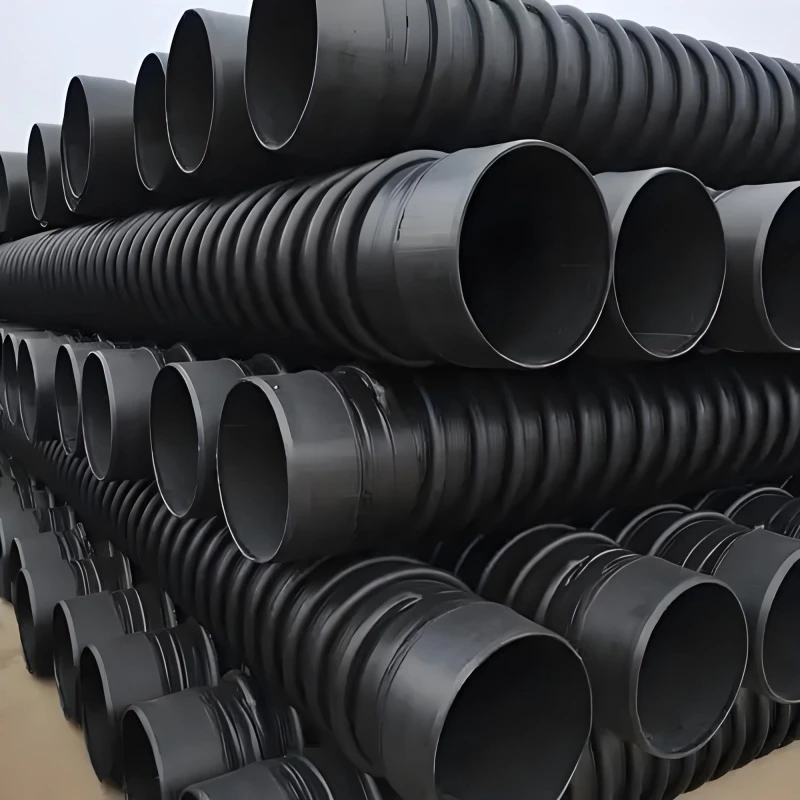
Spiral-Wound / Profile-Wall HDPE Pipe
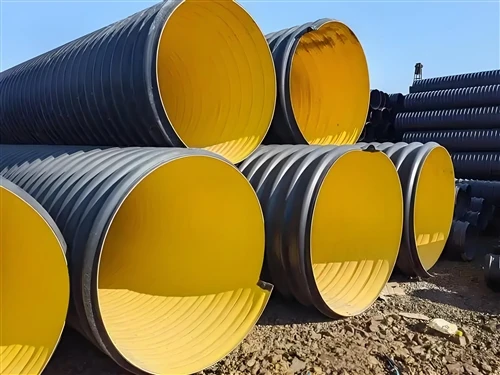
Spiral-wound structured-wall pipe is manufactured from a profiled strip that is continuously formed into a pipe.
The profile may contain hollow sections or ribs. Changing the profile changes the structural properties of the pipe without necessarily changing the required internal flow diameter.
This is one reason the technology is particularly useful for large-diameter gravity drainage.
Typical Technical Parameters
|
Parameter |
Typical specification |
|
Material |
HDPE / PE |
|
Wall structure |
Spiral-wound profiled wall |
|
Typical internal diameter |
DN400–DN5000 |
|
Ring stiffness |
SN2–SN16 |
|
Common pipe length |
6 m |
|
Inner surface |
Smooth |
|
Outer structure |
Profiled / hollow / ribbed |
|
Joint |
Mechanical / welded / project-specific |
|
Flow |
Gravity |
|
Typical feature |
Large diameter and flexible profile design |
The dimensional range is highly dependent on the manufacturing system. For large-diameter projects, the internal diameter should normally be stated directly because it is the dimension that governs hydraulic capacity.
Application Comparison of the Three Structures
The application difference is easier to understand when the project conditions are compared directly.
|
Application / Project condition |
Double-wall corrugated |
Steel-reinforced structured wall |
Spiral-wound / profile wall |
|
Residential rainwater drainage |
★★★★★ |
★★ |
★★ |
|
Municipal stormwater drainage |
★★★★★ |
★★★★ |
★★★★ |
|
Roadside drainage |
★★★★★ |
★★★★ |
★★★★ |
|
Highway drainage |
★★★★ |
★★★★★ |
★★★★ |
|
Agricultural drainage |
★★★★★ |
★★ |
★★★ |
|
Subsoil drainage |
★★★★★ |
★★ |
★★★ |
|
Small culverts |
★★★★★ |
★★★ |
★★★ |
|
Large culverts |
★★★ |
★★★★★ |
★★★★★ |
|
Industrial drainage |
★★★★ |
★★★★★ |
★★★★★ |
|
Large municipal sewerage |
★★★ |
★★★★★ |
★★★★★ |
|
Deep-buried drainage |
★★★ |
★★★★★ |
★★★★ |
|
Heavy traffic loading |
★★★★* |
★★★★★ |
★★★★* |
|
DN1500+ drainage |
Limited by product range |
★★★★★ |
★★★★★ |
|
DN2000+ drainage |
Generally limited |
★★★★ |
★★★★★ |
|
Very large internal diameter |
Limited |
Very good |
Excellent |
|
Projects requiring different wall profiles |
Limited |
Moderate |
Excellent |
*Actual suitability depends on pipe diameter, selected ring stiffness, burial depth, soil conditions and installation quality.
The table is for preliminary selection only. Final selection should follow the applicable pipe standard and project structural calculation.
Ring Stiffness
For buried structured-wall pipe, ring stiffness is normally specified in kN/m².
|
Class |
Ring stiffness |
|
SN2 |
2 kN/m² |
|
SN4 |
4 kN/m² |
|
SN8 |
8 kN/m² |
|
SN10 |
10 kN/m² |
|
SN12.5 |
12.5 kN/m² |
|
SN16 |
16 kN/m² |
The SN value is not an allowable burial-depth rating.
For example, a DN1000 pipeline under a landscaped area may have very different requirements from a DN1000 pipeline beneath a highway. Pipe diameter, soil conditions, cover depth and surface loading all affect the calculation.
Installation also matters. With a flexible buried pipe, the bedding and material placed around the springline provide important lateral support. Poor compaction can increase deformation even when the pipe itself has a relatively high nominal stiffness.
ID, OD and Profile Dimensions
Structured-wall pipe needs more dimensional information than a simple solid-wall pipe.
A DN1000 designation may refer to an internal diameter, outside diameter or nominal size depending on the product system.
For this reason, an RFQ should preferably state:
Required internal diameter
Required external diameter, where applicable
Ring stiffness
Pipe profile
Pipe length
Joint type
For hydraulic design, the internal diameter is normally the key dimension.
For installation and connection, the external diameter and profile dimensions also need to be known.
Technical Comparison
|
Parameter |
Double-wall corrugated |
Steel-reinforced |
Spiral-wound / profile wall |
|
Main material |
HDPE |
HDPE + steel |
HDPE |
|
Wall structure |
Corrugated |
Steel-reinforced profile |
Spiral-wound profile |
|
Typical diameter |
DN200–DN1200 |
DN300–DN2200+ |
DN400–DN5000 |
|
Typical stiffness |
SN4 / SN8 |
SN8–SN16 |
SN2–SN16 |
|
Inner surface |
Smooth |
Smooth |
Smooth |
|
Structural element |
HDPE corrugation |
Steel + HDPE |
HDPE profile |
|
Typical length |
6 m |
6–9 m |
6 m |
|
Large-diameter capability |
Good |
Very good |
Excellent |
|
Typical market |
General drainage |
Large / high-load drainage |
Large / very large drainage |
These figures are representative ranges rather than a universal product standard. Final dimensions should be taken from the manufacturer's drawings and the applicable standard.
How to Specify a Structured-Wall Drainage Pipe
For procurement, a specification such as "DN1000 HDPE drainage pipe" leaves too many questions unanswered.
A more useful RFQ would look like this:
|
Item |
Example |
|
Pipe structure |
Double-wall corrugated |
|
Internal diameter |
1000 mm |
|
Ring stiffness |
SN8 |
|
Pipe length |
6 m |
|
Joint |
Rubber ring |
|
Burial depth |
3.5 m |
|
Surface loading |
Highway traffic |
|
Installation |
Open trench |
|
Drainage medium |
Stormwater |
|
Applicable standard |
Project specified |
|
Quantity |
Project quantity |
|
Fittings |
Manhole connection / bends / tees as required |
For a large-diameter project, the supplier can then determine whether the proposed wall structure is appropriate rather than simply matching a nominal DN number.
Conclusion
The three structured-wall designs are separated mainly by their wall construction and the type of project they are intended to serve.
Double-wall corrugated HDPE pipe is a practical option for conventional stormwater, road, agricultural and subsoil drainage.
Steel-reinforced structured-wall pipe is more suitable when diameter, burial depth or external loading pushes the structural requirement higher.
Spiral-wound/profile-wall pipe is particularly useful for large and very large gravity drainage systems where internal diameter and wall-profile flexibility are important.
The basic selection parameters are:
Internal diameter + wall structure + ring stiffness + burial depth + external load + soil conditions + joint system.
That combination gives a much more useful engineering specification than pipe diameter alone.
Request an HDPE Pipe Quotation
|
Step |
Process |
Details |
|
1 |
Send Requirements |
DN, pressure, medium, working temperature and application |
|
2 |
Specification Confirmation |
Pipe type, material grade, pressure rating, wall thickness/SDR and connection |
|
3 |
Quotation |
Price, lead time, packing and shipping terms |
|
4 |
Order & Production |
Contract, payment and production |
|
5 |
Inspection & Delivery |
Quality inspection and shipment |
For HDPE Mining Pipe, Send Us:
DN + PN/SDR + Medium + Working Temperature + Installation Method + Pipeline Length + Quantity
For mine drainage and dewatering applications, please also provide:
Application + Working Pressure + Installation Environment
For mineral-containing mine water, if available:
Water Chemistry / pH + Temperature + Suspended Solids
Luoyang Zhengju New Materials Technology Co., Ltd.
WhatsApp: +86 19937270645
Email: baibaili456@gmail.com,lyzjxc@mtwkj.com
WeChat: +86 19937270645
Get Best Price for Your HDPE Mining Pipe.