Introduction
A mine does not stay in the same place.
As an open-pit operation advances, the working area, drainage points and pumping locations can change. Underground mining can have the same problem in a different form: new working faces are developed, old areas are abandoned, and water collection points move with the mining operation.
This creates a different requirement for the pipeline.
A permanent buried pipeline may not be the most practical solution for every section of a mine. Some sections need to remain in service for years, while others may only be required until the mining face moves to another location.
For these applications, SRTP pipe for temporary mine dewatering can be considered when the project requires a pressure-bearing pipe that can be installed, relocated or extended as mining conditions change.
The important point is that "temporary" does not mean "low pressure" or "low importance." A temporary dewatering line can still be carrying significant water flow under pressure.
Why Temporary Mine Pipelines Are Different
A fixed pipeline normally has one defined route.
A temporary mine dewatering pipeline may have several routes during its service life.
For example, a pumping point may initially be located near one section of an open pit. As excavation progresses, the sump may move deeper or farther away. The discharge pipeline then needs to be extended, rearranged or replaced with another section.
The pipeline therefore has to fit the working method of the mine.
Transportation, handling, connection, support and future relocation can become just as important as the nominal pressure rating.
This is a different procurement requirement from a pipeline that will be buried permanently and never moved.
Pressure Still Matters in a Temporary System
There is sometimes a misconception that temporary pipelines can use a lower specification simply because they are not permanent.
That can create unnecessary risk.
A temporary mine dewatering line may still operate with a pump delivering pressurized water over a considerable elevation difference. Pump startup and shutdown can also create pressure fluctuations.
The pipeline should therefore be selected according to its actual operating pressure and system conditions.
The service period does not replace pressure calculations.
For procurement teams, the useful information includes pump discharge pressure, flow rate, pipe diameter, pipeline length and elevation difference.
Handling Becomes More Important
A temporary pipeline may be handled several times.
Sections can be moved from one working area to another, stored temporarily and installed again.
This puts greater emphasis on transportation and site handling.
The pipe should be protected from unnecessary damage during lifting, dragging and storage. Ends should also be protected from contamination and impact before installation.
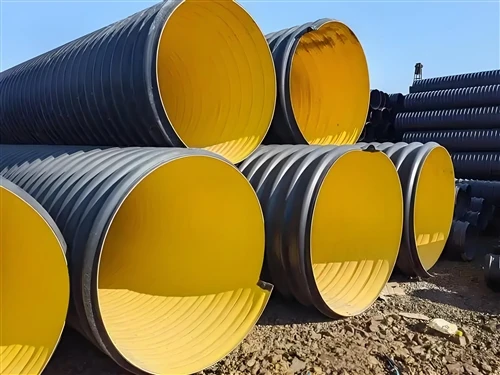
For an SRTP pipe, the composite structure provides pressure reinforcement while the PE layers form the protective outer and inner structure.
The pipe still needs to be handled according to the manufacturer's requirements.
Open-Pit Mining Creates Constant Route Changes
Temporary dewatering is especially common in areas where the mining face moves continuously.
A pipeline may begin at a sump, run along a bench and connect to a pumping system farther from the active working area.
As the pit develops, the same route may no longer be suitable.
The pipeline can then be extended or rearranged.
This is why mining contractors often need to think about the pipeline as a system of sections rather than one uninterrupted line.
Different sections can have different service periods and installation conditions.

Above-Ground Installation Can Be Practical
A temporary mine dewatering line does not necessarily need to be buried.
Where the site layout permits, above-ground installation can simplify relocation and inspection.
However, exposed pipe sections may encounter mining equipment, traffic, sunlight, temperature changes and accidental impact.
The route should therefore be kept away from equipment paths where possible, and suitable supports should be provided.
Where the pipeline crosses a traffic route, the protection arrangement needs to be designed for the actual site conditions.
Temporary Does Not Mean Disposable
A good temporary mining pipeline can remain in service through several stages of a mining operation.
This makes durability important.
If the pipe requires frequent replacement because of corrosion, mechanical damage or inadequate pressure capacity, the supposed advantage of a temporary system can disappear quickly.
SRTP combines PE protection with steel-wire reinforcement, giving it a structure intended for pressurized service while avoiding direct exposure of the embedded steel reinforcement to the transported water.
This can be useful where mine water chemistry makes exposed steel vulnerable to corrosion.

When Should Buyers Consider SRTP?
SRTP can be considered when a temporary mine pipeline needs to transport pressurized water and the project also requires a reinforced pipe structure.
Typical situations include temporary pit dewatering, changing sump locations, temporary water transfer between mining areas and staged mine development.
It is less about the word "temporary" and more about the actual operating conditions.
If the pipeline carries highly abrasive mineral slurry rather than relatively clean mine water, the selection criteria change. In that case, wear resistance may become more important than the pressure-focused characteristics of an SRTP structure.
Product Features
|
Feature |
Temporary Mine Dewatering Relevance |
|
Steel wire reinforcement |
Provides structural reinforcement for pressurized service |
|
PE inner and outer layers |
Provide corrosion-resistant fluid contact and protection |
|
Composite structure |
Combines pressure support with PE protection |
|
Relatively manageable handling weight |
Useful for relocation and site transportation |
|
Pressure-pipe construction |
Suitable for pressurized mine water applications |
|
Buried or above-ground installation |
Can be selected according to the mining layout |
Product Parameters
|
Parameter |
Project Consideration |
|
Pipe Type |
SRTP / Steel Wire Reinforced PE Pipe |
|
Application |
Temporary mine dewatering |
|
Diameter |
Based on required flow rate |
|
Pressure Rating |
Based on actual operating and transient pressure |
|
Standard Length |
Commonly 9 m / 12 m |
|
Installation |
Above ground / buried |
|
Medium |
Mine water / groundwater |
|
Pipeline Layout |
Fixed, extendable or relocatable |
|
Operating Temperature |
Project-specific |
FAQ
Can SRTP pipe be used for temporary mine dewatering?
Yes. SRTP can be considered for temporary pressurized mine water and dewatering lines when its pressure and installation requirements match the project.
Does temporary use mean a lower pressure rating is acceptable?
No. The required pressure rating should be determined from the actual working pressure and pressure fluctuations of the pumping system.
Can a temporary SRTP pipeline be relocated?
The feasibility depends on the pipe specification, connection method and site installation arrangement. If relocation is expected, this should be communicated before ordering the pipe.
Is SRTP suitable for slurry dewatering?
If the transported medium contains significant hard mineral particles, internal wear must be evaluated separately. UHMWPE may be more appropriate where abrasion is the dominant concern.
Conclusion
Temporary mining pipelines have a different job from permanent pipelines. They need to follow the mining operation rather than remain fixed in one location.
SRTP pipe for temporary mine dewatering can provide a reinforced pressure-pipe structure for mine water systems where the pipeline may need to be extended, rearranged or relocated as mining progresses.
Primary Keyword: SRTP pipe for temporary mine dewatering
Secondary Keywords: temporary mine dewatering pipe, mining dewatering pipeline, movable mine water pipe, SRTP mining pipe, temporary mining pipeline
Request an SRTP Pipe Quotation
|
Step |
Process |
Details |
|
1 |
Send Requirements |
DN, pressure, medium, working temperature and application |
|
2 |
Specification Confirmation |
Pipe structure, pressure rating, specification and connection |
|
3 |
Quotation |
Price, lead time, packing and shipping terms |
|
4 |
Order & Production |
Contract, payment and production |
|
5 |
Inspection & Delivery |
Quality inspection and shipment |
For Steel Wire Mesh Reinforced PE Pipe (SRTP), steel wire reinforced PE pipe and mining pressure pipelines, send us:
DN + PN + Medium + Working Temperature + Installation Method + Pipeline Length + Quantity
For slurry applications:
Slurry Type + Solid Concentration + Particle Size
Luoyang Zhengju New Materials Technology Co., Ltd.
WhatsApp:+86 19937270645
Email: baibaili456@gmail.com
Wechat: +86 19937270645
Get Best Price for Your Mining Pressure Pipeline.