Introduction
A mining water pipeline can become surprisingly long.
Water may need to travel from a pumping station to an underground working area, from a water source to a remote mine site, or from a deep mine to a surface discharge point.
As pipeline length increases, the pipe selection cannot be based on diameter alone.
Pressure, elevation, flow velocity, pump capacity, route conditions and installation method all begin to interact.
For mining projects requiring long-distance pressurized water transport, SRTP pipe offers a reinforced PE pipe structure that can be evaluated where pressure resistance and corrosion protection are both important.
Why Long-Distance Mining Pipelines Are Different
A short pipeline may have relatively simple hydraulic conditions.
A long mining pipeline can contain hundreds or thousands of meters of pipe, multiple elevation changes and different installation environments.
The pump must overcome both static head and pipeline resistance.
If the destination is significantly higher than the water source, the elevation difference can create a substantial pressure requirement.
This is why procurement teams should provide the complete route information rather than simply requesting "a high-pressure mining pipe."
Pressure Is Not the Only Number
When selecting an SRTP mining pipe, working pressure is an important starting point.
But the actual pipeline may experience pressure changes during pump startup, shutdown and valve operation.
Long pipelines can also have different pressure conditions along their route.
The pipe's pressure class should therefore be selected based on the system's actual operating conditions, including expected pressure fluctuations.
A pressure rating should never be treated as a substitute for hydraulic system design.
Diameter Affects the Entire System
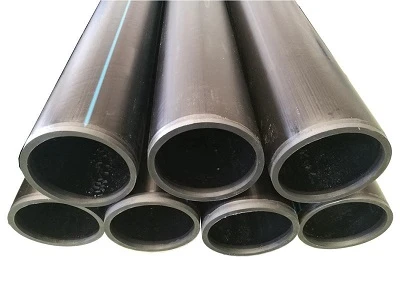
Pipe diameter influences flow velocity and pressure loss.
If the diameter is too small for the required flow, velocity and friction losses can increase. The pumping system may then need to provide more pressure.
If the diameter is increased, the hydraulic conditions change again.
For this reason, the pipe diameter should be determined from the required flow rate and pipeline layout rather than selected independently.
When requesting a quotation, mining buyers should provide the target flow rate whenever possible.
Buried Long-Distance Mining Pipelines
Long-distance pipelines are often buried to protect the pipeline from traffic, equipment and environmental exposure.
Buried installation introduces another set of considerations.
The pipe interacts with the surrounding soil. Backfill quality, trench conditions and surface loads can influence the external loading on the pipeline.
For SRTP, the steel-wire reinforcement contributes to the structural strength of the composite pipe while the PE layers provide protection and corrosion resistance.
This combination can be useful when a long mining pipeline contains both pressurized service and buried sections.
Long Pipeline Routes May Cross Different Environments
A single mine water pipeline does not necessarily have uniform conditions from beginning to end.
One section may pass through open ground. Another may cross a road. A third may run underground or near a pumping station.
The pipeline design should therefore consider the route section by section.
This is particularly important for long-distance mine projects because a problem at one section can affect the operation of the entire water transfer system.
Procurement teams should communicate the installation environment when selecting the pipe rather than providing only DN and pressure requirements.

SRTP for Mine Water, UHMWPE for Abrasive Slurry
Not every long mining pipeline should use the same pipe material.
If the transported medium is mainly mine water, pressure performance and corrosion resistance may dominate the selection.
If the medium contains a high concentration of hard mineral particles, internal abrasion may become the dominant issue.
This is where SRTP and UHMWPE serve different purposes.
SRTP is mainly considered for reinforced pressure transport, while UHMWPE is particularly useful where wear resistance and low friction are major requirements.
A mining project can therefore use different pipe technologies in different sections rather than forcing one material to handle every medium.
Product Features
|
Feature |
Long-Distance Mining Application |
|
Steel wire reinforcement |
Supports the pressure-bearing structure |
|
PE layers |
Protect the reinforcement and provide corrosion-resistant fluid contact |
|
Composite construction |
Combines reinforcement with PE protection |
|
Lower handling weight than steel |
Useful for long pipeline logistics |
|
Pressure-pipe structure |
Suitable for pressurized mining water applications |
|
Buried installation capability |
Can be considered according to site design |
Product Parameters
|
Parameter |
Project Requirement |
|
Pipe Type |
SRTP / Steel Wire Reinforced PE Pipe |
|
Application |
Long-distance mine water transport |
|
Diameter |
Based on flow rate and hydraulic design |
|
Pressure Rating |
Based on working pressure and system fluctuations |
|
Standard Length |
Commonly 9 m / 12 m |
|
Installation |
Buried / above ground |
|
Medium |
Mine water / process water where compatible |
|
Pipeline Length |
Project-specific |
|
Operating Temperature |
Project-specific |
FAQ
What information should buyers provide when ordering SRTP for a long mine pipeline?
The most useful information includes pipe diameter, required flow rate, working pressure, pipeline length, elevation difference, installation method and transported medium.
Is SRTP suitable for buried long-distance pipelines?
It can be considered for buried pressurized mining water pipelines when the pipe specification and installation design match the external and internal loads.
Does a longer pipeline require a higher pressure rating?
Not necessarily. Pressure requirements depend on elevation, hydraulic conditions, pump operation and system design. Pipeline length alone does not determine the pressure class.
Can SRTP transport mining slurry?
It depends on the slurry characteristics. For highly abrasive slurry, wear resistance becomes a key selection factor and UHMWPE may be more appropriate.
Conclusion
Long-distance mine water transport requires more than choosing a pipe with a nominal pressure rating.
Flow rate, elevation, pump operation, pipeline length and installation conditions all affect the final specification.
SRTP pipe for long-distance mine water transport provides a reinforced PE structure that can be considered for pressurized mining water systems where both structural support and corrosion resistance are important.
Primary Keyword: SRTP pipe for long-distance mine water transport
Secondary Keywords: long-distance mining pipeline, mine water transfer pipe, SRTP mining pipe, high-pressure mine water pipeline, mining water supply pipe
Request an SRTP Pipe Quotation
|
Step |
Process |
Details |
|
1 |
Send Requirements |
DN, pressure, medium, working temperature and application |
|
2 |
Specification Confirmation |
Pipe structure, pressure rating, specification and connection |
|
3 |
Quotation |
Price, lead time, packing and shipping terms |
|
4 |
Order & Production |
Contract, payment and production |
|
5 |
Inspection & Delivery |
Quality inspection and shipment |
For Steel Wire Mesh Reinforced PE Pipe (SRTP), steel wire reinforced PE pipe and mining pressure pipelines, send us:
DN + PN + Medium + Working Temperature + Installation Method + Pipeline Length + Quantity
For slurry applications:
Slurry Type + Solid Concentration + Particle Size
Luoyang Zhengju New Materials Technology Co., Ltd.
WhatsApp:+86 19937270645
Email: baibaili456@gmail.com
Wechat: +86 19937270645
Get Best Price for Your Mining Pressure Pipeline.