Introduction
When an HDPE mining pipe is selected, operating pressure is usually one of the first parameters checked. If the working pressure is below the pipe's rated pressure, the selection may appear reasonable.
However, a pipe that performs well during commissioning does not necessarily have the same level of reliability after years of continuous service.
The reason is that HDPE is a viscoelastic material. Its response to a sustained load changes with time. A pipe wall may deform gradually under constant stress, even when the load does not increase. Under unfavorable conditions, this long-term deformation can contribute to cracking and eventual failure.
For mine drainage and water supply systems, understanding creep behavior is important because pipes may remain pressurized for years, operate continuously, and experience additional loads from installation and the surrounding ground.
1. What Is Creep in an HDPE Pipe?
Creep refers to the gradual deformation of a material under a sustained load.
Imagine an HDPE pipe carrying water at a relatively stable pressure. The internal pressure produces circumferential stress in the pipe wall. Unlike a load applied for only a few seconds, this stress remains for an extended period.
The polymer chains within HDPE can gradually rearrange under sustained stress. Consequently, deformation may continue even though the applied load remains approximately constant.
This behavior does not automatically indicate a defect. Creep is an inherent characteristic of polymer materials, and properly designed HDPE pipes account for long-term material behavior.
The engineering concern is whether the pipe's stress level, material grade, wall thickness, temperature and operating conditions remain within the limits established for its intended service life.

2. Why Is Rated Pressure Not the Whole Story?
A pressure rating is useful, but it should not be interpreted as a guarantee against every possible failure.
For a pressure pipe, circumferential stress is related to internal pressure, outside diameter and wall thickness. For a pipe with outside diameter ded_ede and wall thickness eee, the approximate nominal hoop stress can be expressed as:
σh=p(de−e)2e\sigma_h=\frac{p(d_e-e)}{2e}σh=2ep(de−e)
Here, ppp is the internal pressure and the expression assumes a uniform pipe wall under internal pressure. It does not account for every installation load or local stress concentration.
Two pipes operating at the same pressure may therefore experience different wall stresses if their dimensions differ.
A pipe with a thinner wall generally experiences higher circumferential stress than a pipe with a thicker wall of the same outside diameter. Material grade and the applicable design standard also affect the pressure rating and long-term allowable stress.
Temperature matters as well. Higher operating temperatures can accelerate polymer deformation and reduce the pressure capacity permitted by the applicable design rules. A pressure rating established for one temperature should not automatically be applied at another.
For a mining buyer, the important question is not simply whether the operating pressure is below the printed PN value. It is whether that rating applies to the actual material, dimensions, temperature and service conditions.
3. How Does Creep Rupture Develop?
Long-term pressure failure is not necessarily a sudden event caused by one excessive load.
Under sustained circumferential stress, a pipe may undergo gradual deformation. If the stress level and exposure time are unfavorable, microscopic damage can develop and eventually lead to rupture.
The relationship between stress and time is central to long-term pipe design. Material qualification commonly uses hydrostatic strength data and regression methods to assess long-term performance under specified test conditions.
The following factors are particularly relevant to mining applications.
|
Factor |
Potential effect on long-term performance |
|
Internal pressure |
Produces sustained circumferential stress |
|
Wall thickness |
Affects the stress carried by the pipe wall |
|
Material grade |
Influences long-term hydrostatic strength |
|
Operating temperature |
Changes the long-term strength and deformation behavior |
|
Scratches and notches |
Can create local stress concentrations |
|
Installation damage |
May introduce defects that were absent before installation |
|
Pressure fluctuations |
Add cyclic loading to the sustained operating stress |
These factors should not be considered independently. For example, a deep scratch in a pipe operating under sustained pressure presents a different concern from a superficial mark on an unloaded pipe.
Likewise, a pipe operating at a stable pressure may experience a different loading history from one exposed to repeated pump starts and stops.
4. Why Do Small Surface Defects Deserve Attention?
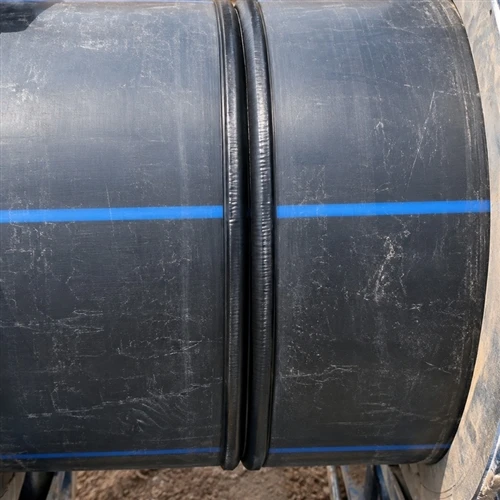
A pipe wall can appear generally sound while containing a localized defect that changes the stress distribution.
A notch or sharp scratch can concentrate stress around its tip. Under sustained loading, that region may become a preferred location for crack initiation or slow crack growth.
This is one reason why inspection should distinguish between superficial handling marks and damage that affects the structural integrity of the wall.
For HDPE mining pipes, acceptance criteria should come from the applicable product standard, manufacturer requirements and project specifications. A visual inspection alone cannot establish the remaining service life of a pipe containing a significant defect.
Procurement teams should also clarify how pipe ends, lifting operations, temporary storage and site handling are controlled. Damage introduced before installation can remain relevant throughout the operating life of the system.

5. What Should Buyers Check Before Ordering HDPE Mining Pipes?
A useful procurement review goes beyond nominal pressure.
|
Parameter |
What to verify |
|
Material designation |
Confirm the specified PE grade and applicable product standard |
|
Outside diameter |
Verify the required DN or outside-diameter designation under the selected standard |
|
Wall thickness |
Confirm the specified minimum wall thickness |
|
SDR |
Check the ratio between nominal outside diameter and nominal wall thickness |
|
PN or pressure class |
Confirm that the rating is applicable to the specified material and service temperature |
|
Hydrostatic qualification |
Request applicable long-term material qualification and product test documentation |
|
Operating temperature |
Confirm any required pressure derating |
|
Intended service life |
Ensure the design assumptions match the project requirements |
|
Surface condition |
Establish inspection and acceptance criteria for handling damage |
SDR is particularly useful because it relates pipe diameter to wall thickness. For a given material and design basis, a lower SDR generally indicates a thicker wall relative to the outside diameter.
Nevertheless, SDR alone does not establish every aspect of long-term reliability. Material classification, design coefficients, temperature and the governing standard remain important.
Buyers should also distinguish between short-term factory testing and long-term material qualification. Passing a short-duration pressure test is not equivalent to demonstrating decades of service under a particular operating condition.
6. When Should HDPE and SRTP Be Evaluated Differently?
HDPE is commonly considered for mine drainage and water supply where its corrosion resistance, relatively low weight and installation flexibility are valuable.
SRTP, which combines polyethylene layers with a steel-wire reinforcement structure, is another option where the project requires a reinforced pipe system for higher-pressure service.
The comparison should begin with the actual design requirements rather than the assumption that one material is always better.
For a medium- or lower-pressure drainage line, HDPE may provide a cost-effective solution. For a system with higher pressure demands, SRTP may warrant evaluation because its reinforcement structure changes how the pipe carries load.
The final selection still requires confirmation of the product's rated pressure, dimensions, connection method and installation conditions. Neither a reinforced structure nor a thicker polymer wall removes the need for proper hydraulic and structural design.
Conclusion
An HDPE mining pipe does not need to exceed its rated operating pressure to encounter long-term performance problems. Sustained stress, temperature, wall thickness, material properties and localized damage all influence how the pipe behaves over time.
For procurement engineers, the most useful approach is to assess long-term hydrostatic qualification alongside the actual pressure rating, rather than relying on one number printed in a catalogue.
The objective is not simply to buy a pipe that passes an initial pressure test. It is to specify a pipe whose long-term performance matches the demands of the mine.
Primary Keyword HDPE mining pipe creep rupture Secondary Keywords HDPE pipe long-term hydrostatic strength, mining drainage pipe pressure rating, HDPE pipe slow crack growth, HDPE pipe wall thickness, SRTP mining pipe.
Primary Keyword
HDPE mining pipe creep rupture
Secondary Keywords
HDPE pipe long-term hydrostatic strength
HDPE mining pipe pressure rating
HDPE pipe slow crack growth
HDPE pipe wall thickness
HDPE pipe SDR and PN
HDPE pipe creep behavior
HDPE pipe long-term performance
HDPE mine drainage pipe
HDPE pipe operating temperature
SRTP mining pipe
Request an HDPE Pipe Quotation
|
Step |
Process |
Details |
|
1 |
Send Requirements |
DN, pressure, medium, working temperature and application |
|
2 |
Specification Confirmation |
Pipe type, material grade, pressure rating, wall thickness/SDR and connection |
|
3 |
Quotation |
Price, lead time, packing and shipping terms |
|
4 |
Order & Production |
Contract, payment and production |
|
5 |
Inspection & Delivery |
Quality inspection and shipment |
For HDPE Mining Pipe, Send Us:
DN + PN/SDR + Medium + Working Temperature + Installation Method + Pipeline Length + Quantity
For mine drainage and dewatering applications, please also provide:
Application + Working Pressure + Installation Environment
For mineral-containing mine water, if available:
Water Chemistry / pH + Temperature + Suspended Solids
Luoyang Zhengju New Materials Technology Co., Ltd.
WhatsApp: +86 19937270645
Email: baibaili456@gmail.com
WeChat: +86 19937270645
Get Best Price for Your HDPE Mining Pipe.