Introduction
Mining pipelines are rarely exposed to one constant temperature throughout their service life. A pipeline may be installed outdoors, buried underground, exposed to sunlight during the day, or carry water and slurry at temperatures different from the surrounding soil.
For SRTP mining pipe, temperature changes are particularly interesting because the pipe is a composite structure. It combines polyethylene layers with a high-strength steel wire reinforcement layer. PE and steel do not respond to temperature changes in exactly the same way.
For long mining pipelines, repeated temperature changes can therefore affect pipe movement, connections, support points and installation conditions. Understanding how the SRTP structure responds helps buyers avoid treating temperature as an afterthought.
Why Do PE and Steel React Differently to Temperature?
Polyethylene expands and contracts more noticeably with temperature changes than steel. When temperature increases, the PE layers tend to expand. When temperature decreases, they contract.
The steel wire reinforcement embedded inside SRTP has a much lower coefficient of thermal expansion than PE. It therefore does not follow the same dimensional change as the surrounding polymer.
This does not mean the two materials work against each other and cause the pipe to fail. The composite structure is designed so that the PE layers and steel reinforcement work together. However, the different thermal behavior becomes important when a pipeline is very long or when temperature changes repeatedly.
A short pipe section may experience only limited movement. Over hundreds of meters or kilometers, even small dimensional changes can accumulate.
How Does the SRTP Structure Respond to Temperature Change?
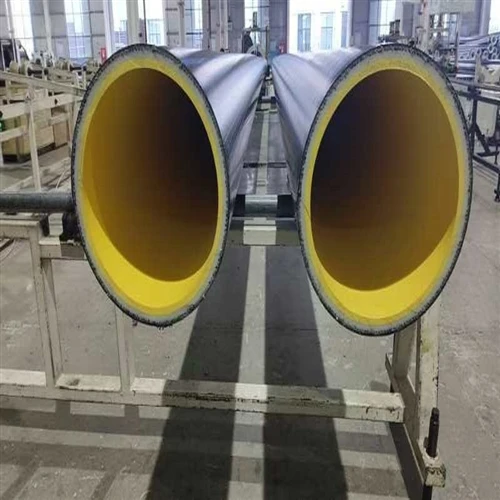
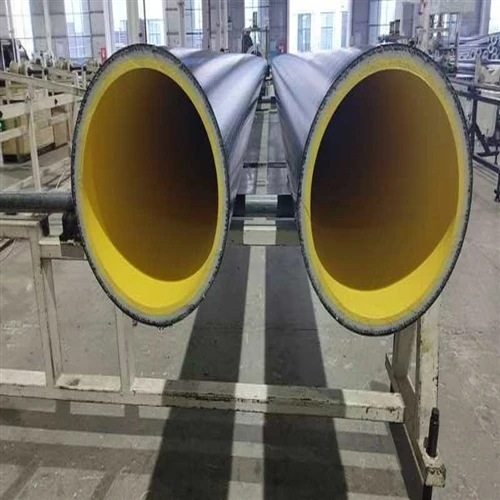
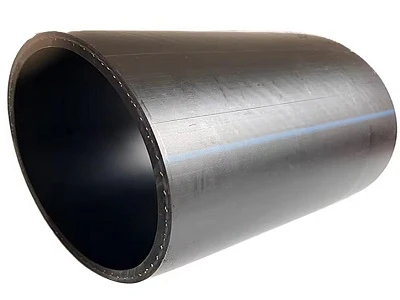
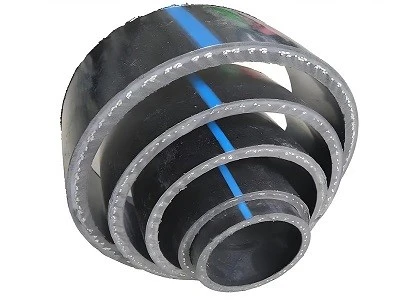
SRTP is not simply a steel pipe covered with plastic. Its structure normally consists of an inner PE layer, a high-strength steel wire reinforcement layer and an outer PE layer.
The inner PE layer provides the fluid-contact surface. It is resistant to many corrosive mining media and provides a relatively smooth internal surface.
The steel wire reinforcement layer provides structural reinforcement and contributes significantly to the pipe's pressure-bearing capability.
The outer PE layer protects the reinforcement structure from the surrounding environment and provides the external polymer surface.
When temperature changes, the PE layers respond to thermal expansion and contraction while the embedded steel reinforcement provides structural restraint. The result is different from a conventional unreinforced PE pipe, where the entire wall relies primarily on the polymer structure.
For this reason, temperature behavior should be considered as part of the composite pipe design rather than treated as a simple PE material issue.
Why Does Pipeline Length Matter?
Temperature-related movement becomes more noticeable as pipeline length increases.
Imagine a long above-ground mining pipeline exposed to large differences between daytime and nighttime temperatures. The pipe repeatedly expands and contracts along its length.
If the pipeline has sufficient freedom to move, this movement can be accommodated by the installation arrangement. If the pipe is heavily restrained at supports, fixed points or connections, thermal movement can instead generate additional forces in the system.
This is especially relevant for long-distance mining pipelines, where the pipe may pass through different environmental conditions along the route.
The issue is therefore not simply whether SRTP can "handle temperature." The more important question is how the pipe, supports and connections are arranged to accommodate the expected temperature range.
What Happens at Supports and Connections?
Connections and support points deserve particular attention because they restrict pipe movement.
For example, an above-ground pipeline may be supported at regular intervals. If the pipe expands as temperature increases, it needs sufficient room for controlled movement between restraint points.
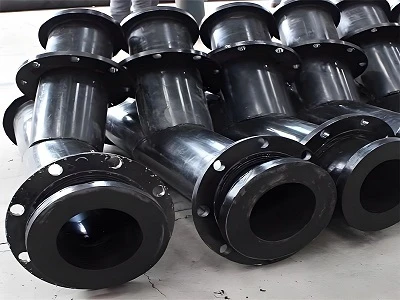
The same principle applies to connection areas. Flanges, electrofusion joints and other connection arrangements may experience forces generated by thermal movement if the pipeline is unable to move naturally.
This is why temperature information should be considered together with installation method, pipeline length and support arrangement when an SRTP mining pipeline is designed or ordered.
The pipe material is only one part of the system.
What Changes When SRTP Is Buried?
Buried SRTP pipelines normally experience a different thermal environment from exposed pipelines.
The surrounding soil limits rapid temperature fluctuations, and the pipe is less directly exposed to solar heating. However, temperature differences can still occur during installation, operation and seasonal changes.
The burial environment also introduces other loads, including soil pressure, backfill loads, traffic loads and possible ground movement.
This is where the composite structure of SRTP becomes relevant. The PE layers provide the corrosion-resistant polymer structure, while the steel wire reinforcement contributes to pressure and mechanical support.
Temperature should therefore be considered together with the actual installation environment rather than evaluated independently.
Does a Higher Pressure Rating Solve Thermal Movement?
No.
Pressure rating describes the pipe's ability to operate under internal pressure. Thermal expansion is related to temperature, material properties, pipeline length and restraint conditions.
Increasing the nominal pressure rating does not automatically eliminate thermal movement.
For an SRTP mining pipeline, the correct pressure class still needs to be selected according to working pressure and operating conditions. At the same time, installation conditions must allow the pipe to respond appropriately to expected temperature changes.
This distinction is particularly important for buyers comparing different pipe specifications. Pressure capacity and thermal movement are related to different aspects of pipeline performance.
Where Is Temperature Most Relevant for SRTP Mining Pipe?
Temperature deserves closer attention in long-distance mining pipelines, exposed pipelines, pipelines installed in regions with large seasonal temperature differences, and systems carrying fluids whose temperature differs significantly from the surrounding environment.
For underground pipelines, environmental temperature may be more stable, but operating conditions and installation temperature can still influence the pipe.
For an SRTP manufacturer, the practical evaluation therefore needs to consider DN size, pressure class, operating temperature, installation method and pipeline configuration together.
Product Features
SRTP mining pipe uses a composite structure of PE layers and high-strength steel wire reinforcement.
The steel wire reinforcement provides structural support for high-pressure applications, while the PE layers provide a corrosion-resistant internal and external surface.
Compared with a conventional polymer pipe relying mainly on PE wall thickness, the reinforced structure provides a different approach to pressure-bearing performance.
The PE structure also gives the pipe a degree of flexibility that is useful in mining environments where the pipeline may encounter changes in terrain or installation conditions.
For temperature-sensitive applications, the actual operating temperature, pipeline length, support arrangement and connection method should be evaluated together with the selected pressure class.
Product Parameters
|
Parameter |
Typical SRTP Mining Pipe Specification |
|
Pipe Type |
Steel Wire Reinforced PE Pipe |
|
Structure |
PE Inner Layer + High-Strength Steel Wire Reinforcement + PE Outer Layer |
|
Nominal Diameter |
DN50–DN600 |
|
Nominal Pressure |
0.8–2.5 MPa |
|
Common Pressure Classes |
0.8, 1.0, 1.25, 1.6, 2.0, 2.5 MPa |
|
Standard Length |
6 m / 9 m / 12 m |
|
Reinforcement |
High-Strength Steel Wire Mesh |
|
Internal Layer |
PE |
|
External Layer |
PE |
|
Typical Operating Temperature Range |
Approximately −40°C to +80°C, depending on material and specification |
|
Connection |
Electrofusion or Flange Connection, depending on pipe specification |
|
Wall Thickness |
Determined by DN and pressure class |
Actual dimensions, wall thickness and pressure specifications should be confirmed according to the selected SRTP product specification.
FAQ
Does temperature change affect SRTP mining pipe?
Yes. The PE components expand and contract with temperature changes, while the steel reinforcement has a different thermal expansion behavior. The effect becomes more important in long pipelines and restrained installations.
Is SRTP suitable for outdoor mining pipelines?
SRTP can be used in outdoor mining pipeline systems, but the expected temperature range, exposure conditions, support arrangement and connection design should be considered before installation.
Does buried installation eliminate temperature-related movement?
No. Burial generally reduces rapid temperature fluctuations, but the pipe can still experience temperature changes. The buried environment also introduces soil pressure and other external loads.
Does a higher PN rating prevent thermal expansion?
No. PN rating concerns pressure-bearing capability. It does not eliminate thermal expansion or contraction caused by temperature changes.
What information should be provided when ordering SRTP for a temperature-variable application?
The buyer should provide pipe DN, working pressure, operating temperature range, pipeline length, installation method and connection method. These details help determine a suitable specification.
Conclusion
Temperature change is not an isolated material issue for SRTP mining pipe. It involves the interaction between PE layers, steel reinforcement, pipeline length, connections, supports and installation conditions.
The composite structure of SRTP allows the pipe to combine PE's environmental resistance and flexibility with steel-wire reinforcement for pressure and structural support. For long or temperature-variable mining pipelines, understanding this interaction can help buyers select the appropriate specification and installation arrangement rather than relying on pressure rating alone.
Primary Keyword
SRTP Mining Pipe
Secondary Keywords
SRTP pipe temperature change, steel wire reinforced PE pipe, SRTP thermal expansion, mining pipeline temperature, high pressure mining pipe, buried mining pipe, SRTP pipe specifications
Request an SRTP Pipe Quotation
|
Step |
Process |
Details |
|
1 |
Send Requirements |
DN, pressure, medium, working temperature and application |
|
2 |
Specification Confirmation |
Pipe structure, pressure rating, specification and connection |
|
3 |
Quotation |
Price, lead time, packing and shipping terms |
|
4 |
Order & Production |
Contract, payment and production |
|
5 |
Inspection & Delivery |
Quality inspection and shipment |
For Steel Wire Mesh Reinforced PE Pipe (SRTP), steel wire reinforced PE pipe and mining pressure pipelines, send us:
DN + PN + Medium + Working Temperature + Installation Method + Pipeline Length + Quantity
For slurry applications:
Slurry Type + Solid Concentration + Particle Size
Luoyang Zhengju New Materials Technology Co., Ltd.
WhatsApp:+86 19937270645
Email: baibaili456@gmail.com
Wechat: +86 19937270645
Get Best Price for Your Mining Pressure Pipeline