Introduction
HDPE solid wall pipes are often associated with water supply systems. Many people see a PE100 pipe marked PN10 or PN16 and immediately think of pressurized water transportation.
But this is only part of the picture.
HDPE solid wall pipes can also be used in drainage systems. Their application is not limited to drinking water or pressurized water supply. Depending on the project design, they can carry industrial wastewater, stormwater, underground drainage water and other non-potable water.
The important question is not whether an HDPE pipe has a solid wall. It is whether the pipe is designed for the actual operating conditions.
Why Are HDPE Solid Wall Pipes Commonly Used for Water Supply?
One reason is that solid wall PE pipes are widely specified in pressure water supply standards, such as ISO 4427.
These pipes are commonly manufactured from PE100 or other specified polyethylene grades. Their pressure capacity is determined by material properties, outside diameter, wall thickness, SDR and design conditions.
For example:
|
PE100 Pipe Specification |
SDR |
Approximate Pressure Class |
|
PN6 |
26 |
0.6 MPa |
|
PN8 |
21 |
0.8 MPa |
|
PN10 |
17 |
1.0 MPa |
|
PN12.5 |
13.6 |
1.25 MPa |
|
PN16 |
11 |
1.6 MPa |
|
PN20 |
9 |
2.0 MPa |
These are common reference relationships for PE100 pipes under specified design conditions. Actual allowable pressure must be checked against the applicable standard, temperature and design coefficient.
However, a pressure-rated pipe does not automatically become unsuitable for drainage. In fact, pressure drainage is one of the situations where HDPE solid wall pipes are particularly useful.

Can HDPE Solid Wall Pipes Be Used for Gravity Drainage?
Yes.
Gravity drainage does not rely on continuous internal pressure generated by pumps. Water flows through the pipeline mainly because of the elevation difference and the designed hydraulic gradient.
HDPE solid wall pipes can be used in such systems if their structural capacity and installation design meet the project requirements.
Typical applications include:
|
Drainage Application |
Possible Use of HDPE Solid Wall Pipe |
|
Industrial wastewater drainage |
Yes, subject to chemical compatibility |
|
Underground drainage |
Yes, subject to external load design |
|
Stormwater drainage |
Yes |
|
Mine drainage water |
Yes |
|
Pump station discharge |
Yes, with suitable pressure rating |
|
Municipal gravity drainage |
Possible, subject to project specifications |
|
Industrial pressure drainage |
Yes, with appropriate pressure design |
A common mistake is to assume that gravity drainage must always use corrugated or structured-wall pipes.
That is not correct. Solid wall pipes can also be used for gravity flow. The key is to verify the external loading, deformation limits, installation conditions and required service performance.

What Makes Solid Wall HDPE Different from Structured-Wall Drainage Pipes?
The main difference lies in their wall construction.
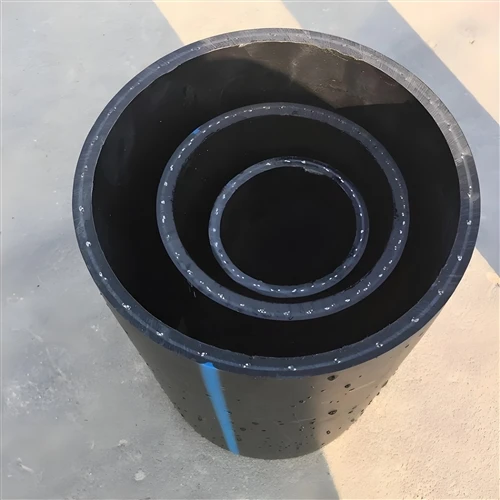
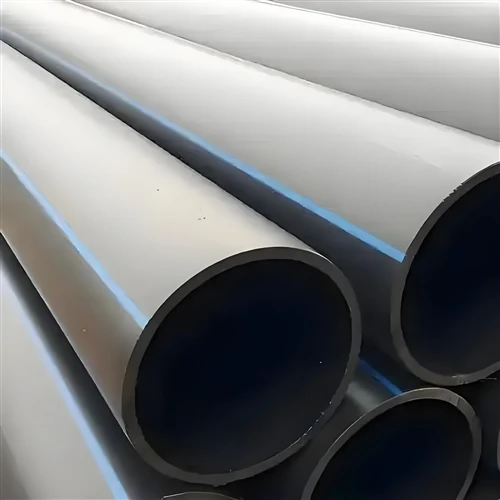
A solid wall HDPE pipe has a relatively uniform, continuous wall. Its pressure capacity is commonly described using SDR and PN when it is designed for pressure applications.
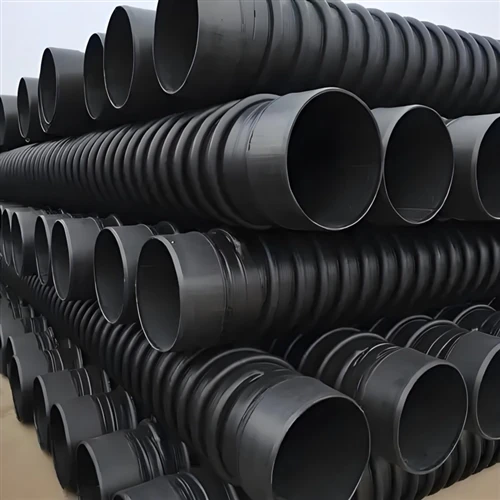
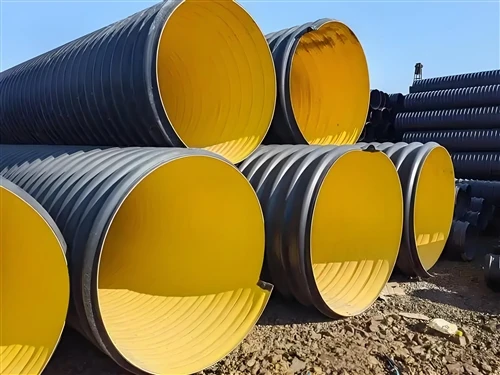
Structured-wall drainage pipes use specially designed wall profiles or reinforcement structures. Examples include double-wall corrugated pipes, steel-strip reinforced spiral corrugated pipes and large-diameter hollow-wall pipes.
These structures are designed to provide ring stiffness while controlling material consumption.
|
Comparison |
HDPE Solid Wall Pipe |
Structured-Wall Drainage Pipe |
|
Wall structure |
Uniform solid wall |
Corrugated, hollow-wall or reinforced structure |
|
Common design indicators |
SDR, PN |
SN or specified structural performance |
|
Pressure applications |
Suitable when pressure-rated |
Usually designed for non-pressure drainage unless specifically verified |
|
Gravity drainage |
Can be used |
Common application |
|
External load resistance |
Depends on wall thickness and installation |
Depends on ring stiffness and structural design |
|
Material consumption |
Can be higher for large diameters |
Can be optimized through wall structure |
|
Typical applications |
Water supply, pressure drainage, gravity drainage |
Stormwater, sewage and underground drainage |
Neither construction is automatically better. The correct choice depends on the project.
PN, SDR and SN Are Not the Same Thing
This is one of the most important points when selecting a drainage pipe.
PN refers to nominal pressure classification. SDR is the ratio between the pipe's outside diameter and its wall thickness.
SN refers to nominal ring stiffness, commonly expressed in kN/m簡. It describes the pipe's resistance to external radial deformation.
For example:
|
Classification |
What It Indicates |
Typical Application |
|
PN10 |
Nominal pressure class of 1.0 MPa |
Pressure water systems |
|
SDR17 |
Outside diameter divided by wall thickness |
Pressure pipe dimension series |
|
SN8 |
Nominal ring stiffness of 8 kN/m² |
Buried non-pressure drainage |
A PN10 pipe does not automatically have SN8 ring stiffness. Likewise, SN8 cannot be converted directly into PN10.
For buried gravity drainage, external soil pressure, traffic loads, groundwater conditions, trench width, bedding and backfill compaction all influence pipe deformation.
Selecting a pipe based only on its PN value is not sufficient.
What Wall Thickness Does a Solid Wall HDPE Pipe Have?
For PE100 solid wall pipes, wall thickness is commonly selected according to the outside diameter and SDR.
The following values are representative dimensions for common PE100 pipe series. They should be checked against the applicable ISO 4427 edition and the manufacturer's dimensional tolerances.
|
Outside Diameter (mm) |
SDR17 / PN10 Wall Thickness (mm) |
SDR11 / PN16 Wall Thickness (mm) |
|
315 |
18.7 |
28.6 |
|
400 |
23.7 |
36.3 |
|
500 |
29.7 |
45.4 |
|
630 |
37.4 |
57.2 |
|
800 |
47.4 |
72.6 |
For pressure drainage, the selected SDR should satisfy the maximum operating pressure and pressure surge requirements.
For gravity drainage, the selection should also consider external loading and pipe deformation. A thicker wall may improve structural capacity, but the final design cannot be based on wall thickness alone.
When Should You Choose Solid Wall or Structured-Wall HDPE Pipes?
For smaller and medium-diameter pressure drainage systems, solid wall HDPE pipes are often a practical option.
For large-diameter gravity drainage, structured-wall pipes may offer advantages because their wall construction can provide the required ring stiffness with a more efficient material structure.
A simple project comparison is shown below:
|
Project Condition |
Pipe Type Worth Evaluating |
|
Pressurized industrial wastewater |
HDPE solid wall pressure pipe |
|
Mine drainage with pump discharge |
HDPE solid wall pressure pipe |
|
Long-distance pressure water drainage |
HDPE solid wall pressure pipe |
|
Large-diameter stormwater drainage |
Steel-strip reinforced or other structured-wall pipe |
|
Municipal gravity sewage |
Solid wall or structured-wall pipe, according to design |
|
Industrial gravity drainage |
Either type, subject to chemical and structural requirements |
For large-diameter buried pipelines, engineers should compare the required ring stiffness, external load capacity, installation cost and hydraulic diameter before making a decision.
One more detail should not be overlooked: solid wall pressure pipes are generally specified by outside diameter, while some structured-wall drainage pipes are specified by nominal inside diameter. A DN1000 solid wall pipe and a DN1000 structured-wall pipe may not have the same actual internal diameter.
Always confirm the dimensional definition before comparing quotations.
The Final Decision Should Be Based on the Drainage Conditions
HDPE solid wall pipe is not exclusively a water supply pipe.
It can be used for pressure drainage and gravity drainage when the product specification and engineering design are appropriate. The same material can serve different applications, but the design requirements are not identical.
For pressure drainage, check operating pressure, surge pressure, SDR and temperature.
For gravity drainage, check ring stiffness, soil loads, groundwater, deformation and installation quality.
For large-diameter drainage, compare solid wall pipes with structured-wall alternatives rather than assuming that one construction is suitable for every project.
The correct pipe is not determined by the word "solid wall" or "corrugated". It is determined by the actual conditions inside and outside the pipeline.
FAQ
Q: Is HDPE solid wall pipe only used for water supply?
A: No. It can also be used for pressure drainage and gravity drainage when the pipe design meets the project requirements.
Q: Can PN10 HDPE pipe be used for drainage?
A: It may be used in drainage projects, but PN10 alone does not confirm its suitability for buried gravity drainage. External load and deformation requirements must also be checked.
Q: Can solid wall HDPE pipe replace double-wall corrugated pipe?
A: In some projects, yes. However, the two products have different wall structures and design characteristics. The choice should be based on diameter, ring stiffness, installation conditions and total project cost.
Q: What is the difference between PN and SN?
A: PN describes nominal pressure classification, while SN describes nominal ring stiffness. They represent different performance characteristics and cannot be directly converted.
Q: Which HDPE pipe is better for large-diameter drainage?
A: There is no universal answer. Solid wall pipes may be suitable for pressure drainage, while structured-wall pipes are often worth evaluating for large-diameter gravity drainage. Project calculations should determine the final choice.
Keywords
HDPE solid wall pipe for drainage, HDPE drainage pipe, HDPE pressure drainage pipe, PE100 solid wall pipe, HDPE gravity drainage, solid wall pipe vs corrugated pipe, HDPE water supply and drainage pipe.
Request an HDPE Pipe Quotation
|
Step |
Process |
Details |
|
1 |
Send Requirements |
DN, pressure, medium, working temperature and application |
|
2 |
Specification Confirmation |
Pipe type, material grade, pressure rating, wall thickness/SDR and connection |
|
3 |
Quotation |
Price, lead time, packing and shipping terms |
|
4 |
Order & Production |
Contract, payment and production |
|
5 |
Inspection & Delivery |
Quality inspection and shipment |
For HDPE Mining Pipe, Send Us:
DN + PN/SDR + Medium + Working Temperature + Installation Method + Pipeline Length + Quantity
For mine drainage and dewatering applications, please also provide:
Application + Working Pressure + Installation Environment
For mineral-containing mine water, if available:
Water Chemistry / pH + Temperature + Suspended Solids
Luoyang Zhengju New Materials Technology Co., Ltd.
WhatsApp: +86 19937270645
Email: baibaili456@gmail.com
WeChat: +86 19937270645
Get Best Price for Your HDPE Mining Pipe