Introduction
Floating pipelines are often used when dredging or mining operations need to move water, sand or mineral slurry across ponds, rivers and other open-water areas. Instead of building a support structure along the entire route, buoyant floats are attached to the pipeline to keep it on the water surface.
Although the arrangement looks straightforward, selecting pipe floats requires careful consideration. A pipeline that floats properly when empty may sit much lower in the water once it is filled with slurry. Floats that provide enough total buoyancy can still create problems if they are installed too far apart or concentrated in the wrong locations.
These details are worth checking before the pipeline enters service, because correcting a poorly arranged floating system after installation can be time-consuming.
Start With the Actual Weight of the Pipeline
The first question is not how many floats are needed. It is how much weight the floating system must support.
For a dredging pipeline, the calculation should include the pipe itself, the material inside it, fittings, connections and the floats. The operating medium is particularly important. Water and mineral slurry do not have the same density, so the weight of the contents can vary considerably.
A common design error is to calculate buoyancy using the weight of an empty pipe. This may give a misleading result, especially when the pipeline is used to transport sand or high-density slurry.
The operating condition should be clearly defined before selecting floats. Engineers may need to consider several conditions, including an empty pipeline, a water-filled pipeline and a pipeline carrying its intended slurry. The most demanding credible condition should be used for the design check.
The basic buoyancy relationship follows Archimedes' principle:
[
F=\rho gV
]
Here, (F) is the buoyant force, (\rho) is the density of the surrounding water, (g) is gravitational acceleration and (V) is the volume of displaced water.
This equation gives the theoretical buoyant force. It does not, by itself, determine the number of floats required. The weight of the complete assembly and the reserve buoyancy needed for the project must also be considered.

Why More Floats Do Not Always Mean a Better Arrangement
Suppose a pipeline has sufficient total buoyancy but still develops a noticeable sag between two floats. The problem may not be the overall buoyancy capacity. It may be the distance between supports.
Each float carries part of the pipeline load. When the spacing is excessive, the pipe section between floats has to support a greater unsupported length. This can increase bending and deformation, particularly on large-diameter pipelines or systems carrying heavy material.
On the other hand, placing floats very close together without considering the pipe structure and installation method may increase project cost without providing a meaningful improvement.
Float spacing should be determined from the pipe diameter, wall thickness, material stiffness, operating weight and expected water conditions. Heavy fittings and connection points also need attention. A reducer, elbow or flanged joint may create a different load distribution from a straight pipe section.
For this reason, a uniform spacing arrangement should be treated as a starting point, not an automatic design rule.
Choosing Between HDPE and UHMWPE Floating Pipelines
The pipe material affects both the floating load and the service life of the system.
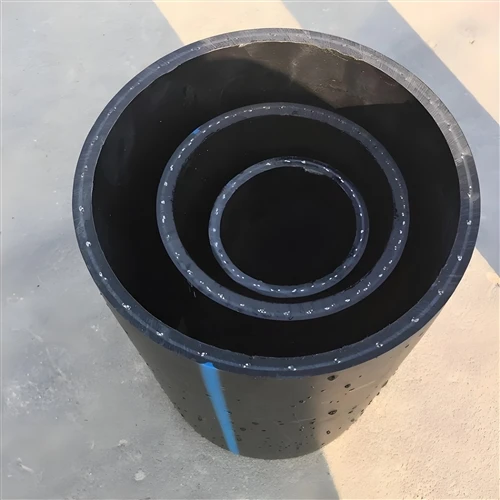
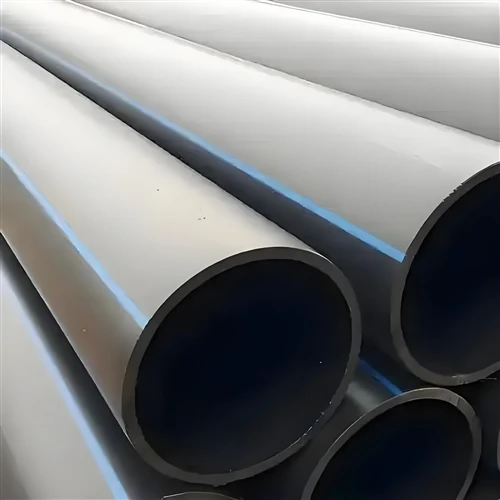
HDPE is widely used in water transportation and dredging pipelines. Its relatively low weight, flexibility and corrosion resistance make it suitable for many floating applications. However, the pipe still needs adequate support to prevent excessive bending under its operating load.
UHMWPE is worth considering where abrasive materials are transported. Sand, mineral particles and slurry can gradually wear the internal surface of a pipeline. UHMWPE offers high abrasion resistance and can be used in demanding material-handling applications.
The choice depends on what the pipeline is carrying. For ordinary water transportation, HDPE may be an appropriate option. Where internal abrasion is a major concern, UHMWPE may offer a more suitable solution.
The difference in pipe weight and dimensions should be included in the float calculation. A float arrangement designed for one pipe specification should not automatically be transferred to another.
Water Conditions Can Change the Design
A floating pipeline in a sheltered settling pond has a different operating environment from one installed in a river or coastal dredging area.
In calm water, the main concern may be supporting the pipeline weight and keeping it at the required immersion level. In moving water, the situation becomes more complicated.
Waves repeatedly move the pipe up and down. Current can push the pipeline sideways, while wind may cause movement along exposed sections. These forces are transferred through the floats, fastening components and pipeline connections.
Water-level changes also need to be considered. If the water level drops significantly, the pipeline may become restricted by the available water depth or interact with the bank and other structures.
Where currents and waves are significant, float selection should be part of a wider assessment of the floating pipeline, including anchoring, movement allowance and connection flexibility.

Installation Details That Are Easy to Overlook
Even a correctly sized float can cause trouble if it is not installed properly.
The floats should be secured firmly enough to prevent unwanted movement along the pipe. At the same time, the fastening arrangement must not create excessive pressure on the pipe surface. Repeated movement between the float and pipe can cause abrasion or localized damage.
The areas around elbows, flanges and reducers deserve particular attention. These components may be heavier than straight pipe sections and can change the balance of the floating assembly. Additional or repositioned floats may be needed, depending on the actual load.
Before the pipeline is put into operation, the installation team should check the float positions, fastening points and overall floating condition. It is also useful to observe the pipeline after it has been filled. The floating position of an empty pipeline does not necessarily represent its position under normal operating conditions.
Problems Found During Operation
Several common problems can be traced to the way the float system was selected or installed.
|
Problem observed on site |
What should be checked |
|
Pipeline sits too deep in the water |
Total operating weight and available buoyancy |
|
Pipe bends between floats |
Float spacing and pipe stiffness |
|
Floats shift along the pipe |
Fastening method and contact arrangement |
|
Pipeline rolls or becomes unstable |
Float distribution and environmental loading |
|
Damage appears near brackets |
Local contact pressure and repeated movement |
|
Connections are under stress |
Support near elbows, flanges and other heavy components |
Adding more floats may solve some problems, but it is not a universal fix. If the pipeline is unstable because of current or poor anchoring, increasing buoyancy alone will not address the underlying cause.
The condition should be inspected first so that the correct adjustment can be made.
Final Considerations
Pipe floats are part of the pipeline support system, not simply accessories attached to the outside of a pipe. Their selection affects how the pipeline sits in the water, how loads are distributed and how the system responds to movement.
For mining and dredging projects, the calculation should begin with the real operating weight, followed by checks on buoyancy reserve, float spacing and installation details. Getting these points right before production and installation can help avoid unnecessary modifications once the pipeline is in service.
Request a Pipe Float Quotation
|
Step |
Process |
|
1 |
Send Requirements - Pipe diameter, float dimensions, quantity and application |
|
2 |
Project Assessment - Pipeline weight, transported medium, operating conditions and buoyancy requirements |
|
3 |
Specification Confirmation - Float dimensions, material, filling and connection design |
|
4 |
Quotation & Production - Price, lead time, packing and shipping terms |
|
5 |
Inspection & Delivery - Product inspection, packaging and shipment |
For HDPE pipe floats and customized floating pipeline systems, please send us:
Pipe OD + Pipe Material + Pipe Length + Empty/Filled Pipeline Weight + Transported Medium + Required Float Dimensions + Buoyancy Requirement + Quantity
The more project details you provide, the more accurately we can recommend a suitable float configuration.
Luoyang Zhengju New Materials Technology Co., Ltd.
Website: https://www.cnzjpipe.com/
WhatsApp: +86 19937270645
Email: baibaili456@gmail.com
WeChat: +86 19937270645
Get a Customized Pipe Float Solution and Factory-Direct Quotation for Your Project.