Introduction
A leak appears in a mine dewatering pipeline.
The usual response is straightforward: shut down the affected section, find the damaged pipe, replace it and restart the system.
That solves the immediate leak.
But what if another leak appears in the same area a few weeks later?
At that point, replacing the pipe again may not solve the problem. The more useful question is what is happening to the pipeline around the failure.
An SRTP pipe failure in mine dewatering systems can have more than one cause. The failure location, joint condition, ground around the pipe and pressure history can tell you much more than the leak itself.
Look at Where the Water Came From
The first thing to record is the exact leakage position.
If water is coming from a joint, start with the connection.
If the pipe wall itself is damaged, the investigation should move to the pipe section and the loads acting on it.
If several leaks occur close together, look at the installation area instead of treating every leak as an independent event.
This sounds simple, but it can save a lot of unnecessary pipe replacement.
When the Joint Is the Problem
A joint is a separate part of the pipeline system.
The pipe may have passed factory inspection, while the connection made on site was not completed correctly.
Alignment, surface preparation, equipment condition and the joining procedure all matter.
The problem can also develop gradually. A joint may appear acceptable during initial testing and begin to leak after repeated pressure changes.
If several failures occur at joints while the straight pipe sections remain intact, the connection process deserves close attention.
Replacing the leaking pipe body in that situation will not address the original cause.
A Leak in the Middle of the Pipe Is Different
A pipe body failure needs a different investigation.
Look at the damaged area.
Is there a clear impact mark?
Is the deformation local or spread over a longer section?
Is the pipe bent?
Is the damage on the upper side, lower side or around the circumference?
These details can help separate different possibilities.
For a buried pipeline, external loading is one of them.
Heavy equipment operating above a shallow section, unsuitable backfill, uneven bedding or local ground movement can all change the load around the pipe.
The pipe does not operate in isolation from the trench.
Ground Movement Can Show Up Later
Mining areas can change after a pipeline has already been installed.
Ground settlement may develop gradually. One section of the pipeline may move while the adjacent section remains relatively stable.
This can place additional stress on the pipe and its connections.
If leakage repeatedly occurs in the same area, check the ground elevation and the condition of the trench before assuming that every failed pipe was defective.
An anti-subsidence mine pipe is not a guarantee against unlimited ground movement. The pipeline still depends on suitable bedding, backfill and route conditions.
Do Not Forget Pressure Surges
Normal working pressure is not necessarily the highest pressure experienced by the pipeline.
Pump start-up and shutdown can change the pressure quickly. Rapid valve operation can also create a pressure surge.
If a failure happens immediately after an operating change, the pressure history should be checked.
This is especially useful when the pipe has operated normally for a long period and then suddenly develops a leak.
The question should not be limited to the rated working pressure. Investigators should also ask what pressure the system actually experienced at the time of failure.
Damage Can Happen Before Installation
Not every failure starts after the pipe is buried.
During loading, unloading and transport, pipe sections can be dragged, dropped or placed against hard objects.
A local damaged area may not leak immediately.
Once the pipeline is put under pressure, however, the damaged section can become a weak point.
For this reason, pipe inspection should continue at the construction site. Factory quality records cannot identify damage that happened after the pipe left the factory.
Could It Be a Manufacturing Problem?
Yes, but the evidence should support that conclusion.
One damaged pipe does not automatically mean the whole batch has a manufacturing problem.
The situation becomes more suspicious when several pipes from the same batch show similar damage or similar structural abnormalities.
At that point, production records, material records, dimensional inspection and pressure test results should be reviewed.
The reinforcement structure should also be examined where appropriate.
For Mining SRTP Pipe, the steel wire reinforcement is part of the pressure-bearing structure. A problem affecting the reinforcement or composite structure deserves a different investigation from simple surface damage.
A Useful Failure Investigation
When a leak occurs, record the following before the failed section is removed:
Pipe location.
Pipe diameter and specification.
Distance from the nearest joint.
Operating pressure at the time.
Recent pump or valve operation.
Burial depth.
Condition of the surrounding soil.
Visible deformation or impact marks.
Condition of the connection.
These records do not require complicated equipment, but they can make the later analysis much easier.
If possible, keep the failed section.
A physical sample can reveal deformation, damage direction and internal structural conditions that may not be visible in a photograph.
What Happens After the Cause Is Found?
The repair should match the cause.
A damaged joint requires attention to the connection.
A damaged section caused by handling needs better site handling controls.
External loading may require changes to bedding, backfill, burial depth or the route itself.
A pressure-related failure requires the operating conditions to be reviewed.
If the cause is not identified, simply replacing the pipe leaves the original condition unchanged.
That is how repeated leakage happens.
Product Characteristics
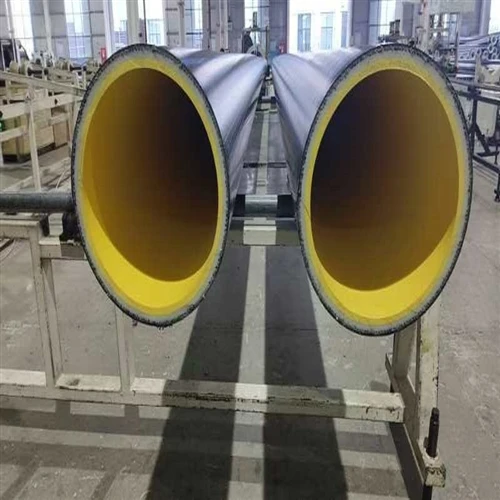
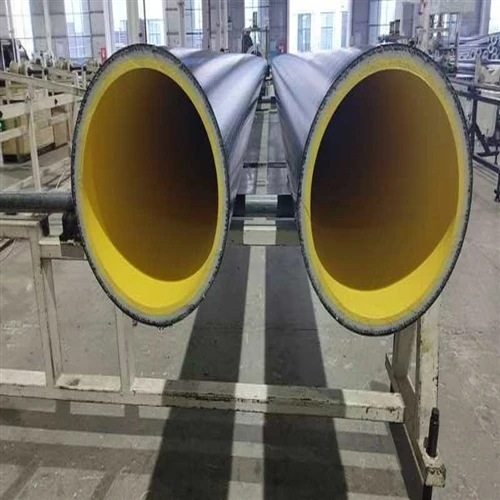
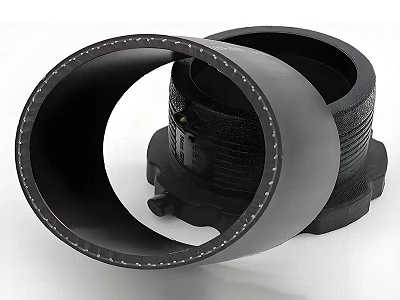
SRTP combines PE layers with high-strength steel wire reinforcement.
The steel wire provides reinforcement within the composite structure, while the PE layers provide the inner flow surface and protect the reinforcement from the surrounding environment.
The pipe can be used in mine dewatering and underground mine water transmission systems where reinforced thermoplastic construction is required.
Its actual performance depends not only on the pipe specification, but also on the connection, installation and operating conditions.
Product Parameters
|
Parameter |
Specification |
|
Product |
Steel Wire Reinforced Thermoplastic Pipe (SRTP) |
|
Structure |
PE + High-Strength Steel Wire Reinforcement + PE |
|
Nominal Diameter |
DN50–DN600 |
|
Pressure |
Up to 2.5 MPa for the specified product range |
|
Standard Length |
9 m / 12 m |
|
Reinforcement |
High-strength steel wire mesh |
|
Inner Layer |
PE |
|
Outer Layer |
PE |
|
Main Applications |
Mine dewatering, underground mine water supply, process water |
|
Installation |
Buried / Underground / Supported |
|
Connection |
According to the supplied SRTP connection system |
|
Temperature |
According to the applicable material and product specification |
These values apply to the specified product range and should be checked against the actual order specification.
FAQ
Does leakage always mean the SRTP pipe itself has failed?
No. Leakage may originate from a joint, the pipe body, installation damage, external loading or abnormal pressure.
Why do leaks sometimes appear repeatedly in the same location?
Repeated failures in one area may indicate a local condition such as ground movement, poor support, external loading or a recurring connection problem.
Can pressure surges damage an SRTP pipeline?
Pressure changes can increase the load on a pressurized pipeline. The actual system pressure history should be considered when investigating a failure.
Should the failed pipe be kept?
Yes, when a failure investigation is required. The physical section may provide useful evidence about the damage and its location.
Fix the Cause, Not Only the Leak
A leaking section is the visible problem.
The cause may be somewhere else.
For a buried mine dewatering pipeline, checking the joint, pipe body, ground condition, installation history and pressure records together gives a much better basis for deciding what needs to be repaired.
That is also the best way to prevent the same composite pipe leakage in mine dewatering system from happening again.
Request an SRTP Pipe Quotation
|
Step |
Process |
Details |
|
1 |
Send Requirements |
DN, pressure, medium, working temperature and application |
|
2 |
Specification Confirmation |
Pipe structure, pressure rating, specification and connection |
|
3 |
Quotation |
Price, lead time, packing and shipping terms |
|
4 |
Order & Production |
Contract, payment and production |
|
5 |
Inspection & Delivery |
Quality inspection and shipment |
For Steel Wire Mesh Reinforced PE Pipe (SRTP), steel wire reinforced PE pipe and mining pressure pipelines, send us:
DN + PN + Medium + Working Temperature + Installation Method + Pipeline Length + Quantity
For slurry applications:
Slurry Type + Solid Concentration + Particle Size
Luoyang Zhengju New Materials Technology Co., Ltd.
WhatsApp:+86 19937270645
Email: baibaili456@gmail.com
Wechat: +86 19937270645
Get Best Price for Your Mining Pressure Pipeline