Introduction
A buried pipeline is usually designed around a set of assumptions. The ground is prepared, the trench is excavated, the pipe is installed, and backfill is compacted to the specified requirements. Once the work is completed, the pipeline is expected to remain in position throughout its service life.
But construction drawings rarely show what happens when the ground changes several years later.
A section of soil may settle after heavy rainfall. A trench may cross from firm ground into soft clay. Underground water may gradually wash away fine particles. Even two adjacent sections of a pipeline can experience different settlement rates.
For a buried SRTP pipeline, these conditions deserve attention. The pipe is not only carrying internal water pressure. It is also interacting with the surrounding soil, and uneven ground movement can create additional bending and deformation.
The important question is not simply whether the pipe can withstand its rated pressure. It is whether the pipeline system can accommodate the ground conditions along its entire route.
A Pipeline Can Be Under Pressure Without Being Properly Supported
Consider a pipeline installed across two different soil zones.
The first section is placed on compact, relatively firm ground. The second crosses a softer area with lower bearing capacity. At the time of installation, the pipe may appear straight and the trench may pass inspection.
After several wet seasons, the softer section begins to settle.
The pipeline is now supported unevenly. Instead of remaining in a relatively uniform condition, part of the pipe may bend between better-supported areas. The amount of bending depends on the settlement difference, the length of the affected section, the pipe's structural characteristics and the restraint provided by the surrounding soil.
This is a different loading condition from ordinary internal pressure.
Internal pressure produces circumferential and longitudinal stresses in the pipe wall. Ground settlement can introduce additional bending, local deformation and stress concentrations. These effects may occur together.
A pressure rating alone cannot describe the full response.
Why Uneven Settlement Is More Difficult Than Uniform Settlement
Uniform settlement means that a long section of pipeline moves downward by approximately the same amount. If the movement is gradual and the surrounding system can accommodate it, the additional bending may be limited.
Differential settlement is more complicated.
It occurs when adjacent sections move by different amounts. The transition between the settled and relatively stable ground becomes the area of concern.
For example, imagine a pipeline crossing a 10 m-wide soft-ground zone. The middle of this zone settles 30 mm more than the surrounding ground.
The average settlement gradient across half the affected zone is:
Settlement gradient = Settlement difference / Horizontal distance
= 0.030 m / 5 m
= 0.006
This is equivalent to 0.6%.
The calculation is only a simplified description of ground movement. It does not directly give the pipe's bending strain or establish whether the pipeline is safe. The actual pipe response also depends on its stiffness, diameter, wall construction, soil support and interaction with adjacent sections.
Still, it illustrates why a relatively small vertical movement can matter when it occurs over a short distance.
The Pipe and Soil Must Be Considered as One System
A buried SRTP pipe does not carry external loads independently. The surrounding soil provides support and restraint.
The quality of this support depends on several factors:
|
Ground condition |
Possible effect on the pipeline |
|
Low soil bearing capacity |
Greater risk of local settlement |
|
Uneven trench bottom |
Irregular support along the pipe |
|
Poor side compaction |
Reduced lateral support |
|
Groundwater movement |
Possible soil erosion or loss of fine particles |
|
Different soil layers |
Uneven deformation along the route |
|
Nearby excavation |
Changes in ground stress and support conditions |
One detail is particularly important: backfill material and compaction are not simply construction housekeeping.
They affect how loads are transferred between the pipe and the surrounding ground. If the pipe is placed on an uneven foundation, or if the side-fill material is poorly compacted, the support conditions may differ significantly from those assumed in the design.
However, excessive compaction equipment loads can also damage a pipeline during construction. The appropriate material, lift thickness and compaction method should follow the project specification and the pipe manufacturer's installation guidance.

Why the Steel Wire Reinforcement Does Not Eliminate This Risk
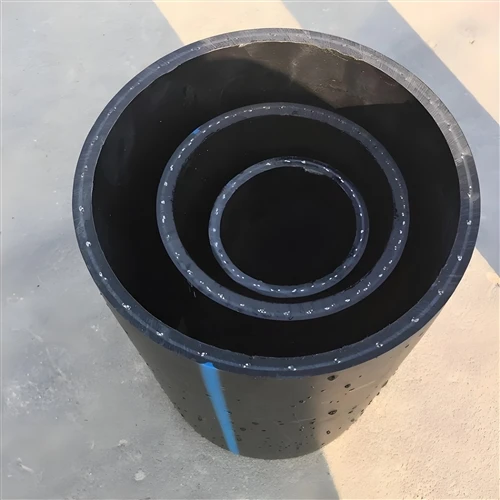
SRTP uses steel wire reinforcement embedded within a polyethylene-based composite structure. The reinforcement improves the pipe's ability to withstand internal pressure.
But reinforcement for internal pressure should not be confused with unlimited resistance to ground movement.
When a buried pipe bends, different parts of its cross-section experience different longitudinal strains. The outer side of the bend is stretched, while the inner side is compressed.
The magnitude of these strains depends on the bending radius.
For a simplified pipe-bending model, the approximate outer-fibre strain can be expressed as:
ε ≈ D / (2R)
Where:
ε = approximate bending strain
D = characteristic pipe diameter used in the simplified model
R = bending radius
This relationship is a basic geometric approximation. It is not a complete stress calculation for an SRTP composite wall. Actual design must account for the composite structure, reinforcement arrangement, material properties and the interaction between pipe and soil.
It does, however, explain an important point: a smaller bending radius produces greater bending strain.
If the pipeline is forced to follow an unexpected ground profile, the designer needs to evaluate whether the resulting deformation remains within the product's allowable limits.
Where Should Engineers Pay More Attention?
Not every buried pipeline route has the same settlement risk. Some locations deserve closer investigation before installation.
Transitions between different soil types
A route moving from dense soil into soft clay may experience different settlement behaviour. The transition zone should be included in the ground investigation and pipeline design.
River crossings and areas with groundwater movement
Changes in groundwater level can affect soil stability. Erosion, seepage and loss of support should be considered where relevant.
Recently filled land
Newly placed fill may continue to consolidate after construction. A pipeline installed before adequate ground preparation can experience settlement that was not apparent during initial inspection.
Road crossings and areas near foundations
Traffic loads, nearby structures and future excavation can change the stress conditions around a buried pipeline. The design should consider the actual site conditions rather than relying only on a standard burial-depth value.
What Should Be Checked Before Installation?
For a project crossing potentially unstable ground, checking the pipe specification is only one part of the work.
The ground investigation should identify soil layers, groundwater conditions and areas where differential settlement may occur.
The trench foundation should be inspected before the pipe is placed. Soft spots, sharp objects and irregular support should be corrected according to the approved construction method.
Backfill should be suitable for the pipe installation, and compaction should be controlled in stages. The pipe should not be subjected to concentrated construction loads that exceed the permitted limits.
Where significant settlement is expected, the engineering design may require a more detailed soil–pipe interaction analysis. This can include the predicted settlement profile, pipe bending response, local deformation and the influence of joints or fittings.
For particularly challenging ground conditions, a geotechnical engineer and pipeline designer should review the same settlement assumptions. Treating the soil report and pipe design as two unrelated documents can leave important risks unnoticed.

Technical Information That Should Be Confirmed for an SRTP Project
The following information helps engineers assess whether a proposed SRTP product is suitable for the project.
|
Parameter |
Required information |
|
Nominal diameter |
DN specified by the project |
|
Outside diameter |
Actual product dimension |
|
Internal diameter |
Required for hydraulic design |
|
Pressure rating |
PN under the specified reference conditions |
|
Pipe wall structure |
PE layers and steel wire reinforcement arrangement |
|
Pipe length |
Standard or project-specific |
|
Allowable installation conditions |
Manufacturer's installation guidance |
|
Connection system |
Joint and fitting requirements |
|
Product testing |
Relevant dimensional and pressure test records |
There is no single settlement limit that can be applied to every SRTP pipeline. A DN200 pipe and a DN800 pipe do not respond identically to the same ground movement. Neither can a settlement value be judged without considering its distribution along the pipeline.
The allowable deformation should be established through the project design and verified against the manufacturer's technical data.
FAQ
Q: Can SRTP pipes be installed in areas with soft soil?
A: The suitability depends on the soil conditions, pipe design, foundation treatment and installation method. Soft ground may require ground improvement or a more detailed soil–pipe interaction assessment.
Q: Does a higher pressure rating mean better resistance to ground settlement?
A: Not necessarily. Pressure rating and resistance to external ground movement are different design considerations.
Q: Why is differential settlement more concerning than uniform settlement?
A: Differential settlement creates changes in the pipeline's support profile. This can introduce bending and localized strain, particularly near transitions between stable and settling ground.
Q: Can proper backfilling prevent settlement problems?
A: Proper backfilling helps provide uniform support and reduce installation-related risks. It cannot eliminate settlement caused by deeper soil layers or long-term geological changes.
Request an SRTP Pipe Quotation
|
Step |
Process |
Details |
|
1 |
Send Requirements |
DN, pressure, medium, working temperature and application |
|
2 |
Specification Confirmation |
Pipe structure, pressure rating, specification and connection |
|
3 |
Quotation |
Price, lead time, packing and shipping terms |
|
4 |
Order & Production |
Contract, payment and production |
|
5 |
Inspection & Delivery |
Quality inspection and shipment |
For Steel Wire Mesh Reinforced PE Pipe (SRTP), steel wire reinforced PE pipe and mining pressure pipelines, send us:
DN + PN + Medium + Working Temperature + Installation Method + Pipeline Length + Quantity
For slurry applications:
Slurry Type + Solid Concentration + Particle Size
Luoyang Zhengju New Materials Technology Co., Ltd.
WhatsApp:+86 19937270645
Email: baibaili456@gmail.com
Wechat: +86 19937270645
Get Best Price for Your Mining Pressure Pipeline.