Introduction
In mining slurry transportation, the pipe material is exposed to much more than internal pressure.
Mineral particles continuously move through the pipeline, creating sliding abrasion and particle impact. Depending on the ore and processing conditions, the slurry may also contain acids, alkalis, salts or process chemicals.
This creates a practical question for mining engineers and buyers:
Which lining material can provide the right balance of wear resistance, impact resistance, chemical resistance and operating temperature?
Common options include ceramic-lined steel pipe, rubber-lined steel pipe and UHMWPE-lined steel pipe.
The comparison below shows why UHMWPE is considered for many abrasive mining pipeline applications.
UHMWPE vs Ceramic-Lined Steel vs Rubber-Lined Steel
|
Feature |
UHMWPE-Lined Steel Pipe |
Ceramic-Lined Steel Pipe |
Rubber-Lined Steel Pipe |
|
Wear Resistance |
★★★★★★ |
★★★★★ |
★★★ |
|
Impact Resistance |
★★★★ |
★★ |
★★★★ |
|
Chemical Resistance |
★★★★★ |
★★★ |
★★ |
|
Ease of Relining |
★★★★ |
★★ |
★ |
|
Operating Temperature |
★★ (-40°C to +80°C) |
★★★★★ (up to 400°C) |
★★ (up to 70°C) |

1. Why Is Wear Resistance Important in Mining Pipelines?
Mining slurry can contain hard and angular mineral particles.
Quartz, silica, rock fragments and other abrasive solids can continuously contact the internal pipe surface. Over time, this repeated sliding and impact can reduce the wall thickness of conventional steel pipelines.
Wear is particularly important in:
Tailings pipelines
Mineral concentrate pipelines
Ore slurry pipelines
Grinding circuits
Hydrocyclone lines
Pump discharge lines
Elbows and other flow-direction changes
The severity of wear depends on more than particle concentration. Particle hardness, particle size, particle shape and slurry velocity all affect the actual wear mechanism.
This is why a wear-resistant lining can become an important part of mining pipeline design.
2. Why UHMWPE Is Used as a Pipe Lining
UHMWPE stands for Ultra High Molecular Weight Polyethylene.
The material is known for its high wear resistance, low-friction surface, impact toughness and chemical resistance.
When used as the internal lining of a steel pipe, the two materials perform different functions:
Steel provides structural support.
UHMWPE protects the internal flow surface.
This combination is particularly useful when the pipeline requires both mechanical strength and protection against internal slurry wear.
Instead of asking the steel wall alone to withstand continuous abrasion, the UHMWPE liner becomes the primary wear-resistant surface.
3. UHMWPE vs Ceramic: Wear Resistance Is Not the Only Factor
Ceramic-lined steel pipe is well known for its high hardness and abrasion resistance.
This makes ceramic attractive in applications involving severe sliding abrasion and high operating temperatures. Some ceramic-lined systems can operate at temperatures far beyond the range of polymer linings.
However, ceramic has a different material behavior from UHMWPE.
Ceramic is hard but relatively brittle. Impact, vibration and thermal shock can become important considerations depending on the system design.
UHMWPE provides a different combination:
Abrasion resistance + impact toughness + chemical resistance
For mining slurry systems where both abrasion and repeated impact are concerns, this combination can be important.
The material choice should therefore depend on the dominant wear mechanism rather than simply selecting the material with the highest hardness.
4. UHMWPE vs Rubber: Impact and Chemical Conditions
Rubber lining is widely used in slurry applications because its elasticity allows it to absorb particle impact.
This can be useful in systems where impact loading is a major concern.
However, rubber performance depends strongly on the rubber formulation and chemical environment. Different rubber compounds are selected for different chemical and operating conditions.
UHMWPE approaches the problem differently.
Its high impact toughness is combined with a smooth, low-friction surface and broad chemical resistance.
For mining applications where abrasion and chemical exposure occur together, UHMWPE can therefore be considered as an alternative lining material.
5. Chemical Resistance Matters in Mining
Abrasion is not always the only problem.
Depending on the ore and processing process, mining slurry may contain:
Acidic components
Alkaline chemicals
Chlorides
Sulfates
Process reagents
Acid mine drainage
Steel can be susceptible to electrochemical corrosion when exposed to certain chemical environments.
UHMWPE has good resistance to many acids, alkalis and salts, which is one reason polymer linings are considered for chemically aggressive slurry service.
However, chemical resistance should never be treated as an absolute statement.
The actual compatibility should be evaluated according to:
Chemical type
Concentration
Temperature
Exposure time
Slurry composition
6. Why Elbows Need Special Wear Protection
One of the most important areas in a mining slurry pipeline is the elbow.
In a straight section, particles generally follow the main flow direction.
At an elbow, the flow direction changes. Particle momentum causes abrasive solids to move toward specific areas of the bend, increasing localized impact and sliding abrasion.
This can make elbows wear faster than nearby straight pipe sections.
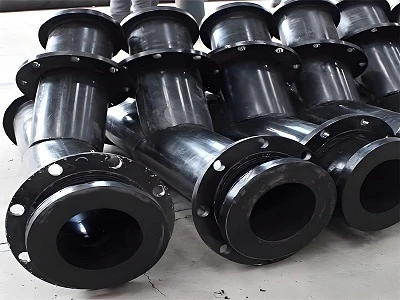
For this reason, a complete UHMWPE mining pipeline may include:
UHMWPE-lined straight pipe
UHMWPE-lined elbows
UHMWPE-lined tees
UHMWPE-lined reducers
Flange connections
Using the same wear-resistant lining concept at critical fittings helps maintain more consistent protection across the pipeline.
7. Temperature: Where Ceramic Has an Advantage
Temperature is one area where the three materials in the comparison are clearly different.
The chart shows an approximate operating range of:
UHMWPE-lined steel: -40°C to +80°C
Rubber-lined steel: up to approximately 70°C
Ceramic-lined steel: up to approximately 400°C
Ceramic therefore becomes relevant for applications involving temperatures beyond the practical range of polymer or rubber linings.
For normal-temperature mining slurry transportation, however, temperature may not be the primary selection factor.
In those cases, abrasion, impact, chemical compatibility, pressure and pipeline configuration may have a greater influence on material selection.
8. Relining and Maintenance
Mining pipelines eventually require inspection and maintenance.
The ease of repairing or replacing the internal lining can therefore influence the overall maintenance strategy.
UHMWPE-lined steel pipe can be designed so that the wear-resistant liner and structural steel shell perform separate functions.
Depending on the product construction, relining or replacement can be considered when the internal liner reaches its service limit.
This can be particularly useful for long-distance mining pipelines where replacing an entire steel pipeline would involve significant installation work.

9. Where Is UHMWPE-Lined Steel Pipe Used?
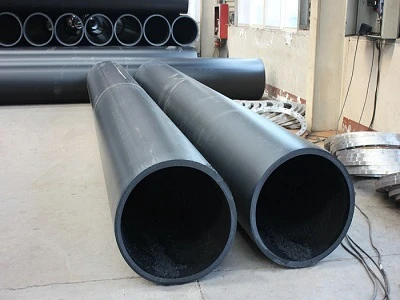
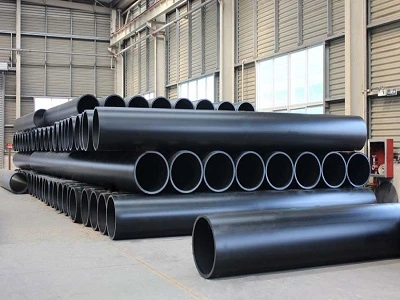
UHMWPE-lined steel pipe can be considered for a range of mining and mineral-processing applications.
Tailings Transportation
Tailings can contain hard mineral particles and may be transported over long distances.
The combination of a steel structural layer and UHMWPE wear-resistant liner can be considered where both mechanical support and internal abrasion protection are required.
Mineral Concentrate
Concentrate transportation can involve high solids concentrations and abrasive particles.
The actual pipe selection should be based on particle size, hardness, concentration, velocity and pressure.
Mineral Processing
Pipelines around grinding, classification and other processing stages can experience localized wear.
Elbows, pump connections and other flow-direction changes should receive particular attention.
Slurry Transportation
UHMWPE-lined steel pipe can be considered where continuous abrasive slurry flow creates a significant internal wear problem.
10. UHMWPE-Lined Steel Pipe Specifications
For a mining application, buyers should not select a lined pipe only by nominal diameter.
Important technical parameters include:
|
Parameter |
Typical Consideration |
|
Pipe Diameter |
DN65–DN1000 |
|
Pressure Rating |
PN1.0–PN10 |
|
Pipe Length |
9 m / 12 m |
|
Lining Material |
UHMWPE |
|
Slurry Type |
Tailings / concentrate / mineral slurry |
|
Solids Concentration |
Required for application evaluation |
|
Particle Size |
Required |
|
Particle Hardness |
Required |
|
Operating Velocity |
Required |
|
Operating Temperature |
Required |
|
Chemical Conditions |
Required |
Actual specifications should be confirmed according to the specific pipe structure and operating conditions.
11. How Should Mining Buyers Choose the Lining Material?
There is no single lining material that is suitable for every mining application.
Instead, start with the actual failure mechanism.
If abrasion is the main concern
Evaluate:
Particle hardness
Particle size
Slurry concentration
Flow velocity
Pipeline geometry
If impact is the main concern
Pay particular attention to:
Coarse particles
Elbows
Pump discharge
Direction changes
Vibration
If chemical exposure is significant
Evaluate:
pH
Chemical type
Concentration
Operating temperature
Exposure time
If temperature is extremely high
Ceramic or another high-temperature material may need to be considered rather than selecting a polymer lining simply because of its wear resistance.
This is the key to proper material selection:
Do not select the lining based on abrasion resistance alone. Select it according to the complete operating condition.
Why Consider UHMWPE for Mining Pipelines?
The comparison in the chart shows the main reason UHMWPE attracts attention in mining applications.
It provides a combination of properties rather than relying on a single performance characteristic:
High wear resistance
Good impact resistance
Good chemical resistance
Smooth internal surface
Low friction
Relatively easy maintenance and relining
For mining slurry applications operating within its temperature and pressure range, this combination can make UHMWPE-lined steel pipe a practical option.
The steel shell provides structural support, while the UHMWPE liner is designed to protect the internal surface from continuous contact with abrasive slurry.
FAQ
Is UHMWPE-lined steel pipe suitable for tailings?
It can be suitable for tailings transportation where abrasion and chemical exposure are important considerations. The final selection should be based on tailings characteristics, pressure, velocity, temperature and pipeline configuration.
Is ceramic-lined steel pipe more wear-resistant than UHMWPE?
Ceramic can provide extremely high hardness and abrasion resistance, particularly in suitable high-temperature or severe sliding-abrasion applications. UHMWPE offers a different balance of abrasion resistance, impact toughness and chemical resistance.
Why choose UHMWPE instead of rubber lining?
UHMWPE can be considered where abrasion resistance and chemical resistance are important together. Rubber remains useful where its impact absorption and flexibility are advantageous. The correct choice depends on the actual slurry and operating conditions.
Can UHMWPE-lined steel pipe handle high-pressure mining slurry?
The steel shell provides structural pressure support, but the allowable pressure depends on pipe diameter, steel wall thickness, liner structure, joint design and pressure rating. The specific PN rating should be confirmed before ordering.
Do UHMWPE-lined elbows need special consideration?
Yes. Elbows are often high-wear locations because slurry changes direction and abrasive particles can concentrate at the outer radius of the bend.
Conclusion
Mining slurry pipeline selection is not simply a choice between steel, rubber and ceramic.
Each material has a different combination of wear resistance, impact resistance, chemical resistance, temperature capability and maintenance characteristics.
Ceramic is attractive for high-temperature and severe abrasion conditions. Rubber can provide strong impact absorption in suitable slurry service. UHMWPE-lined steel pipe offers a balanced combination of abrasion resistance, impact toughness and chemical resistance for many mining slurry applications.
For tailings, concentrate and mineral slurry pipelines, the final decision should be based on the actual particle characteristics, slurry concentration, velocity, pressure, temperature and pipeline geometry.
That is where UHMWPE-lined steel pipe can become a practical solution for demanding mining pipeline systems.
Request a UHMWPE Pipe Quotation
|
Step |
Process |
|
1 |
Send Requirements - DN, pressure, quantity and application |
|
2 |
Specification Confirmation - Pipe type, size, wall thickness and connection |
|
3 |
Quotation - Price, lead time, packing and shipping terms |
|
4 |
Order & Production - Contract, payment and production |
|
5 |
Inspection & Delivery - Quality inspection and shipment |
For UHMWPE mining pipe, UHMWPE lined steel pipe, UHMWPE elbows and link flanges, send us:
DN + PN + Slurry Type + Solid Concentration + Particle Size + Flow Rate + Pipeline Length + Quantity
Luoyang Zhengju New Materials Technology Co., Ltd.
WhatsApp:+86 19937270645
Email: baibaili456@gmail.com
Wechat: +86 19937270645
Get Best Price for Your Grinding Slurry Pipeline.