Introduction
A buried mine drainage pipe does not only carry water. Once it is installed underground, the pipe becomes part of a system made up of the pipe wall, surrounding soil and backfill.
That changes the way the pipe behaves.
Soil pressure pushes on the outside of the pipe. Traffic or mining equipment can add surface loads. Changes in the surrounding ground can create uneven pressure around the pipe. If these loads become large enough, the circular cross-section can start to flatten.
This is known as ovalization.
For HDPE mining pipe, a certain amount of deformation is part of the material's flexible behavior. The important issue is whether the deformation remains within an acceptable range and whether the surrounding soil is providing adequate support.
What Happens When a Round Pipe Becomes Oval?
A new HDPE pipe has a circular cross-section.
After burial, the vertical and horizontal forces around the pipe are no longer perfectly balanced. The pipe wall responds to these loads by changing its shape.
Instead of remaining perfectly circular, the vertical diameter can decrease while the horizontal dimension changes.
This matters because the internal flow area also changes.
For a mine drainage pipeline, that is not simply a cosmetic deformation. Excessive ovalization can affect hydraulic capacity and increase local stresses in the pipe wall.
The pipe therefore needs enough resistance to deformation while still retaining the flexibility that makes HDPE useful in buried applications.
Why HDPE Does Not Behave Like Steel Pipe
A steel pipe generally has much higher stiffness than HDPE.
That does not automatically mean a flexible HDPE pipe is unsuitable for buried installation. The load is transferred differently.
With a flexible pipe, the surrounding soil becomes part of the structural system. Proper bedding and side support allow the soil to help carry and redistribute external loads.
This is one of the most important points when evaluating HDPE mining pipe.
The pipe wall should not be considered in isolation.
A poorly compacted trench can create a very different loading condition from a properly prepared installation, even when the pipe itself is identical.

Wall Thickness Still Matters
Flexibility does not mean wall thickness becomes unimportant.
A thicker HDPE wall provides greater resistance to deformation. SDR is useful here because it describes the relationship between outside diameter and wall thickness:
SDR = Outside Diameter / Wall Thickness
A lower SDR means a thicker wall at the same pipe diameter.
For a buried mining pipeline, SDR should therefore be considered together with external loading, burial conditions and internal pressure. It is not a substitute for ring-stiffness or structural assessment.
Mining Conditions Can Make External Loads More Complicated
Mine drainage pipelines may be installed beneath haul roads, access roads, stockpile areas or other locations where external loading changes over time.
Underground mining can introduce another problem: ground movement.
If the soil settles uniformly around the pipe, the pipe and surrounding soil may move together. Uneven settlement is more difficult because different sections of the pipeline can experience different levels of support.
That can produce local deformation rather than a simple uniform reduction in diameter.
This is where the flexibility of HDPE becomes relevant. Instead of resisting every ground movement as a rigid structure, the pipe can accommodate a degree of controlled deformation.
The objective is not to eliminate deformation completely. The objective is to keep deformation and stress within acceptable limits.
The Pipe and Soil Need to Work Together
For buried HDPE pipe, installation quality directly affects structural behavior.
The material placed beside the pipe provides lateral support. If that support is poor, the pipe can deform more easily under external loads.
The same principle applies to the pipe crown. Backfill material and compaction influence how surface and soil loads are transferred to the pipeline.
This is why two identical HDPE pipes can perform differently under different installation conditions.
For mine drainage projects, the pipe specification and the trench condition should therefore be considered together.

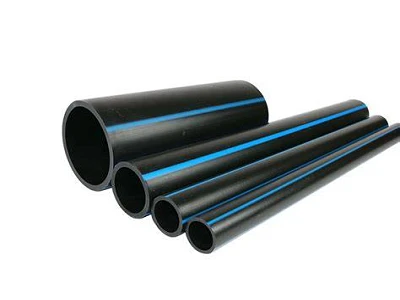
HDPE Mining Pipe Parameters
|
Parameter |
Product Specification |
|
Material |
HDPE / PE100 |
|
Nominal Diameter |
DN50–DN1200 |
|
Pressure Rating |
PN1.0–PN10 |
|
Pressure Range |
1.0–10 MPa |
|
Standard Length |
9 m / 12 m |
|
Application |
Mine drainage, mine water supply, buried mining pipelines |
|
Pipe Structure |
Solid-wall HDPE pressure pipe |
|
Diameter Range |
Small to large diameter mining pipeline applications |
The exact wall thickness and SDR are selected according to the required pressure class and pipe diameter.
Where Ovalization Becomes a Procurement Concern
A mining buyer should pay particular attention to buried sections exposed to heavy surface loading, deep cover, variable soil conditions and ground movement.
The question should not simply be whether the pipe has a high PN rating.
PN primarily describes pressure capability. External deformation is a separate issue.
For a buried mine drainage line, internal pressure, external loading, pipe geometry and soil support all need to be considered.
FAQ
Does HDPE pipe deform after burial?
Some deformation can occur because HDPE is a flexible pipe material. The important issue is whether the deformation remains within acceptable design limits.
Does a higher PN rating automatically mean higher resistance to external loads?
No. Pressure rating and resistance to external loading are different design considerations.
Does lower SDR mean a thicker HDPE pipe wall?
Yes. Because SDR is the ratio of outside diameter to wall thickness, a lower SDR corresponds to a thicker wall for the same diameter.
Why is backfill important for HDPE mining pipe?
The surrounding soil provides support to a flexible buried pipe. Bedding, side support and backfill conditions can significantly affect deformation.
Conclusion
Ovalization is a useful way to understand what actually happens to a flexible HDPE mining pipe after it is buried.
The pipe is not simply sitting inside the ground. It is interacting with the surrounding soil while carrying internal water pressure.
For mine drainage pipelines exposed to external loads, the right question is therefore not simply whether HDPE is flexible. It is whether the pipe geometry, pressure class and installation conditions provide enough control over deformation for the actual mining environment.
Request an HDPE Pipe Quotation
|
Step |
Process |
Details |
|
1 |
Send Requirements |
DN, pressure, medium, working temperature and application |
|
2 |
Specification Confirmation |
Pipe type, material grade, pressure rating, wall thickness/SDR and connection |
|
3 |
Quotation |
Price, lead time, packing and shipping terms |
|
4 |
Order & Production |
Contract, payment and production |
|
5 |
Inspection & Delivery |
Quality inspection and shipment |
For HDPE Mining Pipe, Send Us:
DN + PN/SDR + Medium + Working Temperature + Installation Method + Pipeline Length + Quantity
For mine drainage and dewatering applications, please also provide:
Application + Working Pressure + Installation Environment
For mineral-containing mine water, if available:
Water Chemistry / pH + Temperature + Suspended Solids
Luoyang Zhengju New Materials Technology Co., Ltd.
WhatsApp: +86 19937270645
Email: baibaili456@gmail.com
WeChat: +86 19937270645
Get Best Price for Your HDPE Mining Pipe.