Introduction
A mining water pipeline may operate at a perfectly stable pressure for most of the day.
Then a pump stops.
A valve closes.
Power is interrupted.
The pressure inside the pipeline suddenly changes.
The pressure shown during normal operation may have been well within the pipe's rated range, yet the pipeline can experience a much higher temporary pressure during that event.
This phenomenon is known as water hammer, or pressure surge.
It is one of the easier pipeline problems to overlook because it may happen for only a few seconds. For a long mining water pipeline, however, a short pressure surge can still matter.
Understanding water hammer helps buyers avoid another common mistake: selecting an HDPE pipe according only to normal working pressure.
Normal Pressure and Surge Pressure Are Not the Same
Suppose a mine water pipeline normally operates at 1.6 MPa.
If the pump runs steadily, the pressure may remain close to that value.
But water has mass and momentum.
When the flow changes suddenly, the moving water does not stop instantly. The change creates a pressure wave that travels through the pipeline.
The resulting pressure can temporarily rise above the normal operating pressure.
That is the basic idea behind water hammer.
The exact pressure increase depends on factors such as flow velocity, pipeline length, fluid properties, pipe characteristics and how quickly the flow changes.
For the buyer, the important point is simply this:
The normal pressure on the gauge is not necessarily the maximum pressure the pipe will experience.
Why Can Mining Pipelines Be Sensitive to Pressure Surges?
Mining water systems often have several conditions that make pressure transients relevant.
Long pipelines are common.
Pumping stations may be separated from the water-use point by large distances.
Elevation changes can be significant, especially in underground mines.
Valves may be operated during production changes.
Power interruptions can stop pumps unexpectedly.
Check valves can also close rapidly under certain conditions.
Any of these events can produce a pressure transient.
The longer and more complex the pipeline, the more important it becomes to understand how the system responds to sudden changes in flow.

Does HDPE Handle Water Hammer Better Than Rigid Pipe?
HDPE has a useful characteristic here: flexibility.
When pressure rises inside an HDPE pipe, the pipe wall can expand slightly. That flexibility can reduce the severity of some pressure transients compared with a highly rigid pipe.
This is one reason polyethylene is widely used in pressure water systems.
But it would be a mistake to interpret this as "HDPE does not have water hammer problems."
It can still experience pressure surges.
If the transient pressure is high enough, it can exceed the intended operating conditions of the pipe or place excessive loads on fittings and connections.
HDPE's flexibility reduces certain risks. It does not eliminate the need for system design.
Pump Shutdown Is a Common Trigger
Consider a long mine water pipeline supplied by a pump.
Under normal conditions, water flows continuously.
Now imagine an unexpected power failure.
The pump stops rapidly.
The water column continues moving for a short period, creating a transient condition.
The pressure response can travel through the pipeline and interact with valves, bends, elevation changes and other components.
If the system was designed only around steady-state pressure, this event may have been overlooked.
This is why pump operation should be part of the pipe-selection discussion.
Valve Closure Can Create Another Problem
A valve does not need to be completely closed to influence pipeline pressure.
The faster the flow is changed, the greater the potential for a pressure surge.
A rapidly operated valve can therefore create a more severe transient than a valve that closes gradually.
This is particularly relevant in systems where operators manually control water flow or where automatic valves respond quickly to changes in the process.
The solution is not necessarily to specify a much higher-pressure pipe.
Controlling the speed of the pressure change can be much more effective.

Why Fittings Matter Too
Water hammer does not act only on straight pipe.
Pressure waves travel through the entire system.
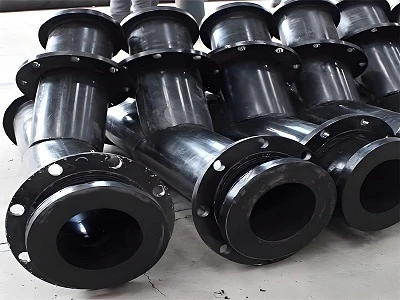
Elbows, tees, reducers, valves, flanges and other fittings are exposed to the pressure change.
A pipeline may therefore have a pipe wall capable of handling the transient while a poorly selected or poorly supported connection becomes the vulnerable point.
This is why the pipe, fittings and connection method should be treated as one system.
For a mining project, specifying the straight pipe correctly is only part of the job.
Why Long Pipelines Deserve More Attention
Pipeline length affects the behavior of pressure waves.
A short pipe may respond differently from a long water transfer line.
Mining water systems can extend over considerable distances, particularly when water must be moved from underground workings to the surface or between remote areas of a mine.
The combination of long distance, high flow velocity and sudden pump or valve changes can make pressure transients more significant.
This does not mean every long HDPE pipeline will experience serious water hammer.
It means the possibility should be considered before the system is built.
Can a Higher PN Rating Solve Water Hammer?
Not automatically.
A higher pressure class provides greater pressure capacity, but it does not remove the pressure surge itself.
If a system regularly produces a large transient, simply installing a higher-rated pipe may not be the most efficient solution.
Depending on the system, pressure surges can be managed through controlled pump shutdown, gradual valve operation, surge vessels, air chambers, suitable check valves or other hydraulic measures.
The appropriate solution depends on the actual pipeline.
The pipe pressure rating still needs to account for the expected pressure conditions, but the system should not rely on pipe strength alone to absorb every transient.
Water Hammer and Long-Term Pipe Life
One pressure surge does not necessarily mean immediate pipe failure.
The concern becomes greater when pressure transients occur repeatedly.
Frequent cycling can expose the pipe and its connections to repeated changes in stress.
Over a long service period, repeated pressure fluctuations become part of the pipeline's operating history.
For mining pipelines expected to run continuously for years, this is another reason to understand the complete pressure profile rather than only the average operating pressure.
Typical HDPE Mining Pipe Parameters
|
Parameter |
Typical Specification |
|
Material |
HDPE / PE100 |
|
Nominal Diameter |
DN50–DN1200 mm |
|
Pressure Rating |
PN1.0–PN10.0 MPa |
|
Standard Length |
6 m / 9 m / 12 m |
|
Operating Temperature |
Approx. -40°C to +60°C |
|
Density |
≥930 kg/m³ |
|
Tensile Strength |
≥20 MPa |
|
Elongation at Break |
≥350% |
|
Connection |
Butt fusion / flange connection |
|
Main Hydraulic Concern |
Pressure surge / water hammer |
These are typical ranges; the actual pipe specification should be confirmed according to the selected product and project requirements.
FAQ
What is water hammer?
Water hammer is a rapid pressure change caused by a sudden change in water flow, such as pump shutdown or rapid valve closure.
Can water hammer damage HDPE pipe?
A severe pressure surge can exceed normal operating conditions and place additional stress on the pipe, fittings and connections. HDPE's flexibility can help reduce some transient effects, but it does not eliminate the risk.
Is water hammer important in mine water pipelines?
It can be, particularly in long pressurized pipelines with pumps, valves and significant elevation differences.
Is PN1.6 MPa enough if the normal pressure is 1.6 MPa?
Not necessarily. The system should also consider possible transient pressure above the normal operating value.
Can water hammer be reduced without changing the pipe?
Often, yes. Pump control, gradual valve operation, suitable check valves and surge-control equipment can reduce pressure transients depending on the system.
Conclusion
A mining pipeline does not experience only the pressure shown during normal operation.
Pumps start and stop. Valves open and close. Power failures happen. Flow changes.
Each event can produce a temporary pressure surge.
HDPE's flexibility gives it useful resistance to pressure transients, but buyers should not assume that this makes water hammer irrelevant.
The safer approach is to understand the complete operating condition before selecting the pipe.
For a pressurized mining pipeline, one question is worth asking before placing the order:
What is the highest pressure the system may actually experience when something changes suddenly?
That number may be very different from the normal working pressure.
Primary Keyword
water hammer in HDPE mining pipe
Secondary Keywords
HDPE pipe water hammer, HDPE mining pipeline, pressure surge in HDPE pipe, HDPE pressure pipe, mining water supply pipe, HDPE pipe pressure surge, underground mining pipeline, water hammer pressure surge
Request an HDPE Pipe Quotation
|
Step |
Process |
Details |
|
1 |
Send Requirements |
DN, pressure, medium, working temperature and application |
|
2 |
Specification Confirmation |
Pipe type, material grade, pressure rating, wall thickness/SDR and connection |
|
3 |
Quotation |
Price, lead time, packing and shipping terms |
|
4 |
Order & Production |
Contract, payment and production |
|
5 |
Inspection & Delivery |
Quality inspection and shipment |
For HDPE Mining Pipe, Send Us:
DN + PN/SDR + Medium + Working Temperature + Installation Method + Pipeline Length + Quantity
For mine drainage and dewatering applications, please also provide:
Application + Working Pressure + Installation Environment
For mineral-containing mine water, if available:
Water Chemistry / pH + Temperature + Suspended Solids
Luoyang Zhengju New Materials Technology Co., Ltd.
WhatsApp: +86 19937270645
Email: baibaili456@gmail.com
WeChat: +86 19937270645
Get Best Price for Your HDPE Mining Pipe.