Introduction
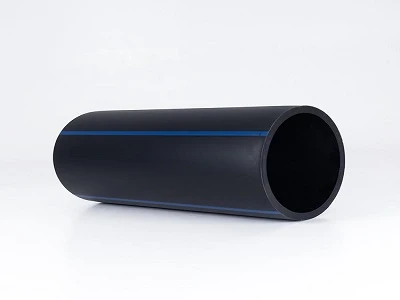
When buyers compare HDPE mining pipes, the discussion usually starts with diameter, pressure rating, wall thickness and price.
Those specifications are necessary, but they do not tell the whole story.
HDPE is a polymer, and polymers do not behave exactly like steel or cast iron when they remain under load for a long period. The material can gradually change its internal stress state while maintaining the same general deformation. This behavior is known as stress relaxation.
It is not something that a mine operator normally notices during the first few days of pipeline operation. It becomes relevant when a pipe is expected to remain under continuous pressure, restrained at a connection, or exposed to long-term deformation.
Understanding stress relaxation gives a buyer another useful tool for judging HDPE pipe quality. More importantly, it helps avoid a common mistake: assuming that the mechanical behavior of a new HDPE pipe will remain exactly the same throughout years of service.
HDPE Does Not Behave Like a Rigid Metal Pipe
Imagine a section of HDPE pipe under a constant load.
At the beginning, the pipe wall develops a certain level of internal stress. If the pipe remains in that condition, the polymer chains inside the material gradually rearrange themselves.
The deformation may remain approximately the same, while the internal stress required to maintain that deformation gradually decreases.
That is stress relaxation.
This behavior is closely related to the viscoelastic nature of polyethylene. It does not mean that the pipe suddenly becomes weak, nor does it mean that a properly designed HDPE pipe will simply lose its pressure capability.
The important point is that the material response changes with time.
For a mining pipeline expected to operate for many years, that time-dependent behavior matters more than it would for a short-term temporary pipeline.

Why Should a Mining Buyer Care?
Mining pipelines are rarely installed for short service periods.
A mine water supply line may operate continuously throughout a production cycle. A buried pipeline may remain in place for years. Reaching the pipeline for inspection or replacement may require shutting down part of the system or bringing equipment into difficult working areas.
That makes long-term material behavior important.
If a pipe is continuously exposed to internal pressure, the wall remains under stress. If a section is restrained by a connection or support, the material may also remain under deformation.
The pipeline therefore has a history of loading rather than a single loading event.
A buyer who only looks at the initial tensile strength may miss this part of the picture.
Stress Relaxation Is Not the Same as Creep
These two terms are often confused.
Creep describes how deformation changes when a material remains under a sustained load.
Stress relaxation describes how internal stress changes when a material is held at a relatively constant deformation.
Both are time-dependent behaviors of polymer materials, and both can be relevant to HDPE pipe.
For example, a buried HDPE pipe can experience long-term external loading from soil. A pressure pipe can experience continuous stress from internal water pressure. A restrained section can experience deformation while its connection limits movement.
The actual pipeline may involve both creep and stress relaxation at the same time.
For a buyer, the important lesson is simple: HDPE should be evaluated using long-term performance data rather than only short-term mechanical values.
Where Can Stress Relaxation Become More Relevant?
One example is a restrained pipeline section.
Suppose a long HDPE pipeline is connected to a rigid structure. The pipe wants to respond to pressure, temperature and movement, but the connection limits that movement.
The material remains in a strained condition.
Over time, stress relaxation changes the internal stress distribution.
Another example is a mechanically restrained connection. The pipe may experience local deformation around the connection, and the long-term behavior of the polymer becomes part of the connection design.
Temperature is another factor.
Polymer behavior is strongly affected by temperature. As temperature rises, molecular movement becomes easier and long-term deformation processes can become more significant.
That means a pipe operating continuously at a higher temperature cannot automatically be evaluated in exactly the same way as a pipe operating at normal ambient conditions.
Why Long-Term Data Matters More Than One Strength Number
A datasheet may provide a tensile strength value such as 20 MPa or higher.
That number is useful, but it is not a complete description of long-term pipe performance.
Tensile strength generally describes what the material can withstand under a particular test condition.
A mining pipeline, however, may remain under pressure for years.
For this reason, pressure-pipe materials are normally evaluated using long-term hydrostatic performance and other time-dependent properties.
The purpose is to understand how the material behaves after prolonged exposure to pressure, temperature and stress.
This is particularly important when comparing different HDPE products that appear similar on a basic quotation sheet.

Does Stress Relaxation Mean HDPE Is Unsuitable for Pressure Applications?
No.
The opposite is closer to the point.
The fact that HDPE has time-dependent behavior is one of the reasons polyethylene pressure-pipe design is based on long-term material performance rather than short-term strength alone.
A properly designed HDPE pressure pipe takes these characteristics into account.
The material grade, wall thickness, pressure class, temperature and expected service period all contribute to the final design.
The buyer's job is not to eliminate polymer behavior. That is not realistic.
The buyer's job is to make sure the selected material and pipe structure are appropriate for the expected operating conditions.
What Does This Mean for Underground Mining?
Underground mine water pipelines can be particularly sensitive to long-term reliability.
Once a pipeline is installed, access may be limited. A failure may interrupt water supply or drainage and require additional labor and equipment.
For that reason, the selection process should consider how the pipe behaves after installation, not simply how the new pipe performs during an incoming inspection.
HDPE offers several characteristics that are useful underground, including corrosion resistance, toughness and flexibility.
Its long-term behavior should be considered as part of that overall performance rather than treated as a separate laboratory topic.
Parameters Buyers Should Check
|
Parameter |
Typical Specification |
|
Material |
HDPE / PE100 |
|
Nominal Diameter |
DN50–DN1200 mm |
|
Pressure Rating |
PN1.0–PN10.0 MPa |
|
Standard Length |
6 m / 9 m / 12 m |
|
Density |
≥930 kg/m³ |
|
Tensile Strength |
≥20 MPa |
|
Elongation at Break |
≥350% |
|
Operating Temperature |
Approx. -40°C to +60°C |
|
Main Long-Term Factors |
Creep, stress relaxation, hydrostatic performance |
|
Typical Applications |
Mine water supply, pressure drainage, underground water pipelines |
The exact values depend on the selected material grade and manufacturer's specification.
What Should Be Included in a Purchase Inquiry?
A useful inquiry should contain more than:
"DN500 HDPE pipe, PN1.6 MPa."
It is better to tell the supplier the actual working pressure, expected temperature, installation environment and intended service.
If the pipeline will remain continuously pressurized, that should be stated.
If the pipeline will be connected to rigid equipment, restrained sections or special fittings are involved, that information is also useful.
The more accurately the operating condition is described, the easier it is to determine whether the proposed HDPE pipe is appropriate.
FAQ
Does stress relaxation reduce the strength of HDPE pipe?
Stress relaxation changes the internal stress state of the polymer over time. It does not mean that the pipe suddenly loses its structural integrity. Long-term pressure-pipe design accounts for the time-dependent behavior of the material.
Is stress relaxation the same as creep?
No. Creep concerns increasing deformation under sustained load, while stress relaxation concerns decreasing internal stress under sustained deformation. They are related but describe different material responses.
Why is temperature important?
Temperature affects polymer behavior. Higher operating temperatures can accelerate time-dependent deformation and influence long-term pressure performance.
Should buyers compare HDPE pipe using tensile strength alone?
No. Tensile strength is only one short-term material property. For pressure applications, long-term hydrostatic performance and the actual operating conditions are much more informative.
Is stress relaxation important for every HDPE pipe?
It becomes particularly relevant when the pipe is exposed to sustained pressure, long-term deformation or restraint. The significance depends on the application.
Conclusion
HDPE is not a material that should be judged only by the strength of a new pipe.
Its polymer structure gives it useful flexibility and toughness, but it also means that its response to long-term loading is time-dependent.
Stress relaxation is one part of that behavior.
For mining buyers, understanding this property helps put short-term strength values into perspective. A pipe intended to operate underground for years needs to be evaluated according to what happens during those years, not only what happens during the first pressure test.
Knowing more about the material's long-term behavior is one more way to avoid choosing a mining pipe based on an incomplete specification.
Primary Keyword
HDPE pipe stress relaxation
Secondary Keywords
stress relaxation in HDPE pipe, HDPE mining pipe, long term HDPE pipe performance, HDPE pressure pipe, HDPE pipe creep, polyethylene pipe behavior, underground HDPE pipe, HDPE mining water pipe
Request an HDPE Pipe Quotation
|
Step |
Process |
Details |
|
1 |
Send Requirements |
DN, pressure, medium, working temperature and application |
|
2 |
Specification Confirmation |
Pipe type, material grade, pressure rating, wall thickness/SDR and connection |
|
3 |
Quotation |
Price, lead time, packing and shipping terms |
|
4 |
Order & Production |
Contract, payment and production |
|
5 |
Inspection & Delivery |
Quality inspection and shipment |
For HDPE Mining Pipe, Send Us:
DN + PN/SDR + Medium + Working Temperature + Installation Method + Pipeline Length + Quantity
For mine drainage and dewatering applications, please also provide:
Application + Working Pressure + Installation Environment
For mineral-containing mine water, if available:
Water Chemistry / pH + Temperature + Suspended Solids
Luoyang Zhengju New Materials Technology Co., Ltd.
WhatsApp: +86 19937270645
Email: baibaili456@gmail.com
WeChat: +86 19937270645
Get Best Price for Your HDPE Mining Pipe.