Introduction
A slurry pipeline can remain in service for a long time without showing serious problems along most of its route. Then, during an inspection, the maintenance team may find that one section has lost considerably more wall thickness than the rest of the line.
This is not unusual in mineral transportation. Pipe wear is rarely distributed evenly from the beginning to the end of a pipeline. The condition of the slurry, the direction of flow and the layout of the route all affect where particles make the strongest contact with the pipe wall.
Replacing the entire pipeline because of damage in a few locations is not always necessary. Before deciding what to replace, it is worth understanding why those particular sections are wearing faster.
The slurry does not behave the same way throughout the pipeline
Mineral slurry is a mixture of liquid and solid particles. Its behavior changes with particle size, particle shape, solids concentration and flow velocity.
Fine particles may travel through the pipeline with relatively little impact on the wall. Larger or sharper particles can create more severe abrasion, especially when they repeatedly slide or strike against the same area.
The situation can also change when the slurry concentration fluctuates. A pipeline carrying a relatively dilute mixture may experience different flow conditions from one transporting a denser slurry. If the operating conditions are not stable, the wear pattern may change over time.
This is one reason why checking only the pipe diameter and working pressure is not enough when selecting a material for mineral transportation. The actual contents of the pipeline need to be considered as well.

Why bends often need closer inspection
A straight pipeline and a pipeline bend do not expose the pipe wall to exactly the same flow conditions.
When slurry changes direction, solid particles do not always follow the liquid at the same speed or along the same path. Depending on the bend angle, radius, flow velocity and particle characteristics, some particles may move toward the outer side of the bend and strike the wall.
Repeated contact gradually removes material from the affected area.
The amount of wear depends on the actual operating conditions. It would be inaccurate to assume that every bend will wear at the same rate or that the outer wall is always the only area that needs attention. A site inspection is necessary to identify the real wear pattern.
For maintenance teams, bends are worth including in regular inspection plans, particularly where the slurry contains coarse or abrasive mineral particles.
Horizontal sections can develop a different wear pattern
The lower part of a horizontal pipe may experience more particle contact when heavier solids move close to the bottom of the pipeline.
This does not mean that all particles settle in every horizontal section. Their movement depends on the slurry characteristics and operating velocity. However, when particles are not fully suspended, the bottom of the pipe can be exposed to repeated sliding and friction.
Over time, this may produce a wear pattern concentrated along the lower wall rather than an even reduction in wall thickness.
A useful inspection should therefore look at the position of the damage, not just its depth. If several inspected sections show similar wear near the bottom, the maintenance team should review the operating conditions and the slurry's ability to remain in motion.
Changes in operating conditions matter
A pipeline designed for one operating condition may face a different situation after production changes.
For example, the mine may begin processing ore with different particle characteristics. The solids concentration may increase, or the pumping arrangement may be adjusted to meet a higher transportation demand.
Even when the pipeline itself has not changed, the conditions inside it may no longer be the same.
This is why wear records are useful. Comparing inspection results from different dates can help identify whether damage is developing gradually or becoming more severe after an operational change.
Instead of replacing pipe sections based only on appearance, maintenance teams can use these records to identify recurring problem areas and decide where a material change may be worthwhile.

Choosing a pipe material for abrasive slurry
For mineral slurry containing sand, stone or other abrasive particles, the pipe material needs to be evaluated according to its resistance to continuous wear.
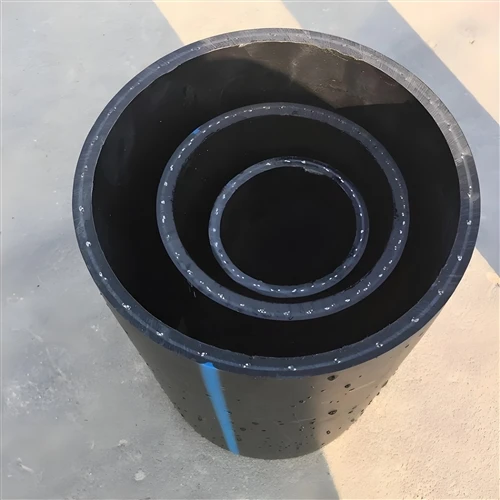
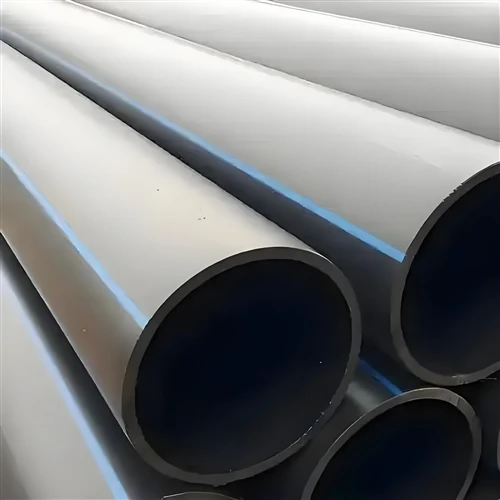
UHMWPE (Ultra-High Molecular Weight Polyethylene) is used in demanding slurry transportation applications because of its abrasion resistance and low-friction surface. Its properties make it suitable for pipelines carrying mineral slurry, tailings, sand and dredging materials.
Compared with ordinary carbon steel, UHMWPE pipe can offer approximately 5–7 times the wear resistance under suitable test and service conditions. Actual service life still depends on particle characteristics, flow conditions, installation and operating practices.
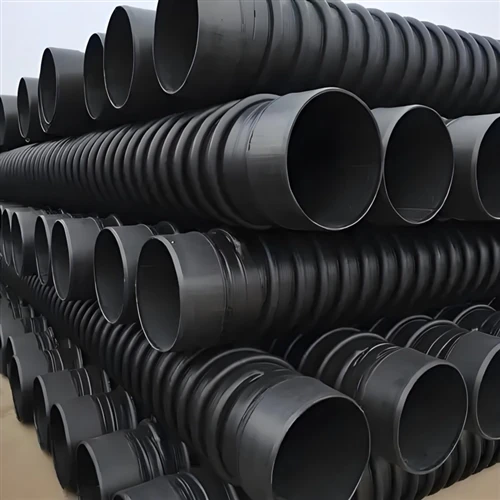
HDPE has a different role. It is widely used for water supply, industrial water and drainage, but it should not automatically be treated as a direct replacement for UHMWPE in heavily abrasive slurry service. The two materials belong to the polyethylene family, but their molecular structures and performance characteristics are different.
The choice should follow the material being transported, rather than simply the name of the polymer.
What should be checked before replacing a worn section?
When a damaged area is found, it helps to record more than the remaining wall thickness.
The inspection team should note the pipe location, the position of the wear, the length of the affected section and whether the damage is concentrated on one side. It is also useful to compare the findings with nearby sections.
The operating team can then review recent changes in slurry concentration, particle size, pumping conditions and production volume.
If the same locations repeatedly require repair, changing the pipe material in those sections may be more practical than treating every repair as an isolated problem. However, the replacement design should still consider pressure requirements, dimensions, connections and installation conditions.
A material with good abrasion resistance cannot compensate for an unsuitable pipeline layout or incorrect operating conditions.
UHMWPE Mining Pipe: Reference Specifications
|
Parameter |
Specification |
|
Product |
UHMWPE Wear-Resistant Pipe |
|
Raw material |
Ultra-High Molecular Weight Polyethylene |
|
Molecular weight |
Above 1.5 million |
|
Diameter range |
DN65–DN1000 |
|
Pressure rating |
PN1.0–PN10 |
|
Standard length |
9 m / 12 m |
|
Temperature range |
-269°C to +80°C |
|
Wear resistance |
Approximately 5–7 times carbon steel |
|
Main characteristics |
Abrasion resistance, impact resistance and low friction |
|
Applications |
Mineral slurry, tailings, sand and dredging transportation |
A closer look at the actual wear pattern
There is no single reason why one section of a slurry pipeline wears faster than another. A bend may be affected by changes in particle direction, while a horizontal section may experience repeated contact near its lower wall. Changes in the material being processed can also alter the wear pattern.
For this reason, pipeline maintenance should begin with the damaged section itself. Understanding where the wear occurs and what the slurry is doing at that point gives engineers a better basis for choosing a replacement material.
For abrasive mineral transportation, UHMWPE is worth considering where continuous particle contact is a major concern. The final selection should still be based on the project's operating conditions and technical requirements.
FAQ
Q: Why does a slurry pipeline wear faster at bends?
A: When slurry changes direction, solid particles may move toward the bend wall and create repeated impact and abrasion. The actual wear depends on the bend geometry, particle characteristics and flow conditions.
Q: Does slurry concentration affect pipe wear?
A: Yes. Changes in solids concentration can affect the movement and interaction of particles inside the pipe. The effect should be evaluated together with particle size, shape and flow velocity.
Q: Is UHMWPE suitable for mineral slurry transportation?
A: Yes. UHMWPE pipe is used for abrasive media such as mineral slurry, tailings, sand and dredging materials because of its high abrasion resistance and low friction.
Q: Can HDPE replace UHMWPE in every slurry pipeline?
A: No. HDPE is commonly used for water and drainage applications, while UHMWPE is selected for demanding abrasive transportation. The material should match the actual medium and operating conditions.