Slurry transport sounds simple - A to B.
In reality? A war against wear, corrosion, pressure, heat, and clogging.
One failure = repairs or shutdown.

So the real question becomes practical:
What are the advantages and disadvantages of different slurry pipeline materials?
And how do you choose without "saving money upfront, only to pay it back later"?

First: What Are You Really Fighting in Slurry Transport?
Pipeline failure in slurry systems is rarely caused by a single factor. It is usually a combination of:
Abrasive wear: Hard, angular particles continuously scour the inner wall. Elbows, tees, and reducers suffer the most.
Corrosion and chemical attack: Some slurries contain acids, alkalis, salts, or flotation reagents, accelerating metal degradation.
Sedimentation and blockage: Pump shutdowns, low velocities, and concentration fluctuations cause deposits that increase resistance or clog the line.
Pressure fluctuation and water hammer: Start-stop cycles and valve switching induce fatigue, especially at weak joints.
Installation and maintenance costs: From material selection to installation and repairs, lifecycle cost - not unit price - determines the real expense.
So slurry pipe selection is never just about wear resistance.
Wear resistance is the threshold.
Overall system performance and reliability define the upper limit.

Common Slurry Pipeline Materials: Pros and Cons Explained Clearly
Seven mainstream pipeline materials are widely adopted in mining, tailings transportation, chemical slurry and fluid conveying engineering. All materials meet basic conveying requirements, but targeted material selection matching operating conditions drastically reduces lifecycle cost, downtime and maintenance workload.
Overall Classification & Full-Parameter Comparison Table
Illustration Note: This table supports engineering CAD/process schematic matching; each material corresponds to independent pipeline section renderings for on-site construction drawing use.
|
No. |
Pipeline Material Category |
Core Advantages |
Key Defects & Limitations |
Core Applicable Scenarios |
Engineering Cost Attribute |
|---|---|---|---|---|---|
|
1 |
Carbon Steel / Ordinary Steel Pipe |
High structural strength, superior pressure bearing capacity, mature on-site welding process, sufficient market supply, low one-time procurement cost |
Ordinary anti-wear performance; fast wall thinning under high-solid high-velocity slurry; easy electrochemical corrosion in aggressive media; frequent cutting & welding maintenance; heavy deadweight raises logistics and installation cost |
Moderate stable working conditions; cost-controlled short-cycle projects; temporary slurry conveying pipelines; sites with convenient on-site maintenance conditions |
Low upfront cost, High long-term maintenance cost |
|
2 |
Alloy Steel / Wear-Resistant Steel Pipe |
Improved surface hardness and abrasion resistance via alloy smelting or wear-resistant plate composite processing; reserved high-pressure bearing performance; customizable for local reinforced sections |
High material and customized processing cost; strict welding and post-weld heat treatment technical standards; still susceptible to chemical corrosion of acidic/alkaline slurry |
Abrasive main slurry trunk lines; pipe elbows, tee joints and particle impact concentrated zones; long-service-life fixed conveying pipelines under abrasive working conditions |
Medium-high full-cycle cost |
|
3 |
Stainless Steel Pipe |
Excellent chemical inertness and comprehensive corrosion resistance; minimal rust failure, low daily anticorrosion maintenance workload |
Premium material cost; poor heavy-abrasion resistance, mismatch for high-impact slurry; standardized welding, cutting and anti-scratch handling required |
Highly corrosive low-abrasion slurry transportation; special chemical medium conveying pipelines; sanitary-grade fluid delivery systems |
High procurement cost, economical only for corrosion-dominated working conditions |
|
4 |
Rubber-Lined Composite Steel Pipe |
Steel substrate guarantees pressure resistance; inner rubber liner buffers particle impact, reduces pipeline abrasion; low conveying noise, smooth inner flow surface; mature mining industry application technology |
Fixed temperature and chemical medium application threshold; liner aging, bubbling, peeling failure risks; overall service quality determined by lining vulcanization process |
Medium/high-abrasion impact slurry conveying; working conditions requiring vibration damping and noise reduction; conventional mineral raw material conveying pipelines |
Medium cost, stable medium-cycle service performance |
|
5 |
Ceramic-Lined Pipe |
Ultra-high hardness ceramic inner layer delivers top-tier abrasion resistance; optimal reinforcement effect for severe wear hotspot pipe fittings |
Vulnerable to strong mechanical impact and drastic thermal shock; ultra-high installation precision requirement; difficult local repair, high replacement cost |
Severe localized wear sections; key process pipelines with zero-allowable downtime; partial reinforcement of elbows, tees and impact dead angles (not for full-pipeline laying) |
High unit cost, targeted partial use only |
|
6 |
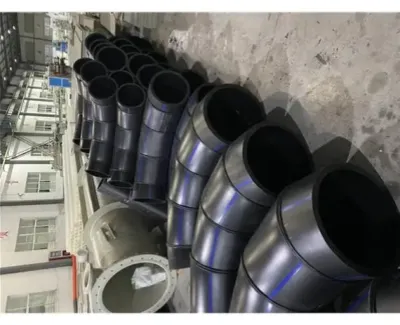
Plastic Pipe (HDPE As Representative) |
Full corrosion resistance, uniform inner wall to avoid scaling and fluid friction loss; good flexibility and impact resistance; lightweight, convenient transportation and laying; competitive whole-lifecycle cost |
Fixed pressure and ambient temperature bearing limit; controllable thermal expansion displacement required; butt fusion/electrofusion welding quality determines pipeline integral safety |
Long-distance tailings & slurry transmission; corrosive underground conveying environments; foundation settlement risk areas; projects focusing on whole-lifecycle economic benefit |
Low whole-lifecycle cost, limited extreme working condition adaptability |
|
7 |
Composite / Plastic-Lined Steel Pipe System |
Integrate steel pressure resistance and liner anti-corrosion/anti-wear performance; customized liner material to solve targeted pipeline failure defects |
Complex composite structure; performance highly dependent on factory manufacturing quality; professional installation and pre-formulated maintenance scheme mandatory |
Coupled working conditions of high fluid pressure + medium corrosion; projects with complete professional supply chain and on-site construction team |
Customized cost, matched for complex composite working conditions |
Six Practical Selection Principles
Define slurry properties first
Solid concentration, particle size, hardness, chemical composition.
Define operating conditions
Velocity, pressure, temperature, start-stop frequency.
Strengthen wear hotspots separately
Reinforce elbows and reducers instead of overspecifying the entire line.
Calculate lifecycle cost
Include downtime loss and maintenance frequency - not just material price.
Treat joint reliability as critical
Welding, flanges, fusion quality determine system integrity.
Choose a supplier capable of system solutions
Material alone does not guarantee performance - system integration does.
Quick Material Matching Cheat Sheet
Heavy abrasion & elbow wear: Ceramic lined / wear-resistant steel pipe
Medium abrasion + impact load: Rubber lined steel pipe
Severe corrosion, low maintenance: HDPE & anti-corrosion pipes
High-pressure main pipelines: Carbon/alloy steel (match abrasion degree)
Heavy corrosion, mild abrasion: Stainless steel / matched lining
Final Thoughts
There is no universally "best" slurry pipeline material.
There is only the material that best matches your operating conditions.
If you are currently evaluating slurry pipe materials, summarize your situation in four lines:
Slurry properties (abrasion vs. corrosion)
Flow velocity and pressure
Temperature and start-stop frequency
Line characteristics (length, elbows, settlement risk)
With those clarified, material selection becomes structured instead of blind.
Luoyang Zhengju is a professional manufacturer of plastic piping systems and wear-resistant engineering materials. Its products are widely used in mining, tailings transport, dredging, municipal drainage, irrigation, and industrial applications.