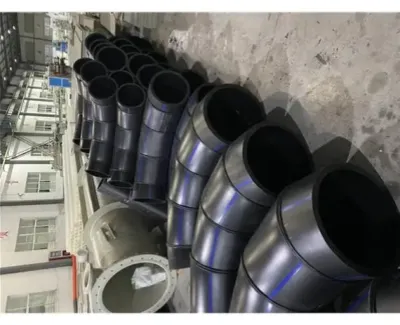
At mining sites, what operators fear most is not "high cost," but "repetition."
A blockage today, wear-through tomorrow, insufficient pressure drop the day after-many slurry conveying problems can ultimately be traced back not to the pump or the process, but to one fundamental issue: the slurry pipeline diameter was not selected correctly from the start.

Once the diameter is wrong, you are forced to choose between higher energy consumption and greater operational risk.
This guide explains slurry pipeline diameter selection in a clear and systematic way:
How to determine pipe diameter based on working conditions
How to match common pipe materials
Which industries are more prone to selection mistakes
What key questions must be clarified before purchasing
If you want your slurry pipeline system to run stable, last longer, and reduce downtime, this is a guide worth saving.

1. Why Slurry Pipeline Diameter Selection Is a "System Engineering" Task
Many diameter decisions are made by experience, by copying old lines, or by referencing other projects. But slurry transport is not clean water transport. Slurry is a solid–liquid two-phase medium with particle erosion, concentration fluctuations, and complex flow behavior.
A small deviation in diameter can affect the entire system:
Diameter too small
Flow velocity increases, wear accelerates, local resistance rises, pumps work harder, energy consumption climbs, and risks of vibration, noise, and leakage increase.
Diameter too large
Flow velocity drops, solids settle, pressure becomes unstable, and blockage risks grow. Cleaning, dismantling, and downtime costs surge.
Correct diameter but mismatched material
Some conditions require high wear resistance; others demand corrosion or temperature resistance. Focusing only on "diameter" while ignoring "material + structure" also leads to premature failure.
The true goal of slurry pipeline diameter selection is not choosing a number-it is ensuring long-term stability, low maintenance, scalability, and serviceability.

2. Clarify These Working Conditions Before Selecting Diameter
Accurate diameter selection begins with clear operational data.
1) Slurry Characteristics
Solid content (mass or volume fraction)
Particle size distribution (fine, coarse, angular particles)
Density and viscosity range
Presence of corrosive media (acid, alkali, salts, solvents)
2) Transport Requirements
Design flow rate and future expansion capacity
Allowable pressure drop
Operation mode (continuous or intermittent, start-stop frequency)
3) Pipeline Route Conditions
Total length and elevation difference
Number and radius of bends
Long-distance transport or multiple branches
Installation space and vibration sources
4) Environmental & Maintenance Strategy
Temperature range (winter low temp, summer heat, process temp)
Maintenance capability (routine inspection, pigging ability)
Downtime cost per hour
These variables determine the reasonable velocity range, system resistance, and required levels of wear and corrosion resistance.

3. How to Calculate and Select Diameter: Focus on Two Core Factors
Without overcomplicating the mathematics, focus on flow rate and flow velocity.
1) Determine Flow Rate First, Then Derive Diameter from Velocity
Flow rate is the hard requirement from the process.
Velocity defines operational safety limits.
Too high → accelerated wear.
Too low → sedimentation and blockage.
In practice, engineers select a velocity within an industry-accepted range to balance wear and sedimentation risks, then calculate pipe diameter accordingly. Pump selection and pressure drop verification complete the loop.
2) Don't Ignore Local Resistance
Straight pipe calculations are not enough. Most failures occur at:
Elbows
Tees
Reducers
Valves
Elevation changes
Particles accelerate and impact concentrated zones, creating wear hotspots. Therefore, diameter selection must be integrated with structural design and material reinforcement.
4. Matching Materials with Working Conditions
Slurry pipeline material selection revolves around wear resistance, corrosion resistance, structural strength, weight, installation, and lifecycle cost.
Two common solutions in industrial slurry systems:
1) Ultra-High Molecular Weight Polyethylene (UHMWPE) Pipes
Suitable for high-abrasion applications where reduced scaling and lower friction are desired.
Advantages:
Excellent abrasion resistance
Smooth inner surface, lower friction loss
Lightweight, easier installation
Good chemical resistance in many environments
2) Steel-Lined Composite Pipes
Suitable for high-pressure, high-temperature, heavy-load, or structurally demanding conditions.
Advantages:
High structural strength
Strong resistance to external forces
Greater safety margin in complex operating conditions
Diameter and material selection are interconnected. The same flow rate with different materials leads to differences in resistance, wear rate, installation method, and maintenance strategy. Selection must consider the system as a whole.
5. The Real Advantage: Lower Lifecycle Cost
The largest cost in slurry pipeline projects is not initial procurement, but:
Downtime
Emergency repairs
Pump energy consumption
Production fluctuations
A well-designed slurry pipeline diameter selection provides:
Stable flow regime
Reduced maintenance frequency
Controlled wear locations
Capacity for future expansion
Optimized energy consumption
When diameter and material are properly matched, slurry systems tend to become more stable over time rather than more problematic.
6. Industry-Specific Focus Points
Although all involve slurry transport, industries prioritize differently:
Mining: Strong particle erosion, long lines → focus on wear resistance and hotspot reinforcement
Metallurgy: Higher temperatures, complex media → structural safety
Coal: Slurry fluctuation → anti-sedimentation and stable flow
Phosphate mining: Complex chemistry → corrosion and scaling resistance
Chemical industry: Sensitive media and temperature → compatibility and safety margin
Best solutions differ by industry. Avoid copying designs across sectors.
7. Seven Questions to Ask Before Purchasing
What is the basis for the recommended diameter?
Are future capacity expansions considered?
Where are the predicted wear hotspots?
Is material compatibility verified for this slurry?
What connection method is proposed?
What maintenance strategy is included?
Are there similar reference projects?
System-level questions produce system-level solutions.
8. Engineering Capability Behind the Product
A slurry pipeline is not just a pipe-it is a long-term conveying system.
Luoyang Zhengju specializes in industrial pipeline manufacturing, offering a comprehensive product system including UHMWPE pipes and steel-lined composite pipes. These products are widely applied in mining, metallurgy, coal, phosphate, and chemical industries.
This integrated capability allows diameter selection to move beyond single-material limitations and toward optimized, condition-based system solutions.
Conclusion
Slurry pipeline diameter selection may look like a matter of size, but in essence it determines system stability.
Choosing one inch correctly can save:
A year of downtime costs
Emergency repair risks
Production instability