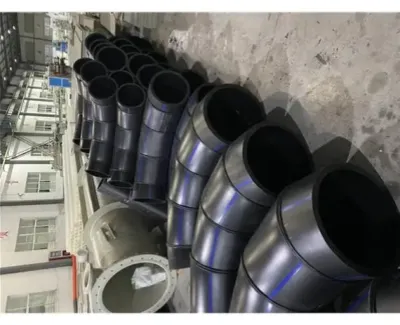
In many mining sites, the most "troublesome" piece of equipment is often not the crusher or the pump, but an inconspicuous slurry pipeline. It lies quietly on pipe racks or is buried in trenches. Yet once it is selected incorrectly, problems quickly follow: frequent leakage, inner wall wear-through, pressure fluctuations, and shutdowns for maintenance. What seems like simply replacing a section of pipe can end up affecting pumps, valves, supports, and even the stability of the entire conveying system.

So, "How should you choose a slurry pipeline?" This is not merely a purchasing question-it is a system engineering issue. What you are choosing is not just material, structure, and connection method; you are betting on service life, energy consumption, downtime risk, and total lifecycle cost.
I. Don't Ask About Price First: Clarify the Working Conditions
The essence of slurry pipeline selection is matching the pipe to the slurry-not forcing one type of pipe to handle all conditions.

Before anything else, clarify the following key factors:
1) How Abrasive Is the Slurry?
Abrasiveness depends on:
Ore hardness and particle size
Solid concentration
Flow velocity
Presence of sharp particles
Sand content
Many premature failures are not due to poor materials, but because the combination of velocity, particle size, and solids exceeded expectations.
2) Is the Slurry Corrosive?
Some slurries contain acids, alkalis, salts, or chemical reagents. The combination of abrasion and corrosion can drastically shorten service life. In industries such as chemical processing or phosphate mining, corrosion must be evaluated separately.
3) What Is the Temperature Range?
Temperature affects the stiffness and creep performance of plastic pipes and the stability of certain linings. Do not simply state "room temperature." Specify maximum, minimum, and whether thermal shock occurs.
4) What About Pressure, Pulsation, and Start-Stop Frequency?
Pump start-ups, valve operations, and pressure fluctuations place high demands on pipe toughness and connection strength. Many "mysterious leaks" are actually caused by pressure pulsation and fatigue.
5) Installation Method and Maintenance Conditions?
Is the pipe overhead, buried, installed in shafts, or routed through multiple bends? Can the system be shut down easily? Is quick disassembly required?
These factors influence whether to choose flanged, clamped, welded, or composite structures-and whether fast repair is feasible.
When you compile all this into a working condition checklist, selection becomes evidence-based rather than experience-based. Pipes are not better just because they are thicker; they are better when precisely matched.

II. Six Core Performance Indicators to Focus On
Ignore excessive marketing language. The following six indicators determine success:
Wear Resistance
Focus on material system and inner wall performance. Wear often occurs at bends, tees, and turbulent zones. Hardness alone is insufficient-toughness and friction coefficient matter too.
Corrosion Resistance
Confirm long-term chemical compatibility with media type, concentration, and temperature. Don't just ask, "Can it be used?" Ask, "How long will it last?"
Impact and Fatigue Resistance
Slurry systems often fail due to sudden impact or pressure shock rather than gradual wear.
Pressure Capacity and Safety Margin
Consider pressure fluctuations, installation deviation, and long-term creep (especially in plastic systems).
Connection Reliability
Installation difficulty, leak risk, maintenance convenience, and spare part availability are critical.
Total Lifecycle Cost
Downtime, cleaning, emergency repair, and spill losses often cost more than the pipe itself.
III. How to Choose Between Common Materials and Structures
There is no absolute "best"-only what fits best.
1) UHMWPE (Ultra-High Molecular Weight Polyethylene) Pipes
Ideal for high-abrasion applications requiring reduced friction and anti-scaling properties. Their toughness and wear resistance make them widely used in mining, metallurgy, and coal slurry systems. Lower friction can improve stability and reduce energy consumption.
2) Steel-Lined Composite Pipes
Suitable for higher pressure systems and complex structural conditions. They combine external structural strength with internal wear and corrosion resistance. Frequently used in mining and chemical industries facing high-pressure and corrosive conditions.
3) Metal Pipes and Other Wear Solutions
Metal pipes offer strong structural capacity but can face severe wear and corrosion in abrasive slurries unless enhanced with linings or protective layers.
A quick rule of thumb:
High abrasion, desire for reduced friction, anti-scaling → Consider high-performance polymer systems (e.g., UHMWPE).
High pressure + complex conditions + abrasion and corrosion → Consider steel-lined composite structures.
IV. The Real Advantages of Correct Selection
Choosing the right slurry pipe delivers measurable benefits:
Fewer unplanned shutdowns
More stable conveying efficiency and energy consumption
Lower maintenance intensity and safety risks
Predictable service life and budget planning
The goal is predictability and stability-not just durability.
V. Matching to Different Industry Scenarios
Different industries prioritize different factors:
Mining: High abrasion, focus on impact resistance and bend protection.
Metallurgy: Complex media, balance between corrosion and wear resistance.
Coal: Anti-scaling and adaptability to start-stop conditions.
Phosphate & Chemical: Chemical compatibility and long-term sealing reliability.
Though all are called "slurry transport," failure mechanisms vary greatly.
VI. A Practical 6-Step Selection Process
Create a detailed working condition table.
Define your priority risks.
Determine material and structural direction.
Focus on connections and fittings.
Require a solution-level proposal from suppliers.
Validate with comparable case studies.

Slurry pipelines represent a "product + solution + implementation" category. Complexity of conditions and maintenance costs make system-level thinking essential.
Luoyang Zhengju specializes in the production of various pipe materials with a comprehensive product portfolio. The company independently develops ultra-high molecular weight polyethylene (UHMWPE) pipes and steel-lined composite pipes, which are widely used in mining, metallurgy, coal, phosphate, and chemical industries.
For procurement and technical teams, cross-industry application experience often means more mature material selection expertise and a stronger ability to transform parameters into stable, running systems.
In Conclusion
The method for selecting slurry pipelines can be summarized in three key principles:
Clarify working conditions before discussing materials.
Focus on connections and vulnerable components, not just pipe thickness.
Make decisions based on total lifecycle cost, not just purchase price.