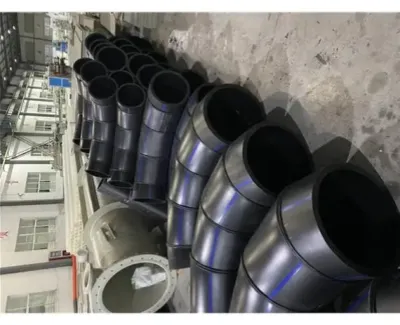
You may think they're both "plastic pipes," so performance should be similar. But once slurry actually starts running through a pipeline for a period of time, reality sets in: abrasion, erosion, cracked elbows, frequent maintenance, unexpected shutdowns, and production losses. These issues are never offset simply by choosing a cheaper pipe.

Slurry transport basically involves solid-liquid two-phase flow with constant scouring. Inside this rough, turbulent high-wear environment, wear-resistant slurry pipes and regular HDPE pipes look nearly identical, yet they're built with totally different mindsets against abrasion. Slurry pipes are custom-designed to handle heavy wear head-on, while standard HDPE pipes only cope with minor abrasion as an afterthought.
1. Different Product Positioning
Many buyers compare slurry wear-resistant pipes and HDPE pipes on price and size alone. In reality, they are designed for different purposes.
What Is an Ordinary HDPE Pipe?
Ordinary HDPE (High-Density Polyethylene) pipe is a general-purpose plastic pipe known for:
Good corrosion resistance
Light weight
Easy installation
Mature connection methods
It is widely used in water supply and drainage systems, general fluid transportation, and mildly abrasive slurry applications.
However, it is not originally designed for prolonged exposure to high-concentration solid particle abrasion.
What Is a Slurry Wear-Resistant Pipe?
A slurry wear-resistant pipe is specifically developed for transporting:
Mineral slurry
Tailings
Concentrates
Ash slurry
Sand slurry
Its primary goal is not just "can it transport the medium," but:
How long can it operate under severe abrasion?
How often will maintenance be required?
How low can downtime risk be kept?
Therefore, its structure and materials are typically reinforced with wear-resistant linings or composite designs to significantly extend service life under abrasive conditions.
In short:
HDPE pipe is a general-purpose pipe.
Slurry wear-resistant pipe is an application-specific, heavy-duty pipe.
The harsher the operating condition, the larger the performance gap.

2. Core Differences Under Slurry Conditions
1) Wear Resistance: The Primary Indicator
Slurry often contains irregular, high-hardness particles moving at high velocity, continuously cutting and scouring the pipe wall.
Ordinary HDPE performs acceptably in mild abrasion.
Under high concentration and high flow velocity, wear accelerates-especially at elbows, tees, and reducers.
Slurry wear-resistant pipes prioritize abrasion resistance, significantly extending service life under the same conditions and reducing the risk of perforation.
2) Impact & Fatigue Resistance: Critical at Key Points
Slurry systems experience:
Pump start/stop pressure fluctuations
Turbulence at elbows
Localized impact at pump outlets
Particle settling and re-suspension
In ordinary HDPE pipes, wall thinning due to wear may lead to stress concentration and cracking.
Wear-resistant slurry pipes are engineered to remain structurally stable under combined high abrasion and dynamic pressure conditions, converting unexpected failures into predictable maintenance cycles.
3) Service Life & Total Cost of Ownership
Many projects focus on initial purchase price. However, the true cost drivers in slurry systems are:
Production downtime losses
Emergency maintenance labor
Replacement frequency
Environmental and safety risks from leakage
The correct comparison metric is life-cycle cost, not initial procurement cost.
Under the same operating conditions, the better solution is the one with:
Fewer shutdowns
Longer service intervals
Lower failure risk
4) Media Compatibility: Abrasion Often Comes with Corrosion
Slurry systems may also contain chemical components, varying pH levels, or salts.
HDPE typically offers good corrosion resistance. However, corrosion resistance does not compensate for severe abrasion damage.
Slurry wear-resistant pipes are designed with a priority hierarchy:
First solve abrasion, then address corrosion, temperature, and pressure constraints.

3. What Engineering Results Do Wear-Resistant Pipes Deliver?
Instead of simply saying "more durable," let's translate advantages into measurable outcomes:
✅ Turn Emergency Repairs into Planned Maintenance
Improved wear resistance makes degradation predictable, allowing scheduled inspections instead of sudden breakdowns.
✅ Reduce Replacement Frequency
Lower wear rates mean fewer replacements and reduced spare part inventory pressure.
✅ Strengthen Weak Points
Critical sections such as elbows, pump outlets, and diverging points can be reinforced, improving overall system reliability.

4. When Should Slurry Wear-Resistant Pipes Be Prioritized?
If your project involves any of the following, ordinary HDPE should not be the default choice:
1) Mining & Mineral Processing
Concentrate or tailings transportation
High solid concentration
Long-distance pipelines with multiple elbows
2) Tailings Return & Thickener Underflow Systems
Dense slurry
High sedimentation risk
Strict continuous operation requirements
3) Power & Metallurgy Industries
Ash slurry
High abrasive particle content
High downtime cost
4) Dredging & Sand Pumping
Strong sand scouring
Flow rate fluctuations
Mobile or changing operating conditions
5. Practical Evaluation Checklist
To make an engineering-based decision, consider:
Operating Conditions
Solid content percentage
Particle size and hardness
Design flow velocity
Pressure and temperature
Pipeline Design
Total length
Number of elbows
Elevation difference
High-turbulence zones
Downtime Cost
What is the hourly production loss?
Can the system tolerate unexpected shutdowns?
Targeted Reinforcement
Can elbows and pump outlets be upgraded independently?
Is a hybrid solution more cost-effective?
Often, the best approach is not uniform piping throughout the system, but strategic reinforcement at high-wear points.
6. Procurement Recommendations
When requesting quotations, provide:
Medium type
Solid concentration range
Particle characteristics
Flow rate and velocity
Pressure and temperature
Operation mode (continuous or intermittent)
Pipeline layout details
Also confirm:
Whether the pipe is designed specifically for slurry abrasion
Availability of matching wear-resistant fittings
Connection method suitability
Delivery capability and spare part support
Remember: slurry transportation is a system, not a single pipe.
7. Why Overseas Buyers Often Request Wear-Resistant Solutions
In mining, dredging, and tailings industries, downtime is extremely costly. For international projects, long spare part lead times make reliability even more critical.
Buyers increasingly seek:
Stable long-term operation
Predictable maintenance cycles
Complete abrasion-resistant solutions
Clearly explaining the difference between slurry wear-resistant pipes and ordinary HDPE pipes builds trust and supports repeat orders.
8. Luoyang Zhengju: Turning "Wear-Resistant Pipelines" into Practical Engineering Solutions
Truly valuable manufacturer endorsement is not about slogans. It means that after reviewing your operating conditions, the supplier can identify potential risk points in advance, properly configure critical sections from the start, and help you reduce trial-and-error and rework.
In slurry wear-resistant pipeline solutions, fittings integration, and project delivery, Luoyang Zhengju places greater emphasis on condition-based design. Different slurry concentrations, flow velocities, and pipeline layouts require different wear-resistant strategies. A single standardized solution cannot effectively cover all slurry systems.
If you are working on mineral processing, tailings return, dredging and sand pumping, or ash slurry transportation projects, it is recommended to organize your site parameters into a clear table, mark straight sections and key wear points, and then compare solution options.
In many cases, real cost savings do not come from "buying cheaper," but from "reducing downtime."
The Real Difference Is Not the Material Name, but the Operational Result
The key difference between slurry wear-resistant pipes and ordinary HDPE pipes lies in how they manage abrasion risk:
One is engineered to fight wear.
The other performs well in general environments but is not optimized for severe abrasion.
If your system is facing frequent elbow wear-through, repeated leakage, and costly shutdowns, the solution may not be replacing pipes with the same type-but rethinking your pipe selection strategy based on actual operating conditions.