On mining sites, the real fear isn't high upfront cost - it's repeated failure: shutdowns, emergency repairs, delayed schedules, temporary rerouting. When you calculate the total cost, choosing the wrong material at the beginning often turns out to be far more expensive.

So when someone asks, "What is the optimal wear-resistant UHMWPE mining pipeline?" they are usually not looking for a simple definition. What they really want to know is:
Under high-abrasion, heavy scouring, and long-distance conveying conditions, what kind of UHMWPE pipeline truly deserves to be called "optimal wear-resistant"?
Let's break it down clearly: definition, core properties, advantages, applications, replacement value, factory delivery capability, and selection advice - all in one place.

1. First, What Is a UHMWPE Wear-Resistant Mining Pipe?
UHMWPE stands for Ultra-High Molecular Weight Polyethylene. When used in mining pipelines, its core purpose is simple:
To minimize wear-through, blockage, scaling, and frequent replacement caused by continuous transport of abrasive media such as slurry, tailings, sand, and coal powder.

The term "optimal wear-resistant UHMWPE mining pipe" does not refer to a single fixed model. Instead, it refers to a product that, under your specific working conditions, achieves the following:
- ✅ Proper material formulation – suitable molecular weight range, additives, and processing technology tailored for mining wear resistance
- ✅ Appropriate structural design – wall thickness, diameter, length, and connection method suited to installation and long-term operation
- ✅ Consistent quality control – stable batches, dimensional accuracy, reliable welding/connection performance, complete inspection
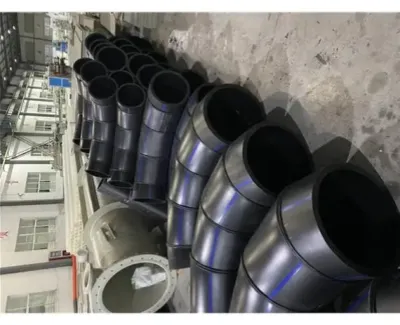
- ✅ Complete engineering delivery – elbows, tees, reducers, stub flanges, and transition fittings supplied as a system
In other words:
"Optimal" starts with wear resistance - but ends with long-term stability, proper adaptation, and reliable project delivery.
2. Core Characteristics: True Wear Resistance Is Not Just "Hardness"
Many people assume that "harder means more wear-resistant."
But mining transport is a long-term endurance battle:
- Irregular particle shapes
- Flow velocity fluctuations
- Localized scouring at bends
- Impact loads
- Frequent start-stop cycles
Real durability depends on comprehensive material performance and structural stability, not hardness alone.
When evaluating whether a UHMWPE mining pipe is truly optimal, focus on four aspects:
1) Abrasion Resistance
The inner wall must withstand continuous cutting and scouring by slurry or sand. High-quality UHMWPE maintains surface smoothness over time and avoids groove formation.
2) Impact & Crack Resistance
Mining systems often experience sudden shocks from large particles and pressure surges. Materials lacking toughness may develop microcracks, leading to leakage or burst failure.
3) Low Friction & Anti-Scaling Performance
A smoother inner wall reduces flow resistance, pumping load, and scaling. For long-distance conveying, this is critical for efficiency and maintenance control.
4) Dimensional & Forming Stability
Pipes that "look the same" may differ significantly in wall thickness uniformity, ovality control, and end perpendicularity. Poor dimensional stability leads to uneven stress and premature failure.
3. Why More Mines Are Choosing UHMWPE
Let's talk about practical value.
1) Reduced Downtime & Maintenance Costs
In mining, downtime is more expensive than material itself. Fewer shutdowns often mean the pipe pays for itself quickly.
2) Lightweight & Easier Installation
Compared to steel-based solutions, UHMWPE pipes are lighter, simplifying transport, lifting, and on-site installation - especially in long-distance or high-elevation projects.
3) Superior Performance at Elbows & High-Impact Areas
The most severe wear often occurs at bends and fittings. A system capable of supplying high-quality elbows and custom fittings significantly extends overall pipeline life.
4) Smoother Operation & More Stable Energy Consumption
Lower friction means steadier pumping loads, lower energy consumption, and reduced blockage risk.
4. Typical Application Scenarios
UHMWPE mining pipelines are especially suitable when two or more of the following conditions apply:
- Long-distance transport of slurry, tailings, or sand
- High solid content and sharp particles
- Multiple bends and significant elevation differences
- Areas where shutdown or replacement is difficult
- Humid or corrosive environments
Common applications include:
- Mineral processing plants
- Tailings backfill systems
- Slurry and coal washing pipelines
- Sand aggregate slurry transport
- Infrastructure mud conveying systems
5. Comparing Alternatives: Look at Total Cost, Not Unit Price
Mining projects often compare:
- Steel pipes
- Alloy wear-resistant pipes
- Rubber-lined pipes
- Ceramic-lined pipes
- HDPE pipes
The real value of UHMWPE lies in balance - abrasion resistance, impact strength, installation convenience, maintenance frequency, and total lifecycle cost.
When evaluating options, consider:
- Service life under identical conditions
- Maintenance complexity and replacement convenience
- Installation feasibility and fitting completeness
- Total lifecycle cost (not just material price)
Many mines switch to UHMWPE not because it's the cheapest upfront - but because it causes fewer operational headaches.
6. Factory Capability & Project Delivery Matter
A mining pipeline is not just "buying pipes." It is building a system.
A reliable UHMWPE supplier should provide:
- Custom diameters, wall thickness, and pressure ratings
- Complete fittings: elbows, tees, reducers, flanges, transition joints
- Engineering configuration support based on flow rate and pressure
- Export experience and international certification
We are ZhengJu Materials, a professional export-oriented pipe manufacturing plant specializing in UHMWPE ultra-high molecular weight wear-resistant pipes for mining applications and SRTP steel wire-reinforced PE composite pipes. We serve mining, infrastructure, and water supply projects worldwide. Many clients take a pragmatic approach: they first conduct a replacement trial in a high-wear section (typically an area with dense elbows or the most severe scouring) to verify performance. Once successful, they gradually expand the scope of application, thereby keeping both risks and costs under control.
7. Procurement Advice
Instead of asking, "What's the price per meter?", prepare the following information:
1) Medium Information
Slurry type? Solid content? Particle size and sharpness? Any corrosive components?
2) Operating Conditions
Flow rate, velocity, conveying distance, elevation difference, pump type, pressure fluctuation, start-stop frequency?
3) Pipeline Structure
Length of straight sections? Number of elbows? Key wear points? Need for quick disassembly?
4) Connection Method
Flange, butt fusion, electrofusion, or transition to steel systems?
5) Inspection & Certification Requirements
Dimensional tolerances? Testing reports? Third-party certifications (especially for export projects)?
Clear answers lead to accurate solutions.
Final Thought
Selecting a mining pipeline is not just material procurement -
it is an investment in long-term system stability.
If you'd like to evaluate your project, share your working parameters - medium type, flow rate, pressure, diameter, pipeline length, number of elbows, and current pain points.
Are you most concerned about wear-through, blockage, or short elbow lifespan?