Introduction
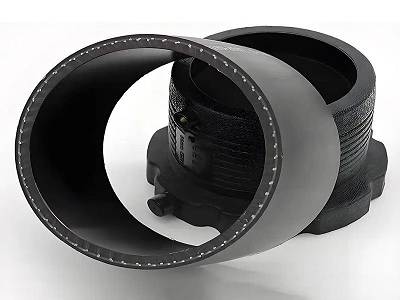
Inside an SRTP pipe, the steel wire does not run randomly through the wall.
It follows a helical path around the pipe, and the angle of that path is part of the pipe's structural design.
This detail is easy to overlook because it cannot be seen from the finished pipe surface. However, changing the winding angle changes the direction in which the steel reinforcement works. For a pressure pipe, that directly relates to how the reinforcement responds when internal water pressure acts on the pipe wall.
This is why the winding angle cannot simply be selected according to production convenience.
SRTP Pipe Parameters
|
Parameter |
Typical Specification |
|
Product |
Steel Wire Reinforced PE Pipe |
|
Nominal Diameter |
DN50–DN600 |
|
Pressure Rating |
PN1.0–PN2.5 MPa |
|
Standard Length |
9 m / 12 m |
|
Reinforcement |
High-strength steel wire |
|
Structure |
PE inner layer + steel wire reinforcement + PE outer layer |
|
Main Applications |
Mine drainage, mine water supply, pressurized water |
The actual reinforcement configuration depends on pipe diameter, pressure rating and structural design.
The Wire Does Not Work in Only One Direction
A steel wire has its highest tensile capacity along its own length.
Once that wire is wound around a pipe, however, its direction is no longer purely axial or purely circumferential.
The wire forms a helix.
Part of its direction follows the circumference of the pipe, while another part follows the length of the pipe. The winding angle determines the relationship between these two components.
That is the basic reason the angle matters.
Internal pressure tends to expand the pipe wall. The steel reinforcement needs to be arranged so that it can effectively participate in resisting the resulting loads.
Changing the angle changes the direction of the steel reinforcement, even though the steel itself has not changed.
A Small Change in Angle Changes the Reinforcement Direction
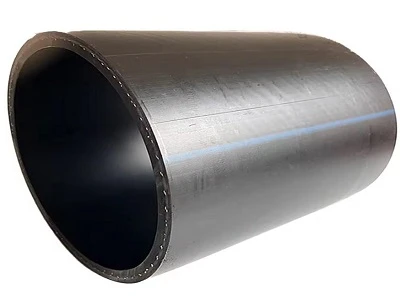
Imagine looking at a single piece of steel wire laid around a pipe.
If the wire is positioned mostly around the circumference, more of its tensile direction contributes to circumferential reinforcement.
If the wire becomes more inclined toward the pipe axis, its longitudinal component becomes more significant.
Neither arrangement is automatically better.
The appropriate geometry depends on what the complete pipe structure is required to do.
This is why the winding angle has to be considered together with pipe diameter, pressure rating, steel wire arrangement and PE wall structure.
Using the same angle for every pipe specification would ignore the changes in pipe geometry and loading.
Why Circumferential Reinforcement Matters
For an internally pressurized pipe, circumferential loading is one of the main structural concerns.
Water pressure pushes outward against the pipe wall.
The PE tends to expand, while the steel reinforcement helps restrict that expansion.
A suitable helical arrangement gives the steel a significant circumferential component, allowing it to participate in resisting this pressure-related deformation.
This is one of the reasons steel-wire reinforced PE pipe can achieve higher pressure ratings than a comparable non-reinforced PE structure.
The steel is not simply added to make the wall heavier. Its orientation is part of how the reinforcement works.
The Longitudinal Direction Cannot Be Ignored
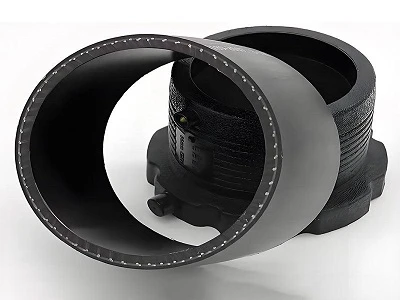
A pressure pipeline also experiences forces along its length.
Pipe ends, fittings, changes in direction and pressure conditions can all introduce longitudinal effects into the system.
The steel wire therefore cannot be considered only as circumferential reinforcement.
The helical structure provides a longitudinal component as well.
This does not mean that the reinforcement carries every load in the pipeline. The complete design still depends on pipe joints, supports, installation conditions and the surrounding structure.
But the orientation of the steel reinforcement gives the composite pipe wall a more balanced structural arrangement than a wire placed in only one direction.
Why Pipe Diameter Matters
The same winding angle does not necessarily produce the same reinforcement arrangement on pipes with different diameters.
Consider DN100 and DN600.
The circumference of the DN600 pipe is much larger. The steel wire therefore travels through a different geometric path around the pipe, and the reinforcement has to cover a much larger wall structure.
As the diameter changes, the relationship between wire spacing, winding geometry and reinforcement density also changes.
This is why SRTP design cannot be separated from DN.
A winding angle is meaningful only when considered as part of a specific pipe structure.
Pressure Rating Also Changes the Requirement
PN is another important factor.
A PN1.0 MPa pipe and a PN2.5 MPa pipe are not expected to operate under the same internal pressure.
Higher pressure produces greater loading on the pipe wall, so the reinforcement arrangement has to be designed accordingly.
This may involve changes in the reinforcement configuration rather than simply changing one isolated production parameter.
For buyers, this is why specifying only "steel wire reinforced PE pipe" is not enough when requesting a quotation.
The supplier needs the required diameter and pressure class to determine the appropriate structure.
The Winding Angle Works Together With Wire Spacing
The angle cannot be evaluated independently from wire spacing.
Two reinforcement layers could use the same wire diameter but distribute the wire differently because of changes in winding arrangement.
Spacing determines how much steel is present within a particular section of the wall, while the winding angle determines the direction in which that steel is oriented.
These two factors therefore influence the final reinforcement structure together.
This is also why simply increasing the amount of steel is not an automatic solution to every pressure requirement.
The steel needs to be placed in a useful structural configuration.
What Happens If the Winding Angle Is Not Stable?
During continuous production, the wire follows the designed path while the pipe moves forward.
If the winding geometry changes during this process, the reinforcement structure can become inconsistent along the pipe.
The issue is not that a tiny difference in one section will immediately cause failure.
The concern is that persistent variation can change the distribution and orientation of the steel over a longer section of pipe.
For a pressure-rated product, maintaining a stable reinforcement configuration is therefore important.
This is also why winding equipment, wire movement and forming conditions need to work together rather than treating the winding angle as a number entered into a machine and forgotten.
Winding Angle and Mine Drainage
The relevance becomes clearer in mining applications.
A mine drainage pipeline may need to transport water over long distances and operate under continuous pressure. The pipeline can also be connected to pumping systems where the operating condition changes during start-up and shutdown.
For these systems, the steel reinforcement needs to provide predictable structural support inside the PE wall.
The winding angle is one part of that structure.
It does not determine the entire performance of the pipe by itself, but it affects how the reinforcement participates in the pressure-bearing wall.
Conclusion
The winding angle of steel wire in an SRTP pipe is not simply a production setting.
It determines the orientation of the steel reinforcement and therefore affects how the reinforcement participates in the circumferential and longitudinal directions.
Its selection is related to DN, PN, wire spacing and the overall composite wall design.
For mine drainage and pressurized mine water systems, this matters because the pipe may remain under internal pressure for long periods. The reinforcement needs to be arranged according to the actual structural requirements rather than treated as an additional material placed inside the PE wall.
FAQ
Is a larger winding angle always better?
No. The appropriate angle depends on the pipe design and the required distribution of reinforcement in different directions.
Does the winding angle affect pressure resistance?
Yes. It changes the orientation of the steel reinforcement and therefore affects how the steel contributes to the pressure-bearing structure.
Is the same winding angle used for all DN sizes?
Not necessarily. Pipe diameter changes the geometry of the reinforcement layer, so the winding configuration needs to match the specific pipe design.
Does wire spacing affect winding angle selection?
Yes. Winding angle and wire spacing work together to determine how the steel is distributed through the pipe wall.
Primary Keyword
SRTP steel wire winding angle
Secondary Keywords
SRTP pipe reinforcement, steel wire reinforced PE pipe, SRTP pressure pipe, steel wire winding, mining dewatering pipe
Request an SRTP Pipe Quotation
|
Step |
Process |
Details |
|
1 |
Send Requirements |
DN, pressure, medium, working temperature and application |
|
2 |
Specification Confirmation |
Pipe structure, pressure rating, specification and connection |
|
3 |
Quotation |
Price, lead time, packing and shipping terms |
|
4 |
Order & Production |
Contract, payment and production |
|
5 |
Inspection & Delivery |
Quality inspection and shipment |
For Steel Wire Mesh Reinforced PE Pipe (SRTP), steel wire reinforced PE pipe and mining pressure pipelines, send us:
DN + PN + Medium + Working Temperature + Installation Method + Pipeline Length + Quantity
For slurry applications:
Slurry Type + Solid Concentration + Particle Size
Luoyang Zhengju New Materials Technology Co., Ltd.
WhatsApp:+86 19937270645
Email: baibaili456@gmail.com
Wechat: +86 19937270645
Get Best Price for Your Mining Pressure Pipeline.