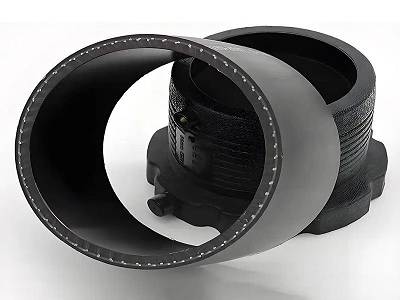
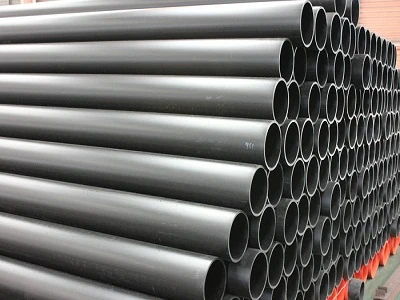
Introduction
For a UHMWPE pipe, making the polymer into a tube is only the first part of the manufacturing problem.
The harder part is keeping that tube consistent along its entire length.
A pipe can have the correct nominal diameter while still having variations in wall thickness, density, internal structure or residual stress. These variations are closely related to what happens before the material reaches the forming die.
UHMWPE makes the problem more complicated because its extremely high molecular weight gives it very high melt viscosity and very poor melt flowability. This is one reason UHMWPE is commonly processed by compression molding or ram extrusion rather than treated like conventional polyethylene in a standard extrusion process.
For ram extrusion, the powder is compacted in successive increments and pushed through a heated die. The production result depends not only on the material itself, but also on how consistently the powder is fed, compacted, heated and moved through the forming system.
That is where wall uniformity starts.
The Pipe Wall Is Built Before It Reaches the Die
It is easy to assume that the forming die determines the final wall thickness.
The die certainly determines the profile, but the material entering the die has already gone through several important stages.
UHMWPE powder enters the machine and is progressively compacted by a reciprocating ram. Each ram movement compresses a portion of powder and pushes the consolidated material toward the heated forming zone. Braskem describes this as successive powder packing and movement through a heated die, with the internal die section determining the final profile.
This creates a very different production situation from ordinary screw extrusion.
A conventional PE extruder continuously conveys a flowing polymer melt. In UHMWPE ram extrusion, the material is moved primarily by positive displacement and compression.
If the powder charge is inconsistent, the forming conditions can also become inconsistent.
The pipe therefore cannot be controlled properly by looking only at the die opening.
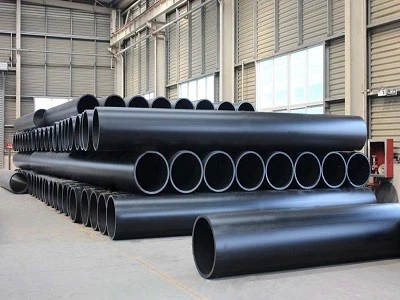
Powder Packing Has a Direct Effect on the Forming Process
Before UHMWPE powder becomes a continuous polymer structure, the powder particles have to be brought into close contact.
The degree and uniformity of compaction influence how the material behaves during subsequent heating and consolidation.
An uneven powder charge can create local differences in density. When the material enters the heated section, these differences can affect how quickly different regions consolidate.
This is particularly relevant for thick-wall products.
A thick UHMWPE pipe does not heat through its entire wall instantly. Heat has to move from the heated surfaces toward the material inside the wall. UHMWPE also has relatively poor thermal conductivity, so the temperature distribution through the section needs to be controlled carefully during processing. Research on UHMWPE processing shows that the material's thermal behavior and limited melt mobility make processing conditions an important part of forming quality.
The production target is therefore not simply "heat the powder."
It is to achieve sufficient thermal conditions throughout the forming section while maintaining pressure and dimensional control.
Temperature Has to Be High Enough - But Not Randomly High
UHMWPE does not respond to temperature in the same way as a low-viscosity polymer.
Its melting point is around 155°C, but complete fusion of powder particles requires higher processing temperatures, and the material still has extremely poor flowability even above its melting point.
This creates an important processing window.
If the thermal condition is insufficient, powder particles may not consolidate adequately.
If the material is exposed to excessive thermal conditions or remains at elevated temperature for too long, thermal degradation becomes a concern. The processing literature also notes that UHMWPE has poor thermal conductivity, which can cause local heat accumulation inside the material.
For pipe production, the issue is therefore not simply the temperature shown on a heating controller.
The material itself has to reach the required thermal condition across the forming section.
That is one reason the heated die is an important part of the process.
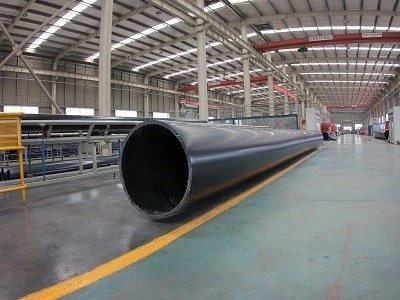
The Heated Die Controls Residence Time
The forming die does more than give the pipe its final shape.
Its heated length determines how long the compacted material remains under controlled thermal conditions before leaving the forming zone.
Braskem specifically identifies heated die zone length, ram step and ram movement regularity as factors affecting production rate.
Consider what happens if the ram movement changes.
A faster movement changes the amount of material passing through the heated section per unit time. The thermal history of the material changes with it.
A slower movement does the opposite.
This means production speed cannot be separated from thermal control. Increasing output without considering the heating capacity and die length can disturb the conditions required for consistent consolidation.
For this reason, UHMWPE pipe production is a coordinated process rather than a simple "powder in, pipe out" operation.
Ram Movement Can Create Process Pulsation
There is another characteristic that is easy to overlook.
A ram extrusion system uses reciprocating movement rather than continuous screw rotation.
The ram advances, compacts the powder and pushes the material forward. It then returns for the next charging and compaction cycle.
This means the process contains an inherent cyclic movement.
Research on UHMWPE ram extrusion notes that intermittent feeding and compaction make the process technically quasi-continuous, and that the cyclic stamping action can contribute to residual stresses in the extruded product. Multiple-plunger systems have been developed to reduce pulsation and make the process closer to continuous operation.
For pipe production, maintaining stable ram movement is therefore important.
If the movement is irregular, the pressure and material delivery conditions can also fluctuate.
The objective is not simply to generate enough force. The force needs to be applied repeatedly and consistently.
Die Geometry Determines the Final Pipe Profile
Once the material has been sufficiently consolidated and heated, it passes through the forming die.
The internal section of the die establishes the tubular geometry. In pipe production, this includes the relationship between outside diameter, inside diameter and wall thickness.
A change in the forming geometry changes the material distribution around the pipe.
For this reason, die design has to be considered together with the material entering it. A theoretically correct die cannot compensate for unstable powder feeding or inconsistent compaction upstream.
The die also has to withstand substantial mechanical loads. The ram must overcome the resistance created by the highly viscous UHMWPE material and the friction associated with the forming process. Braskem identifies hydraulic power and the mechanical strength of the extruder components among the factors affecting productivity and product quality.
Cooling Can Change the Final Dimensions
The pipe does not stop changing as soon as it leaves the heated die.
Cooling causes the polymer structure to contract and stabilize.
For a tubular section, the outer surface and inner surface may not experience exactly the same thermal history. The cooling rate therefore influences dimensional stability and residual stress.
This becomes more significant as pipe dimensions and wall thickness increase.
The objective of cooling is not simply to make the pipe cold as quickly as possible. It is to bring the formed profile into a stable dimensional condition without creating unnecessary thermal differences through the wall.
This is also why downstream cooling and shaping equipment is considered part of the UHMWPE ram extrusion system itself.
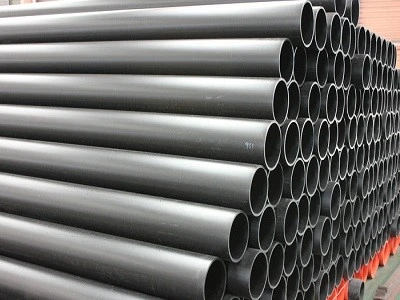
Why Wall Thickness Is Not Controlled by One Number
When buyers specify a UHMWPE pipe, wall thickness is normally given as a dimensional requirement.
During manufacturing, however, maintaining that wall thickness depends on several process conditions working together.
|
Manufacturing factor |
Possible influence on pipe |
|
Powder feeding |
Material consistency along the extrusion direction |
|
Powder compaction |
Density and consolidation |
|
Ram movement |
Pressure and output stability |
|
Heating conditions |
Powder fusion and consolidation |
|
Heated die length |
Thermal exposure during forming |
|
Die geometry |
Pipe dimensions and wall profile |
|
Material residence time |
Thermal history |
|
Cooling |
Final dimensional stability |
|
Process stability |
Consistency between different sections |
This is why wall thickness should not be viewed as something that is "created by the die" alone.
The die defines the geometry, but the stability of the entire forming process determines how consistently that geometry is reproduced.
What Happens If the Process Is Unstable?
Process instability does not necessarily produce an obvious defect immediately.
A pipe may still look smooth from the outside.
However, inconsistent processing can affect dimensional uniformity, internal consolidation and residual stress. Research on ram extrusion specifically identifies residual stress as one consequence of the intermittent compression process, with annealing used in some extrusion products to reduce these stresses.
This is particularly important for UHMWPE pipe because the material is selected for demanding service such as abrasive slurry transport.
The pipe wall has to maintain its structural integrity while the inner surface is exposed to continuous particle impact and sliding wear.
Manufacturing consistency is therefore connected to service performance. The excellent wear resistance of UHMWPE cannot compensate for poor forming quality.
How Manufacturers Monitor the Process
A stable production line needs control points throughout the forming process rather than only a final dimensional inspection.
The raw powder needs consistent feeding. The compaction stage needs stable ram movement. The heating system needs sufficient capacity and stable thermal conditions. The forming die needs to maintain its geometry under mechanical load. Cooling needs to stabilize the finished profile.
The final pipe can then be checked for dimensional requirements and other specified quality characteristics.
This approach is more useful than relying on a single final measurement.
If a pipe is found to have a dimensional deviation, understanding the complete forming sequence makes it possible to investigate whether the problem originated in powder feeding, compaction, heating, die conditions or cooling.
Conclusion
UHMWPE pipe manufacturing is not simply a matter of heating polymer powder and forcing it through a mold.
The difficult part is maintaining a stable forming environment while a material with extremely high molecular weight and very poor melt flowability is being compacted, heated, consolidated and shaped.
In ram extrusion, powder packing, ram movement, heated die length, thermal conditions, die geometry and cooling all contribute to the final pipe structure.
That is why controlling UHMWPE pipe wall quality starts well before the material reaches the final forming die.
For a mining pipe manufacturer, the real manufacturing challenge is not only producing a UHMWPE pipe with the right dimensions. It is producing those dimensions consistently from one section of pipe to the next while preserving the consolidated polymer structure that gives UHMWPE its abrasion resistance and toughness.
Primary Keyword :UHMWPE Pipe Manufacturing Process
Secondary Keywords :UHMWPE pipe production, UHMWPE ram extrusion, UHMWPE pipe forming, UHMWPE wall thickness control, UHMWPE powder compaction, UHMWPE pipe extrusion, UHMWPE pipe quality control
Request a UHMWPE Pipe Quotation
|
Step |
Process |
|
1 |
Send Requirements - DN, pressure, quantity and application |
|
2 |
Specification Confirmation - Pipe type, size, wall thickness and connection |
|
3 |
Quotation - Price, lead time, packing and shipping terms |
|
4 |
Order & Production - Contract, payment and production |
|
5 |
Inspection & Delivery - Quality inspection and shipment |
For UHMWPE mining pipe, UHMWPE lined steel pipe, UHMWPE elbows and link flanges, send us:
DN + PN + Slurry Type + Solid Concentration + Particle Size + Flow Rate + Pipeline Length + Quantity
Luoyang Zhengju New Materials Technology Co., Ltd.
WhatsApp:+86 19937270645
Email: baibaili456@gmail.com
Wechat: +86 19937270645
Get Best Price for Your Grinding Slurry Pipeline.