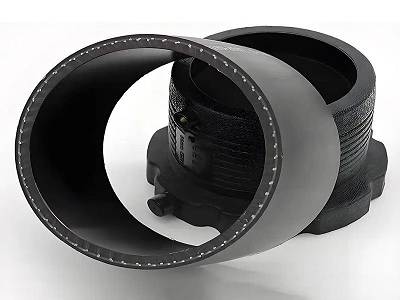
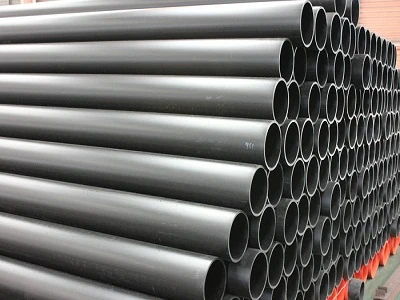
Introduction
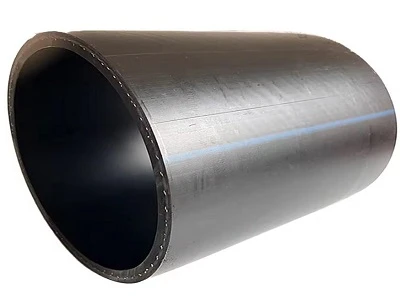
An SRTP pipe coming out of the forming section is not yet dimensionally finished.
The PE has already taken the shape of a pipe, and the steel-wire reinforcement is inside the composite wall, but the material is still carrying a considerable amount of processing heat. The polymer can continue to contract and change shape as that heat is removed.
This is where cooling and sizing become important.
The purpose is not simply to lower the temperature. The pipe has to move from a hot, deformable state toward a stable finished geometry while maintaining its outside diameter, roundness and wall structure.
There is another consideration that does not exist to the same extent in an ordinary single-material PE pipe.
SRTP contains steel wire inside the PE wall. Steel and PE respond differently to temperature changes. The cooling process therefore has to stabilize a composite structure rather than a uniform polymer wall.
SRTP Pipe Parameters
|
Parameter |
Typical Specification |
|
Product |
Steel Wire Reinforced PE Pipe |
|
Nominal Diameter |
DN50–DN600 |
|
Pressure Rating |
PN1.0–PN2.5 MPa |
|
Standard Length |
9 m / 12 m |
|
Pipe Structure |
PE inner layer + steel wire reinforcement + PE outer layer |
|
Reinforcement |
High-strength steel wire |
|
Main Applications |
Mine drainage, mine water supply, pressurized water |
Actual cooling and sizing conditions depend on the pipe diameter, wall construction, material and production line configuration.
The Pipe Is Still Changing After Forming
During extrusion and composite forming, PE has to be heated enough to flow.
Once the pipe leaves the forming section, heat begins to leave the material.
The polymer gradually becomes less deformable as its temperature falls. At the same time, its dimensions change.
This is normal behavior.
The diameter measured immediately after forming is not necessarily the final diameter of the pipe. The same applies to the shape of the cross-section.
That is why the section between forming and final inspection matters. The pipe has to pass through this transition without developing excessive dimensional variation.
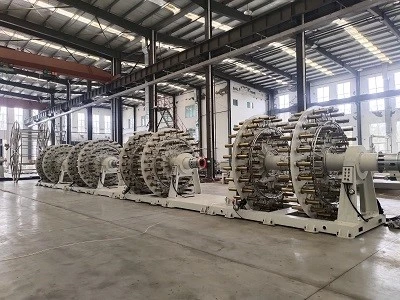
PE Contraction Is Part of the Process
As PE cools, it contracts.
The amount of dimensional change is affected by the material, processing history and temperature change. The wall does not instantly reach its final dimensions the moment it enters the cooling section.
During this period, the pipe is still moving through the production line.
The cooling process therefore has to keep the pipe under sufficient dimensional control while the polymer is becoming stable.
If the pipe were allowed to cool without controlling its geometry, the final cross-section could differ from the intended dimensions.
This is the reason sizing is used together with cooling.
SRTP Has a Composite Wall
The steel wire changes the situation because the wall is not made entirely of PE.
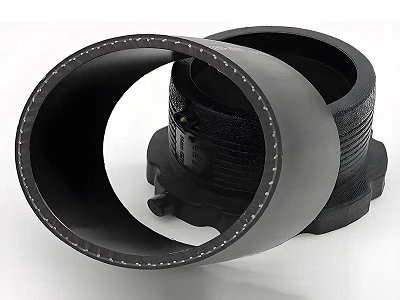
The reinforcement is already positioned inside the pipe when cooling begins. As the surrounding polymer loses heat, the PE undergoes its normal thermal contraction while the steel has different thermal characteristics.
The two materials are physically incorporated into the same wall.
They cannot simply behave as if they were separate pieces.
The final geometry is the result of the entire composite structure reaching a stable condition.
This is one reason cooling conditions have to be considered together with the pipe's actual construction rather than treated as a generic step that is identical for every SRTP specification.
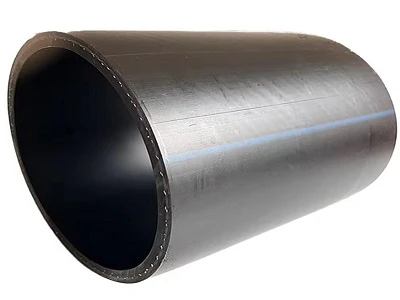
Why Uniform Cooling Around the Pipe Matters
The pipe is circular, so cooling should not create unnecessary differences from one side of the circumference to another.
If one region loses heat substantially faster than another, the material in those regions can pass through the thermal transition at different rates.
That difference can affect contraction and dimensional stability.
The result does not necessarily appear as an obvious defect while the pipe is still hot.
A more meaningful assessment comes after the material has cooled sufficiently and the dimensions can be checked under stable conditions.
For continuous production, maintaining a consistent thermal environment around the pipe is therefore important.
Diameter Makes a Difference
A larger pipe contains more material.
The heat stored inside the wall also has a longer path to travel before reaching the cooling environment.
This does not mean that every large-diameter pipe automatically has a problem. It means the thermal behavior becomes more difficult to treat as a simple surface-cooling operation.
The same consideration applies when wall thickness increases.
A thicker composite wall contains more material that needs to move through the cooling process before the entire structure becomes stable.
Consequently, cooling conditions need to correspond to the pipe specification being produced.
Cooling Too Fast Is Not Automatically Better
Production speed is important, but maximum cooling speed is not the same thing as good cooling.
When a hot composite wall is cooled, the outer regions may lose heat before the inner regions.
If the temperature difference becomes too large, different parts of the wall can contract under different conditions.
That can contribute to dimensional variation and residual stress.
Controlled heat removal gives the material a more stable transition.
The practical objective is to reach the required final dimensions consistently, not simply to reduce the temperature as quickly as possible.
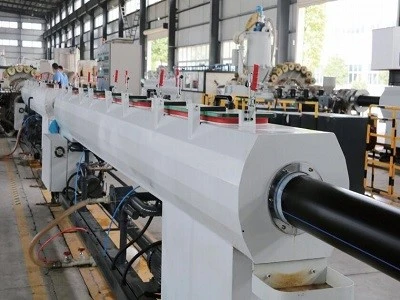
What Sizing Does During This Stage
Cooling and sizing perform different but connected jobs.
Cooling removes heat from the pipe.
Sizing helps maintain the required geometry while the polymer is still capable of changing shape.
The outside diameter is one of the main dimensions being controlled. Roundness is another.
Without dimensional control during this stage, the pipe could gradually move away from the intended circular shape as the material contracts.
This becomes particularly important in continuous production because the pipe does not stop between forming, cooling and sizing.
Roundness Is More Than an Appearance Issue
A circular pipe is expected to maintain a reasonably consistent cross-section.
If the pipe becomes oval, the wall geometry is no longer distributed around the circumference in the same way as the intended design.
For pressure-bearing composite pipe, maintaining the designed geometry is therefore preferable to allowing the cross-section to change freely during cooling.
Roundness also matters during subsequent pipe handling and connection.
A dimensionally stable pipe is easier to process into standard lengths and connect to the corresponding joining system.
Wall Thickness Also Stabilizes During Cooling
Wall thickness is established during forming, but it is also affected by the dimensional changes that occur while the PE cools.
The situation becomes more complicated in SRTP because the steel reinforcement occupies part of the composite wall.
The final relationship between the inner PE layer, reinforcement and outer PE layer depends on how the entire structure stabilizes.
This is another reason final wall measurements should be made after the pipe has reached a sufficiently stable condition.
Measuring a pipe while it is still undergoing significant thermal contraction gives only a temporary picture of its dimensions.
What About Residual Stress?
PE experiences mechanical and thermal history during processing.
The material flows through the extrusion system, changes direction and takes the required pipe shape. Its molecular structure does not necessarily return to an entirely relaxed state before the pipe begins cooling.
As the material cools and contracts, some internal stress can remain.
Residual stress is therefore related to both forming and cooling.
Uneven cooling can make the situation more complicated because different parts of the wall may experience different thermal histories.
Controlled cooling does not erase the entire processing history, but it helps avoid unnecessary temperature differences during the transition to the final state.
The Reinforcement Must Remain Stable
The steel wire has already been incorporated into the pipe wall before cooling starts.
Its position should remain consistent while the PE around it changes from a hot processed material into a stable solid.
If the composite structure moves during this stage, the final relationship between the reinforcement and the PE layers can change.
The cooling process therefore has a structural dimension as well as a thermal one.
The goal is to stabilize what was formed rather than allow the wall structure to continue changing significantly after it has left the forming section.
Cooling Cannot Repair a Poorly Formed Pipe
There is a practical limit to what cooling and sizing can accomplish.
If the reinforcement has already been positioned incorrectly, cooling will not redesign the reinforcement structure.
If the wall has already been formed unevenly, cooling cannot guarantee that the original problem will disappear.
The cooling stage is better understood as a stabilization stage.
The preceding processes establish the composite wall. Cooling and sizing then help bring that structure to its final dimensions.
This distinction is useful when analyzing production problems. A dimensional issue found after cooling may originate from cooling itself, but it may also be a consequence of an earlier forming condition.
Why Dimensional Inspection Comes After Cooling
The purpose of final dimensional inspection is to determine whether the finished pipe meets the required geometry.
Typical measurements can include outside diameter, wall thickness, length and roundness, depending on the applicable product specification.
These measurements become meaningful after the pipe has passed through the major thermal stabilization stage.
A hot pipe is still changing.
A cooled pipe can be measured as a finished product.
This is also why production control should not rely on only one measurement point. Monitoring during production can identify changes as they occur, while final inspection confirms the condition of the finished pipe.
Why This Matters for Mine Drainage Pipe
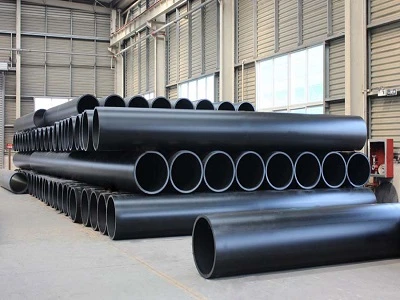
SRTP is used for pressurized mine water and drainage systems where consistent pipe dimensions are important during installation.
Long pipeline sections may contain many individual pipe lengths and joints. If dimensions vary significantly from one section to another, installation becomes less predictable.
A stable cooling and sizing process helps keep the finished pipe within its specified dimensional range.
For the buyer, this is not simply a question of how the pipe looks after production.
Dimensional consistency affects handling, joining and the ability to assemble a long pressure pipeline with predictable geometry.
Conclusion
Cooling and sizing are the stages where the newly formed SRTP structure moves toward its final physical dimensions.
PE contracts as it loses heat, while the embedded steel reinforcement responds differently to temperature. Because the two materials form one composite wall, cooling has to be controlled with the complete structure in mind.
The outside diameter, roundness and wall dimensions continue to stabilize during this period. Sizing helps control the geometry while the PE is still capable of changing shape, and controlled cooling helps limit unnecessary differences in thermal behavior around and through the wall.
For larger-diameter or thicker-wall SRTP pipes, these considerations become more significant because more material has to release heat before the structure becomes stable.
The pipe is therefore not finished simply because the PE has been formed into a tube.
The final product depends on what happens afterward: how the heat is removed, how the geometry is maintained, and whether the cooled pipe reaches the dimensions required for the next stage of inspection and use.
FAQ
Why does SRTP need cooling after forming?
The PE is still hot and dimensionally unstable after forming. Cooling allows the composite wall to move toward its final stable condition.
What is the purpose of sizing?
Sizing helps maintain the required outside diameter and roundness while the PE is cooling and remains capable of deformation.
Does steel wire affect SRTP cooling?
Yes. Steel and PE have different thermal behavior, and both materials are incorporated into the same composite wall.
Does faster cooling always produce better SRTP pipe?
No. Excessively rapid or uneven cooling can create larger temperature differences within the wall and may contribute to dimensional variation or residual stress.
Why is roundness checked after cooling?
Because the pipe can change shape while the PE is cooling. The final roundness is more meaningful after the pipe has reached a stable condition.
Can cooling correct an incorrect reinforcement position?
No. Cooling stabilizes the structure produced by the previous forming stages. It cannot replace an incorrectly positioned reinforcement layer.
Primary Keyword
SRTP pipe cooling process
Secondary Keywords
SRTP cooling and sizing, SRTP pipe production, SRTP dimensional stability, steel wire reinforced PE pipe, SRTP cooling stage, mine drainage pipe
Request an SRTP Pipe Quotation
|
Step |
Process |
Details |
|
1 |
Send Requirements |
DN, pressure, medium, working temperature and application |
|
2 |
Specification Confirmation |
Pipe structure, pressure rating, specification and connection |
|
3 |
Quotation |
Price, lead time, packing and shipping terms |
|
4 |
Order & Production |
Contract, payment and production |
|
5 |
Inspection & Delivery |
Quality inspection and shipment |
For Steel Wire Mesh Reinforced PE Pipe (SRTP), steel wire reinforced PE pipe and mining pressure pipelines, send us:
DN + PN + Medium + Working Temperature + Installation Method + Pipeline Length + Quantity
For slurry applications:
Slurry Type + Solid Concentration + Particle Size
Luoyang Zhengju New Materials Technology Co., Ltd.
WhatsApp:+86 19937270645
Email: baibaili456@gmail.com
Wechat: +86 19937270645
Get Best Price for Your Mining Pressure Pipeline.