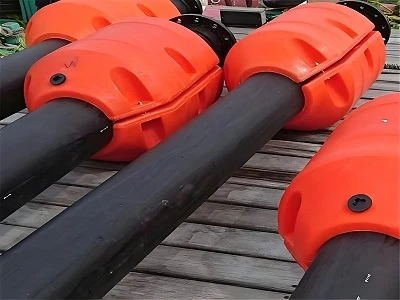
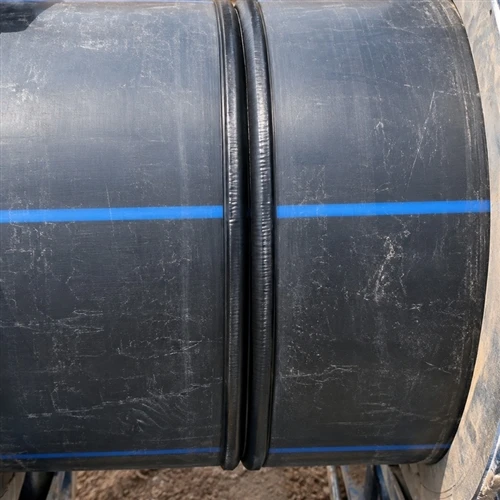
1. Product Overview & Core Advantages
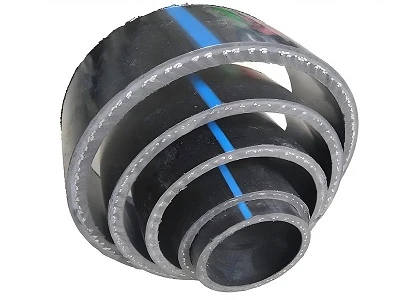
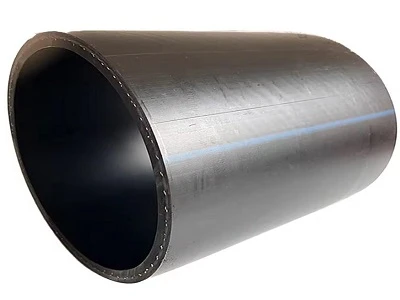
The SRTP-POE composite pipe is a high-performance thermoplastic composite pipe, consisting of three core layers: a modified POE (Polyolefin Elastomer) wear-resistant inner layer, a high-strength steel wire mesh winding reinforcement middle layer, and a high-density polyethylene (HDPE) outer protective layer. Manufactured by one-step co-extrusion molding technology, the pipe achieves molecular fusion between layers without delamination, combining the high pressure resistance of steel pipes and the excellent anti-corrosion and wear-resistant properties of plastic pipes.

1.1 Pipe Structure
Inner Layer (POE): Made of modified polyolefin elastomer, featuring super wear resistance, strong chemical corrosion resistance, and high toughness. It directly contacts and transports abrasive and corrosive media such as ore slurry and tailings.
Middle Layer (Steel Wire Mesh Frame): Adopts high-strength galvanized or stainless steel wires with bidirectional winding and integral welding forming. It provides excellent structural rigidity and high-pressure bearing capacity, serving as the core pressure-bearing layer of the pipe.
Outer Layer (HDPE): High-density polyethylene outer protection, with outstanding anti-aging, UV resistance, and external impact resistance, effectively isolating the steel wire frame from external humid and corrosive environments.
1.2 Key Performance Characteristics
Excellent Abrasion Performance
The specially modified POE lining achieves 3 to 4 times the wear resistance of conventional UHMWPE products and maintains a low wear rate when exposed to slurry. It is engineered for long-term service amid persistent scouring from iron, copper, gold and other hard ores.
Comprehensive Corrosion Resistance
The inner POE material provides robust defense against acid, alkali, salt spray and electrochemical erosion. It cuts down extra anti-corrosion treatments and daily maintenance, addressing the long-standing corrosion problem of steel pipes.
Excellent Pressure Resistance
Reinforced with steel wire structure, the pipe covers a working pressure range of 0.6MPa to 10.0MPa, fully compliant with operational standards for deep mine backfilling and long-distance high-concentration slurry conveyance.
High Toughness & Low-temperature Durability
Featuring an elongation at break of over 1000%, the pipe retains good flexibility without brittle cracking at -50℃. It can withstand foundation displacement, rock impact and extreme low-temperature working conditions in mines.
Low Fluid Resistance & Energy Saving: The inner wall is smooth with a roughness of only 0.0015–0.015mm, 40 times lower than that of steel pipes. It effectively reduces medium transportation resistance, cutting pipeline transportation energy consumption by 20%-30%.
Lightweight & Easy Installation: The pipe weight is only 1/5 of that of steel pipes of the same specification. It supports hot melt welding, electric fusion welding, and flange connection, requiring no heavy construction equipment and improving construction efficiency by more than 50%.

2. Common Specifications & Technical Parameters for Mining & Metallurgy
2.1 Basic Parameter Range
Nominal Diameter: DN50 – DN800mm, covering small-diameter coal injection pipelines and large-diameter tailings and filling main pipelines
Nominal Pressure: PN6 – PN100 (0.6MPa – 10.0MPa), applicable to full working conditions from low-pressure tailings discharge to high-pressure deep well filling
Executive Standards: CJ/T189-2007, HG/T3690-2022
Core Materials: Modified POE inner lining, high-strength steel wire frame, HDPE outer layer
2.2 Typical Specification List for Mining Projects
|
Nominal Diameter (DN/mm) |
Wall Thickness (mm) |
Nominal Pressure (MPa) |
Typical Application Scenarios |
|
110 |
8.5 |
1.6 – 4.0 |
Underground mine filling, coal injection pipelines |
|
160 |
10.0 |
2.5 – 6.3 |
Tailings transportation, ore slurry main pipelines |
|
200 |
12.0 |
4.0 – 8.0 |
Long-distance mine filling, high-concentration ore slurry delivery |
|
315 |
15.0 |
6.3 – 10.0 |
High-pressure deep well filling, main long-distance transportation trunk lines |
3. 5 Frequently Asked Questions (FAQ) for Mining & Metallurgy Applications
Q1: What is the service life advantage of POE-lined steel wire mesh pipes compared with traditional steel pipes?
A1: In acidic and alkaline ore slurry environments, ordinary steel pipes are prone to corrosion and perforation within 1-2 years, and severe wear can cause failure in only 6-12 months. In contrast, SRTP-POE pipes feature excellent wear and corrosion resistance. Their stable service life can reach 15-20 years, 5-10 times that of steel pipes. No regular anti-corrosion maintenance is required, greatly reducing pipeline replacement frequency and production downtime losses.
Q2: Will high-concentration and large-particle ore slurry wear through the POE inner lining?
A2: It will not happen. Our inner layer adopts dual physical and chemical modified POE material, whose wear resistance is 3-4 times higher than that of conventional UHMWPE materials. The ultra-smooth inner wall avoids particle deposition and secondary abrasion. It has been stably applied in high-hardness ore working conditions such as iron ore, gold ore, and copper ore for a long time, with no lining wear-through failure cases.
Q3: Is this pipe suitable for high-pressure mine filling working conditions of 4-8MPa?
A3: Fully applicable. The bidirectional wound and integrally welded steel wire mesh frame provides ultra-high structural stability, with a maximum bearing pressure of 10.0MPa, which far exceeds the conventional working pressure of mine filling. The pipe can resist instantaneous pressure impact of filling pumps without deformation, leakage or pipe burst risks.
Q4: Can SRTP-POE pipes adapt to extreme temperature environments in mines?
A4: Yes. The modified POE lining has excellent extreme temperature resistance, maintaining stable toughness at -50℃ without brittle fracture, and resisting high-temperature deformation below 80℃. It can adapt to northern low-temperature mining areas, high-temperature underground mines, and residual heat medium transportation in metallurgical workshops with stable overall performance.
Q5: Is the installation and later maintenance of POE steel wire mesh pipes complicated?
A5: The installation and maintenance are efficient and simple. The pipe is lightweight and easy for manual handling and construction. Hot melt and electric fusion welding make the pipe interface strength higher than the pipe body, ensuring zero leakage. For later maintenance, only the damaged section needs targeted cutting and replacement, without large-area excavation and construction, which shortens the maintenance time by more than 70% compared with steel pipes.
4. Conclusion
Mining and metallurgy industries put forward strict and comprehensive requirements for pipeline wear resistance, corrosion resistance, pressure resistance, and service life. The steel wire mesh frame POE lined composite pipe perfectly solves the inherent defects of traditional steel pipes (easy corrosion and wear) and ordinary plastic pipes (low pressure resistance).
With the integrated three-layer composite structure, this pipe integrates super wear resistance, strong chemical corrosion resistance, high-pressure bearing, low energy consumption, and convenient installation. Its long-term stable service life effectively reduces the overall operation and maintenance cost of mine pipelines by more than 60%. It is the most cost-effective and reliable pipeline solution for ore slurry transportation, tailings discharge, and underground filling systems in global mining and metallurgy projects.