Introduction
South African platinum mines handle large volumes of material during beneficiation. After valuable minerals have been recovered, the remaining tailings must be transported to designated storage or disposal facilities. Depending on the processing circuit, this material may contain fine mineral particles, residual coarse solids and process water.
Moving tailings sounds straightforward until the pipeline begins to wear unevenly. A section may develop a leak before the planned maintenance shutdown. Another may show little damage after a similar operating period. At a pump station, maintenance crews may find that the pipe near a bend needs attention much earlier than the straight sections.
These differences are important when selecting a pipeline for a platinum operation. The name of the mineral alone does not determine how abrasive the tailings will be. Particle size, mineral hardness, solids concentration, flow velocity and pipeline geometry all influence wear. A pipe that performs well in one section of a processing plant may not have the same service life in another.
UHMWPE pipe is worth considering where abrasion is a major concern. However, the selection process should begin with the actual tailings and operating conditions, rather than a general claim about wear resistance.
Platinum Tailings Are Not the Same as Processed Water
The first question for a pipeline designer is what the line will actually carry.
A mine-water pipeline and a tailings pipeline may have similar nominal diameters, but their internal operating conditions are different. Mine water primarily requires a pipe suitable for the water chemistry, pressure and installation environment. Tailings transport involves solid particles moving continuously through the pipe.
Even within a platinum operation, tailings characteristics can change between processing stages. Fine particles may behave differently from a mixture containing larger, harder fragments. A change in solids concentration can also alter the way particles interact with the pipe wall.
For this reason, purchasing a pipe based only on the label "platinum mine application" is not enough. The engineering team should obtain representative information about the material being transported.
|
Tailings information |
Why it matters for pipe selection |
|
Particle size distribution |
Helps identify whether the slurry contains fine particles, coarse solids or a mixture |
|
Maximum particle size |
Helps assess the possibility of local impact and flow disturbance |
|
Particle hardness and shape |
Influences abrasive wear at the pipe wall |
|
Solids concentration |
Affects slurry behaviour and the amount of solid material passing through the line |
|
Slurry density |
Supports hydraulic calculations and pump selection |
|
pH and chemical composition |
Helps determine material compatibility |
|
Flow velocity |
Influences particle movement, deposition risk and wear |
|
Operating pressure |
Determines the required pressure rating and connection design |
|
Pipeline length and elevation |
Affect hydraulic losses and pumping requirements |
Where UHMWPE Pipe Can Make a Difference
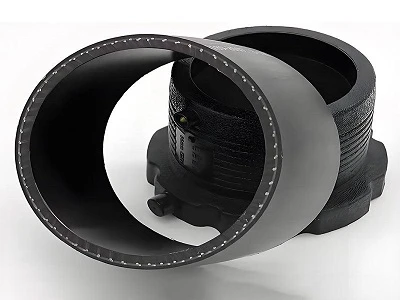
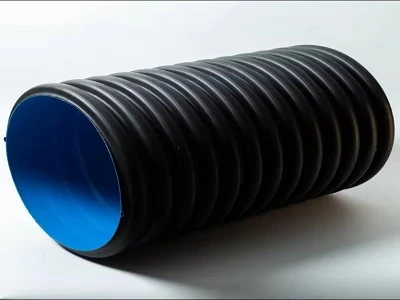
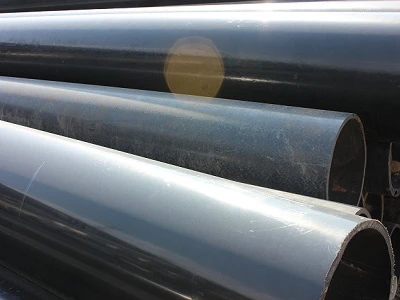
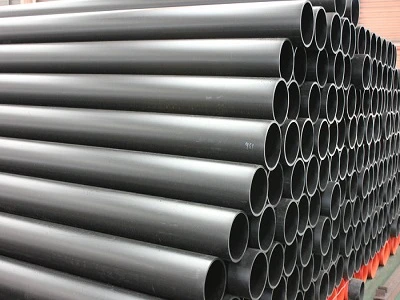
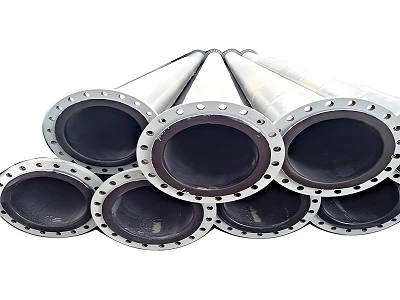
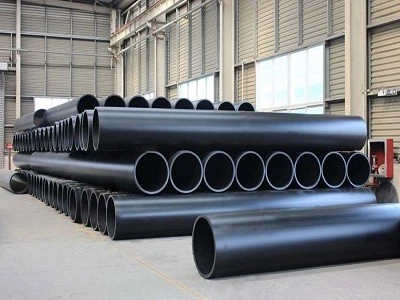
UHMWPE stands for ultra-high molecular weight polyethylene. Its high molecular weight contributes to its toughness and resistance to abrasive wear. The material is commonly considered for pipelines that transport mineral slurry, tailings, concentrates, sand and other abrasive media.
The main advantage is the behaviour of the internal surface under repeated contact with solid particles. In a tailings line, particles slide along the pipe wall and may strike it as flow conditions change. The resulting wear depends on the particles, their movement and the pipeline arrangement, not just the pipe material.
UHMWPE also has a relatively low-friction surface. This can be useful in slurry transport, although the actual pressure loss must still be calculated from the pipe's internal diameter, flow rate, slurry properties and route.
Chemical resistance is another consideration. Mining process water can contain dissolved salts or residual processing chemicals. Compatibility should be checked against the actual liquid composition and operating temperature rather than assumed from the material name alone.
The material's relatively low density can also make transportation and handling easier than with many steel pipe systems. This may be useful at mine sites where access is difficult or pipe sections must be moved across long distances.
None of these properties means that every UHMWPE pipe will automatically outperform every alternative. Pipe construction, wall thickness, pressure rating, joint quality and installation remain important.
Why Wear Often Appears First at Certain Locations
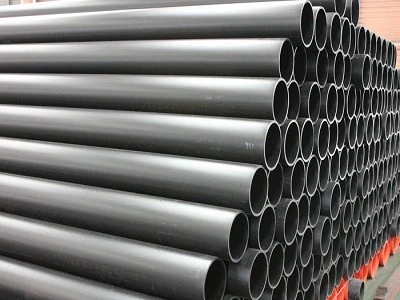
A tailings pipeline rarely wears at a uniform rate from end to end.
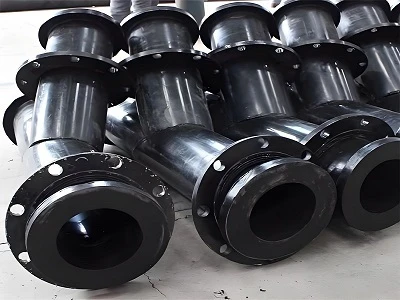
Straight sections can experience continuous abrasion, but changes in flow direction or cross-sectional area can create local differences. Bends, reducers, tees and pump discharge sections therefore deserve particular attention during design and inspection.
Consider a pipeline that carries tailings from a processing plant to a storage facility. The straight sections may remain in acceptable condition while a bend develops visible wear near its outer radius. The reason may be related to particle trajectories and the change in flow direction. Replacing the entire pipeline would not address the underlying issue if the same hydraulic arrangement remained unchanged.
A similar problem can occur at a reducer. If the transition creates an unsuitable internal profile, local turbulence and particle interaction may increase. The result depends on the specific geometry and slurry conditions, so the location should be examined rather than automatically blamed on the pipe material.
For a South African platinum project, it is sensible to identify these locations before installation. The maintenance team can then establish inspection points around bends, pump outlets, reducers and other components that are important to system reliability.
This does not require assuming that every bend will fail early. It means using the pipeline layout to decide where inspections are most valuable.
Selecting the Correct Diameter, Wall Thickness and Pressure Rating
A pipe must carry the required flow while remaining suitable for the system's operating pressure. Increasing the diameter does not automatically solve every problem, and choosing a thicker wall without checking the hydraulic design can also lead to unnecessary compromises.
For example, the internal diameter affects the flow area and velocity. At a given flow rate, changing the internal diameter changes the velocity, which in turn influences slurry movement and hydraulic losses. The appropriate diameter must therefore be evaluated together with the slurry characteristics and the pumping system.
Wall thickness and pressure rating must be considered separately from abrasion resistance. A wear-resistant material does not automatically make a pipe suitable for any working pressure. The allowable pressure depends on the actual pipe dimensions, design, operating conditions and connection arrangement.
The manufacturer's published UHMWPE mining pipe specifications provide a starting point for preliminary selection.
Typical UHMWPE Mining Pipe Specifications
|
Parameter |
Published Specification |
|
Pipe Material |
UHMWPE (Ultra-High Molecular Weight Polyethylene) |
|
Nominal Diameter |
DN50–DN800 mm |
|
Wall Thickness |
5–30 mm |
|
Density |
≥ 0.93 g/cm³ |
|
Tensile Strength |
≥ 21 MPa |
|
Elongation at Break |
≥ 350% |
|
Vicat Softening Temperature |
≥ 120°C |
|
Abrasion Test Indicator |
≤ 0.05 g/1.61 km |
|
Working Pressure |
0.6–2.5 MPa |
|
Standard Length |
6 m; customized lengths available |
|
Connection Method |
Flange connection |
Source: UHMWPE Mining Slurry Pipes - Manufacturer's Product Information.
These figures are published product specifications, not a guarantee that every diameter and wall thickness is available across the full pressure range. The supplier should confirm the specific combination required for the project.
The abrasion test indicator should also be interpreted according to its test method and conditions. It should not be converted directly into a predicted number of operating years without supporting field data.
For a platinum tailings pipeline, the engineering team should confirm the design flow rate, maximum operating pressure, possible pressure surges, slurry temperature and required pipe dimensions before finalising the order.
What About Long-Distance Tailings Transport?
Some tailings routes extend over considerable distances and pass through changing terrain. The pipeline may include elevation differences, multiple support arrangements and sections exposed to changing weather conditions.
These factors influence the installation and operation of the line. Elevation changes affect the hydraulic requirements, while the route determines where supports, bends and connections are needed. Pressure changes during pump start-up or shutdown should also be considered in the design.
UHMWPE's relatively low weight can simplify handling, but the installation method still needs to suit the pipe dimensions and site conditions. Above-ground sections require appropriate support. Buried sections need suitable bedding, backfill and protection against external loads. Flanged connections must be aligned correctly and installed according to the manufacturer's instructions.
The same principle applies to maintenance planning. If the route contains several difficult-to-access sections, the operator should consider how inspections and repairs will be carried out before the pipeline enters service.
A good pipe selection is therefore not just a material decision. It is part of a broader system design that includes hydraulics, installation, connections and maintenance access.
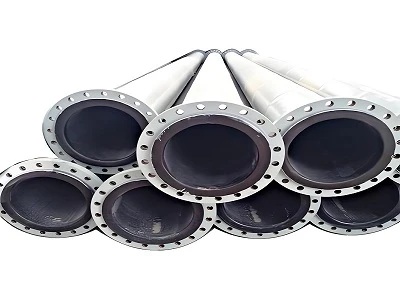
How to Compare UHMWPE With Other Pipeline Materials
Steel, rubber-lined steel and polymer pipes each have applications where they can perform well. The best comparison should use the same operating conditions rather than general statements about which material is always superior.
Steel may be suitable where structural strength and established connection systems are important, but its internal surface can be affected by abrasive wear and corrosion. Rubber-lined steel combines a steel shell with a protective inner lining, so its performance depends on both the lining and the structural design. UHMWPE provides a wear-resistant polymer surface without requiring a steel shell in a solid-wall pipe configuration.
For a platinum tailings line, the purchasing team should compare the complete installed system. Initial material cost is only one part of the decision. Installation labour, joint design, inspection access, expected maintenance requirements and the consequences of unplanned shutdowns also matter.
The supplier should be able to explain which pipe construction is being offered, the applicable pressure rating, the available dimensions and the connection method. Where service-life comparisons are used, the underlying test or field conditions should be stated. A wear-resistance ratio by itself does not establish the service life of a pipeline under a different slurry composition or flow velocity.
Before Ordering Pipe for a Platinum Mine
Before issuing the final specification, the project team should assemble the operating data and review the proposed pipe configuration.
The flow rate and slurry characteristics should be confirmed with the process or hydraulic engineer. The pipeline design should identify the required nominal diameter, wall thickness and working pressure. Bends, reducers, pump connections and support points should be reviewed as part of the same system.
The procurement team should also request the manufacturer's dimensional data and confirmation of the available pressure rating for the selected size. If third-party test reports or inspection documents are required by the project, these should be agreed upon before production rather than requested after shipment.
This preparation helps avoid a common procurement problem: receiving a pipe that matches the nominal diameter but does not meet the complete project specification.
Conclusion
For South African platinum tailings transport, UHMWPE pipe is worth evaluating when abrasive wear is a major maintenance concern. Its suitability depends on the actual tailings, hydraulic conditions, pressure requirements and pipeline layout.
The most useful starting point is not a claim that one material will last a fixed number of years. It is a clear description of the slurry and the operating conditions. With that information, the project team can evaluate pipe diameter, wall thickness, pressure rating and connection design, while paying particular attention to locations where flow changes or maintenance access is difficult.
A properly specified pipeline considers the pipe wall, joints, supports and operating conditions together. That is the basis for reducing avoidable wear problems and planning a more reliable tailings transport system.
FAQ
1. Is UHMWPE pipe suitable for platinum tailings?
It can be suitable where abrasion resistance is important. Final selection depends on particle size, hardness, solids concentration, flow velocity, pressure and the pipe's actual dimensions.
2. What diameter of UHMWPE pipe is available for mining applications?
The manufacturer's published UHMWPE mining pipe range is DN50–DN800 mm. Availability, wall thickness and pressure rating should be confirmed for the required size.
3. What working pressure can UHMWPE mining pipe handle?
The published product information lists a working-pressure range of 0.6–2.5 MPa. This range should not be assumed to apply to every diameter and wall thickness; the manufacturer must confirm the required configuration.
4. Which parts of a tailings pipeline should be inspected carefully?
Bends, reducers, tees, pump discharge sections and connections deserve attention because flow changes, pressure fluctuations or mechanical loads can affect local performance. Inspection priorities should be based on the actual system layout and operating history.
5. What information should a buyer provide when requesting a quotation?
Provide the pipe diameter, required wall thickness if specified, operating and design pressure, flow rate, slurry density, solids concentration, particle size, temperature, pipeline length, route layout and connection requirements. This information allows the supplier to assess the proposed pipe configuration more accurately.
Primary Keyword: UHMWPE pipe for platinum tailings
Secondary Keywords: South Africa platinum mining pipeline, platinum tailings transport pipe, abrasion-resistant mining pipe, UHMWPE tailings pipeline, mining slurry pipe selection, UHMWPE mining pipe specifications, tailings pipeline wear
Request a UHMWPE Pipe Quotation
|
Step |
Process |
|
1 |
Send Requirements - DN, pressure, quantity and application |
|
2 |
Specification Confirmation - Pipe type, size, wall thickness and connection |
|
3 |
Quotation - Price, lead time, packing and shipping terms |
|
4 |
Order & Production - Contract, payment and production |
|
5 |
Inspection & Delivery - Quality inspection and shipment |
For UHMWPE mining pipe, UHMWPE lined steel pipe, UHMWPE elbows and link flanges, send us:
DN + PN + Slurry Type + Solid Concentration + Particle Size + Flow Rate + Pipeline Length + Quantity
Luoyang Zhengju New Materials Technology Co., Ltd.
WhatsApp:+86 19937270645
Email: baibaili456@gmail.com
Wechat: +86 19937270645
Get Best Price for Your Grinding Slurry Pipeline.