Introduction
Mine water pipelines are often treated as simple water transportation lines. In actual mining operations, the pipe may face much more demanding conditions.
Water may need to be pumped from underground workings to the surface, transferred between drainage stations, or transported over long distances through buried pipelines. As the elevation difference increases, the required operating pressure can also rise. At the same time, the surrounding mining environment can expose the pipeline to soil loads, ground movement and corrosion-related conditions.
For these applications, pipe selection cannot be based on diameter alone. Pressure rating, pipe structure, water characteristics, temperature and installation conditions all need to be considered.
Steel Wire Mesh Reinforced PE Pipe, commonly called SRTP, is designed for pressure applications where a reinforced structure and PE-based corrosion resistance are both required.
Why Is High Pressure a Concern in Mine Water Pipelines?
The pressure inside a mine water pipeline depends on more than pump capacity.
Elevation difference is one of the major factors. When water needs to be lifted from a lower underground level to a higher surface location, the pipeline has to withstand the resulting static head as well as the operating pressure generated by the pumping system.
Long pipelines may also experience pressure fluctuations during pump starting, stopping and changes in flow conditions.
This means that a mine water pipe should not be selected simply because its nominal pressure is higher than the normal operating pressure. The actual design condition, pressure fluctuations and operating environment should be reviewed before the specification is finalized.

How Does SRTP Handle Pressure?
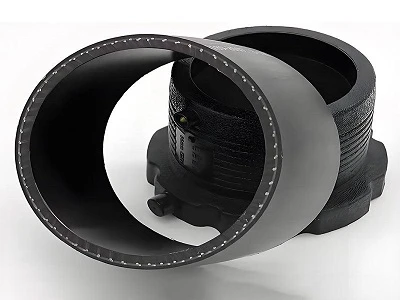
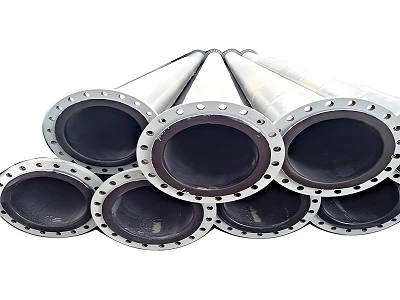
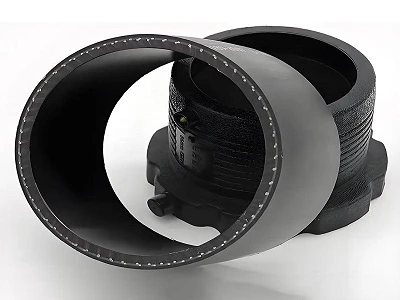
SRTP uses a composite structure consisting of an inner PE layer, a high-strength steel wire mesh reinforcement layer and an outer PE layer.
The steel wire mesh is the key reinforcement component.
Instead of relying entirely on a thick PE wall to resist internal pressure, the reinforcement layer contributes to the pressure-bearing structure of the pipe. This allows SRTP to be developed for pressure applications where additional mechanical strength is required.
The actual pressure rating depends on the pipe diameter, structure and product specification. Therefore, "SRTP" itself should not be treated as a single pressure class.
For example, a buyer may require DN200 pipe at a specific pressure while another project requires DN500 pipe under a different operating condition. The correct specification needs to be selected according to the actual pressure requirement.
PE Provides More Than a Plastic Flow Surface
The pressure-bearing reinforcement is only one part of the pipe.
The PE layers also play an important role in mining environments.
Mine water can contain dissolved salts, minerals and suspended substances. Depending on the geological conditions and mining process, the water may be more corrosive than ordinary industrial water.
The PE inner layer provides a non-metallic contact surface between the transported water and the steel reinforcement.
The outer PE layer also protects the reinforcement from the external environment.
This composite arrangement is particularly relevant when the pipeline needs both pressure reinforcement and resistance to the surrounding mining environment.
Buried Mine Water Pipelines Face Additional Loads
Many mine water pipelines are installed underground or in trenches.
Once the pipeline is buried, internal pressure is no longer the only structural consideration.
The pipe may be subjected to soil pressure, backfill loads and external loads from vehicles or mining equipment. Ground settlement can also change the loading condition after installation.
This is why buried pipe selection should not be based only on the pressure printed on the product specification.
Trench preparation, bedding, backfilling and compaction also influence the actual service condition of the pipeline.
A reinforced pipe can provide additional structural capability, but proper installation remains essential.
What About Working Temperature?
PE performance is affected by temperature.
For this reason, the working temperature should be confirmed when selecting SRTP for mine water service.
The actual allowable working temperature depends on the PE material, pipe specification and operating conditions. It should not simply be copied from another PE or UHMWPE product.
For mine water applications with unusually high or low operating temperatures, the supplier should be informed before the pipe specification is finalized.
Typical SRTP Parameters for High-Pressure Mine Water
|
Parameter |
Typical Specification |
|
Product |
Steel Wire Mesh Reinforced PE Pipe |
|
Structure |
PE + Steel Wire Mesh + PE |
|
Nominal Diameter |
DN50–DN600 |
|
Pressure Rating |
Up to PN2.5 MPa, depending on specification |
|
Working Temperature |
According to actual PE material and product specification |
|
Medium |
Mine water and compatible media |
|
Installation |
Above ground, trench or buried |
|
Reinforcement |
High-strength steel wire mesh |
|
Standard Length |
According to project requirement |
The pressure rating should always be confirmed against the specific DN and pipe structure.
What Information Should Be Provided to the Manufacturer?
A mine water pipe inquiry should contain more than "DN300 PN2.5."
The supplier should know the actual operating pressure and, where available, the design pressure.
The pipeline length is also important because long-distance systems may have different pressure and installation requirements.
The working temperature should be provided, especially when the pipeline operates under unusual environmental conditions.
Installation method should also be identified. A buried pipeline has different external conditions from an above-ground pipeline.
If the mine water contains significant suspended solids or corrosive substances, this information should also be included.
Where Can SRTP Be Used in Mine Water Systems?
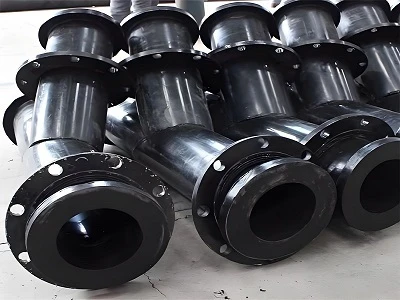
SRTP can be considered for pressure mine water transportation, underground drainage transfer, pumping station connections and surface transfer pipelines.
It can also be evaluated for buried pressure pipelines where the combination of internal pressure and external environmental conditions makes a reinforced structure desirable.
The actual application depends on the required pressure, temperature, medium compatibility and installation conditions.
FAQ
Is SRTP suitable for high-pressure mine water?
It can be used for suitable high-pressure mine water applications. The exact pressure capability depends on the pipe diameter and specification, so the operating and design pressure should be confirmed before ordering.
Does the steel wire contact the mine water?
Under the normal composite pipe structure, the steel wire mesh is located between PE layers rather than directly exposed to the transported medium.
Can SRTP be buried underground?
Yes. SRTP can be used for buried applications, but trench preparation, bedding, backfilling and external loads still need to be considered during installation.
Is SRTP only suitable for water?
No. Depending on material compatibility and operating conditions, SRTP can also be considered for suitable slurry, tailings and other mining media.
Request a SRTP Pipe Quotation
|
Step |
Process |
Details |
|
1 |
Send Requirements |
DN, pressure, medium, working temperature and application |
|
2 |
Specification Confirmation |
Pipe structure, pressure rating, specification and connection |
|
3 |
Quotation |
Price, lead time, packing and shipping terms |
|
4 |
Order & Production |
Contract, payment and production |
|
5 |
Inspection & Delivery |
Quality inspection and shipment |
For Steel Wire Mesh Reinforced PE Pipe (SRTP), steel wire reinforced PE pipe and mining pressure pipelines, send us:
DN + PN + Medium + Working Temperature + Installation Method + Pipeline Length + Quantity
For slurry applications:
Slurry Type + Solid Concentration + Particle Size
Luoyang Zhengju New Materials Technology Co., Ltd.
WhatsApp:+86 19937270645
Email: baibaili456@gmail.com
Wechat: +86 19937270645
Get Best Price for Your Mining Pressure Pipeline.