Introduction
Mining slurry puts two very different demands on a pipeline.
The first is pressure.
The second is wear.
A pipeline may transport mineral slurry under continuous pressure while the solid particles repeatedly contact the internal pipe wall. If the pipe is selected only according to pressure rating, the mechanical requirement may be satisfied while the internal wear problem is ignored.
This is why the application of Steel Wire Reinforced PE Pipe for mining slurry needs to be evaluated according to the actual slurry condition.
Pressure Is Only One Part of the Problem
Mining slurry is not a uniform liquid.
It may contain crushed ore, mineral particles, tailings or other solids. Their concentration, particle size, hardness and flow velocity directly influence the loads acting on the pipe.
At the same time, the pipeline may operate under significant internal pressure.
This creates a combination of mechanical and hydraulic demands.
The steel wire reinforcement in a Steel Wire Mesh Reinforced PE Pipe is intended to improve pressure-bearing performance, while the PE inner layer provides a smooth polymer surface and resistance to many corrosive media.
But reinforcement should not be confused with extreme wear resistance.
That distinction is important when selecting a pipe for slurry transportation.
How Is a Steel Wire Reinforced PE Pipe Structured?
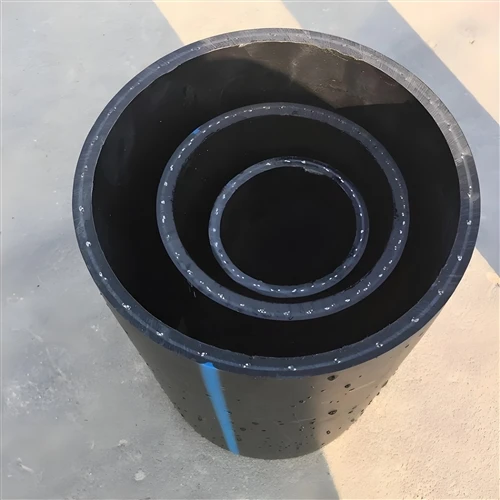
A Steel Wire Reinforced PE Pipe normally uses a composite structure consisting of an inner PE layer, a steel wire mesh reinforcement layer and an outer PE layer.
The inner PE layer contacts the slurry.
The steel wire mesh is embedded within the pipe wall.
The outer PE layer protects the composite structure from the external environment.
This creates a pressure-bearing composite pipe rather than a simple PE pipe.
The steel reinforcement helps resist deformation caused by internal pressure, while the PE layers provide corrosion resistance and protect the reinforcement.

图 1
What Happens When Slurry Pressure Changes?
Mining slurry systems often operate continuously, but operating conditions are not always constant.
Pump output can change.
Valves can be opened or closed.
Flow rates can vary.
Elevation differences can change pressure conditions.
These changes place additional mechanical demands on the pipeline.
The steel wire reinforcement helps the pipe maintain structural stability under pressure. This is one reason Steel Wire Mesh Skeleton Pipe structures are considered for mining pressure applications.
However, the selected pressure rating must still match the actual system.
A pipe should not be selected simply because it contains steel wire.
DN, PN, temperature and operating conditions remain essential.

图 2
What About Slurry Wear?
This is where buyers need to look beyond the pipe name.
PE has a relatively smooth internal surface and can perform well in many slurry applications. However, slurry containing large quantities of hard particles can create substantial abrasion.
Particle hardness matters.
Particle size matters.
Solid concentration matters.
Flow velocity matters.
Pipe diameter and changes in flow direction also affect local wear.
For a moderate slurry application, reinforced PE may provide a useful combination of pressure performance and corrosion resistance.
For highly abrasive mineral slurry, particularly where hard particles are transported continuously at high velocity, a UHMWPE mining pipe or another dedicated wear-resistant structure may need to be considered.
The correct decision therefore starts with the slurry rather than the pipe label.
Why Is the PE Inner Layer Important?
The inner PE layer creates the surface directly exposed to the slurry.
Its smoothness can help reduce flow resistance, while its chemical resistance provides protection against many mining fluids.
This is especially relevant when slurry contains dissolved salts, acidic or alkaline components or process-related chemicals.
The steel reinforcement itself is not intended to contact the transported medium.
The PE layer separates the reinforcement from the internal environment.
That composite structure is one of the defining characteristics of a Steel Wire Mesh Reinforced PE Pipe.
Typical Applications
Steel Wire Reinforced PE Pipe can be considered for mining slurry systems where pressure performance is an important requirement and the slurry characteristics are compatible with the PE inner layer.
Potential applications include selected ore slurry lines, mineral handling systems and pressure sections within mining plants.
For tailings with high solid concentration or strong abrasive characteristics, the actual wear condition should be evaluated before selecting the pipe structure.
Typical Product Parameters
|
Parameter |
Typical Specification |
|
Product |
Steel Wire Reinforced PE Pipe |
|
Structure |
PE + Steel Wire Mesh + PE |
|
Nominal Diameter |
DN50–DN600 |
|
Pressure Rating |
Up to PN2.5 MPa, depending on specification |
|
Working Temperature |
According to actual PE material and product specification |
|
Medium |
Mining slurry, tailings and compatible media |
|
Reinforcement |
High-strength steel wire mesh |
|
Installation |
Above ground, trench or buried |
How Should a Slurry Pipeline Be Specified?
A buyer should provide more than "mining slurry."
The medium should be identified.
The solid concentration should be provided.
Particle size and, where possible, particle hardness should be provided.
Operating pressure should be confirmed.
Working temperature should also be included.
Pipeline length and installation method are important for the overall specification.
These details allow the pipe structure to be evaluated against the actual service condition.
FAQ
Can Steel Wire Reinforced PE Pipe be used for mining slurry?
It can be considered for suitable slurry conditions. The actual selection depends on slurry concentration, particle size, hardness, velocity, pressure and temperature.
Does the steel wire make the pipe wear-resistant?
The steel wire mainly provides structural reinforcement. It should not be treated as the primary wear-resistant layer.
Is Steel Wire Mesh Skeleton Pipe suitable for tailings?
It can be considered for suitable tailings systems, particularly where pressure reinforcement is important. Highly abrasive tailings require a separate wear assessment.
Why is the inner PE layer important?
It provides the contact surface for the slurry and separates the transported medium from the steel reinforcement.
The Slurry Determines the Pipe Structure
A mining slurry pipeline cannot be selected by pressure rating alone.
The steel wire reinforcement addresses structural and pressure requirements. The PE layers provide the corrosion-resistant inner and outer surfaces.
But the slurry itself determines whether this combination is appropriate.
For suitable conditions, Steel Wire Reinforced PE Pipe, Steel Wire Mesh Reinforced PE Pipe and Steel Wire Mesh Skeleton Pipe offer a reinforced PE structure for mining pressure pipelines where both mechanical reinforcement and PE protection are required.
Request a SRTP Pipe Quotation
|
Step |
Process |
Details |
|
1 |
Send Requirements |
DN, pressure, medium, working temperature and application |
|
2 |
Specification Confirmation |
Pipe structure, pressure rating, specification and connection |
|
3 |
Quotation |
Price, lead time, packing and shipping terms |
|
4 |
Order & Production |
Contract, payment and production |
|
5 |
Inspection & Delivery |
Quality inspection and shipment |
For Steel Wire Mesh Reinforced PE Pipe (SRTP), steel wire reinforced PE pipe and mining pressure pipelines, send us:
DN + PN + Medium + Working Temperature + Installation Method + Pipeline Length + Quantity
For slurry applications:
Slurry Type + Solid Concentration + Particle Size
Luoyang Zhengju New Materials Technology Co., Ltd.
WhatsApp:+86 19937270645
Email: baibaili456@gmail.com
Wechat: +86 19937270645
Get Best Price for Your Mining Pressure Pipeline