introduction
Making a PE pipe thicker sounds like an easy answer when the working pressure goes up.
In practice, pipe design is not quite that simple.
A thicker wall means more PE in the pipe. It also means a heavier section and, for larger diameters, more material to handle during production and installation. At some point, it makes more sense to change the way the pipe is reinforced rather than keep adding polymer.
This is the reason steel wire is built into Steel Wire Reinforced PE Pipe.
What Changes When Steel Wire Is Added?
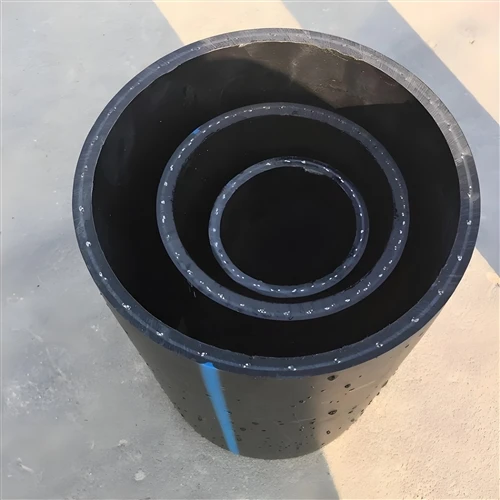
The steel wire is not placed on the outside of the pipe. It is built into the wall and surrounded by PE.
During operation, the pressure inside the pipe tries to expand the pipe outward. The reinforcement layer helps resist this expansion.
The PE still forms the inside and outside of the pipe. The inner surface is in contact with the transported material, while the outer PE protects the reinforcement from the surrounding environment.
So the pipe wall is doing more than one job.
The PE handles the contact with the medium and the environment. The steel wire adds structural support where the pipe needs it under pressure.
That is quite different from simply increasing the thickness of one material.
Why Does Wall Thickness Matter?
PE pipes can deform gradually when they remain under pressure for a long period. This is a normal characteristic of thermoplastic materials and needs to be considered when designing a pressurized pipeline.
Increasing wall thickness can reduce deformation and increase pressure capacity.
But there is another side to it.
A large amount of additional PE increases the weight and material requirement of the pipe. This becomes more noticeable with large-diameter pipes or long pipeline projects where hundreds or thousands of metres may need to be transported and installed.
A reinforced structure provides another way to deal with the pressure.
Instead of asking a thicker PE wall to carry the entire structural load, the steel wire takes part of that load.
How Does the Steel Wire Work Inside the Pipe?
Think about what happens when pressure builds inside a pipe.
The pressure acts against the pipe wall in every direction, with a strong tendency to expand the diameter.
The steel wire reinforcement is arranged within the pipe wall to resist this circumferential stress.
The PE does not disappear from the structural equation. It holds the reinforcement in position and forms the pipe body, while the steel wire provides additional strength.
This is why SRTP is often used when a standard PE pipe would need a much heavier wall to reach the required pressure rating.
The reinforcement is part of the pipe structure, not an external support added after the pipe has been manufactured.
What About Mining Conditions?
Pressure is only one of the loads a mining pipeline may see.
A buried mine pipeline can be surrounded by soil and groundwater. It may also experience external loading or movement of the surrounding ground.
For mine drainage, the pipeline may stay under pressure for long periods. Pump operation can introduce changes in pressure as well.
These conditions put more demand on the pipe than a short-term pressure test would suggest.
The reinforced structure of SRTP is intended for this type of pressurized service. The steel wire contributes to the pressure-bearing structure, while the PE layers keep the reinforcement isolated from the transported fluid and the outside environment.
Why Not Use a Steel Pipe Instead?
That depends on the application.
SRTP is not designed by simply trying to copy a steel pipe using PE.
Its construction is different. A steel pipe uses a continuous steel wall as the main structural body. SRTP uses steel wire reinforcement inside a thermoplastic pipe structure.
This gives the finished pipe a different balance of strength, weight, corrosion resistance and flexibility.
For mining projects, that difference can be useful when the pipeline needs pressure capacity but also benefits from the characteristics of PE.
The PE Layer Still Matters
It would be a mistake to look at SRTP only from the steel reinforcement side.
For a mining pipeline, the inside of the pipe is continuously exposed to the transported material.
In mine drainage, this may be groundwater or mine water.
In slurry service, the inner wall can be exposed to suspended mineral particles moving at relatively high velocity.
The PE inner layer therefore has its own job to do. Its material properties, thickness and condition directly affect the service performance of the pipeline.
This is also why pressure performance and wear performance should not be treated as the same thing.
High Pressure Does Not Automatically Mean High Wear Resistance
For slurry pipelines, the operating medium needs to be looked at separately.
A steel wire skeleton helps with the structural side of the pipe. It does not turn the reinforcement layer into a wear-resistant surface.
If the slurry contains hard mineral particles, the inner PE layer is the part exposed to abrasion.
Particle size, particle hardness, solids concentration and flow velocity can all change the amount of wear.
So when a High Pressure SRTP Pipe is being considered for slurry transport, the pressure requirement and the wear condition need to be checked separately.
A pipe can have sufficient pressure capacity while still requiring a different inner-wall design for highly abrasive slurry.

Where Is This Structure Useful?
One common application is pressurized mine drainage.
Underground drainage systems often have to move water over considerable distances while remaining under pressure. The pipeline may be buried or installed in confined underground areas, making pipe weight and handling relevant during installation.
SRTP can also be considered for other pressurized mining and industrial fluid pipelines.
For slurry transport, the application needs more detailed assessment. The required pressure rating is only one part of the specification. The conveyed material and expected wear conditions also need to be known.
Typical SRTP Parameters
|
Parameter |
Typical Specification |
|
Pipe Type |
Steel Wire Reinforced PE Pipe |
|
Structure |
PE / Steel Wire Reinforcement / PE |
|
Nominal Diameter |
DN50–DN600* |
|
Pressure Rating |
Up to PN2.5 MPa* |
|
Standard Length |
9 m / 12 m |
|
Reinforcement |
High-strength steel wire |
|
Inner Layer |
PE |
|
Outer Layer |
PE |
|
Applications |
Mine drainage, pressurized mining pipelines, slurry and industrial fluid transport |
*Final diameter, pressure rating, wall structure and length should be confirmed according to the actual product design and operating conditions.

图 2
Why SRTP Uses Reinforcement Instead of Just More PE
There is no single reason to put steel wire inside a PE pipe.
The main point is structural.
A conventional PE pipe depends largely on its polymer wall to resist internal pressure. Increasing the wall thickness is one way to increase its pressure capability, but it also adds material and weight.
SRTP uses a steel wire reinforcement layer to provide additional structural strength while keeping PE as the main pipe material.
That combination is particularly relevant for pressurized mining pipelines, where pressure, underground conditions and the properties of the transported medium all have to be considered together.
FAQ
Does a thicker PE wall always give better pressure performance?
Increasing wall thickness can increase pressure capacity, but it is not the only factor involved. Diameter, material properties, temperature, operating pressure and long-term loading all affect the final pipe design.
Is SRTP as rigid as a steel pipe?
No. Steel wire reinforcement increases the structural strength of the pipe, but the pipe remains a thermoplastic composite structure.
Does the steel wire contact the slurry?
No. The reinforcement is embedded within the PE structure. The inner PE layer is the surface exposed to the transported material.
Can SRTP be used for mine drainage?
Yes. High-pressure mine drainage is one of the applications for which reinforced PE pipe can be considered. The final pressure rating and pipe structure should be based on the actual system conditions.
Can SRTP carry abrasive mining slurry?
It can be considered for slurry service, but pressure capacity and abrasion resistance need to be evaluated separately. Particle size, hardness, concentration and flow velocity should be considered when determining the suitable pipe structure.
Request a SRTP Pipe Quotation
|
Step |
Process |
Details |
|
1 |
Send Requirements |
DN, pressure, medium, working temperature and application |
|
2 |
Specification Confirmation |
Pipe structure, pressure rating, specification and connection |
|
3 |
Quotation |
Price, lead time, packing and shipping terms |
|
4 |
Order & Production |
Contract, payment and production |
|
5 |
Inspection & Delivery |
Quality inspection and shipment |
For Steel Wire Mesh Reinforced PE Pipe (SRTP), steel wire reinforced PE pipe and mining pressure pipelines, send us:
DN + PN + Medium + Working Temperature + Installation Method + Pipeline Length + Quantity
For slurry applications:
Slurry Type + Solid Concentration + Particle Size
Luoyang Zhengju New Materials Technology Co., Ltd.
WhatsApp:+86 19937270645
Email: baibaili456@gmail.com
Wechat: +86 19937270645
Get Best Price for Your Mining Pressure Pipeline