Introduction
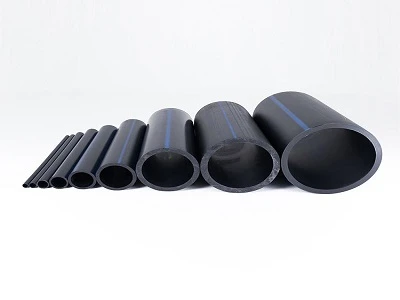
A mining drainage pipe can be damaged before it ever starts carrying mine water.
During unloading, storage, trenching, lowering, and backfilling, the pipe may be hit by equipment, dropped against a hard surface, or pressed against a stone or other sharp object. Underground pipelines can also experience local external loads after installation.
These are short-duration events, but they can leave a permanent mark on a pipe that is too rigid or too brittle.
HDPE takes a different approach to this type of loading. The pipe wall has a high degree of ductility, allowing it to deform locally and absorb mechanical energy instead of transferring all of the impact into a small cracking point.
For mine drainage applications, that difference matters. A pipeline may be buried hundreds of metres underground, installed in difficult ground, and expected to remain in service without frequent access for repair. A material that can tolerate accidental mechanical loading gives the pipeline more room for real-world installation conditions.
The Damage Often Starts Outside the Pipe
When people discuss mining pipe performance, internal water pressure usually gets most of the attention.
But pressure is only one part of the operating environment.
Consider what happens before commissioning. A pipe section is unloaded from a truck, moved across the site, lowered into a trench, positioned on the bedding, and then surrounded by backfill.
The pipe can encounter hard contact points at almost every stage.
A small stone under the pipe can create a concentrated contact area. An excavator bucket can strike a section during trench work. Poorly placed backfill can push against one part of the pipe wall more heavily than another.
HDPE is useful here because the material is not dependent on remaining completely rigid under every short-term load.
Its ductility allows the wall to yield locally and redistribute part of the impact.
That does not make installation practices unimportant. It gives the pipe a greater tolerance when actual site conditions are not as clean and controlled as the design drawing.
What Happens When an HDPE Pipe Is Hit?
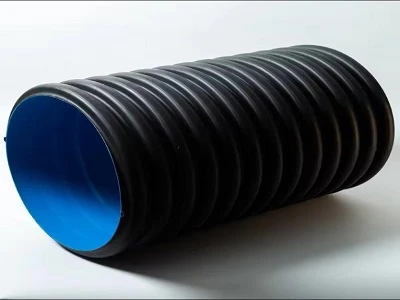
The important point is what happens to the pipe wall during the impact.
A sudden load produces a local deformation. With HDPE, the pipe wall can flex and deform around the loaded area. Because the material has high elongation, the deformation can occur without immediate brittle fracture.
This behavior is useful when the impact is localized.
Imagine a hard object contacting the outside of a buried drainage pipe. The load is initially concentrated over a small area. If the material has little ability to deform, the local stress can remain highly concentrated.
HDPE can spread that deformation through the surrounding pipe wall.
The pipe may show a temporary or local indentation rather than immediately developing a fracture.
That distinction is important for a mining pipeline. An indentation can be evaluated. A crack through the pressure boundary is a much more serious problem.
High Elongation Gives HDPE More Mechanical Tolerance
The mechanical advantage of HDPE is not simply its strength.
PE100 materials commonly have a tensile elongation at break above 600%, together with a tensile strength at yield of around 23 MPa.
The high elongation is particularly relevant to impact behavior.
A material with greater deformation capacity can absorb mechanical energy by changing shape. The pipe does not have to remain perfectly rigid when a short-duration force acts on it.
This is one reason HDPE is commonly considered for buried water and drainage systems where external loading can vary during installation and service.
The pipe wall has some ability to move with the load.
For a mining drainage pipeline, that flexibility can be more useful than simply having a high nominal strength on a datasheet.
Underground Backfilling Is a Real Test for the Pipe
Backfilling is often treated as a routine construction step, but it can have a direct effect on pipe performance.
The material placed around the pipe does not always have uniform particle size or uniform compaction. Large particles can create local contact points. Heavy equipment operating near the trench can also change the external loading on the pipe.
HDPE's flexible wall allows it to accommodate these conditions better than a highly rigid pipe.
The pipe and the surrounding soil gradually work together.
As the soil is placed and compacted, the pipe can deform slightly and develop support from the surrounding material. The load is not carried by the pipe wall alone.
This interaction is particularly relevant for long mine drainage systems, where the pipeline may pass through different soil conditions along the route.
One section may be surrounded by compacted fill. Another may encounter softer ground. Another may be exposed to rock fragments.
A material with useful deformation capacity provides a degree of tolerance across these changing conditions.
Impact Resistance Is Valuable During Transportation Too
The mining environment starts long before the pipe reaches the trench.
Long pipe sections are transported to mine sites, unloaded, stored, moved again, and finally delivered to the installation area.
Every additional handling operation creates another opportunity for mechanical damage.
HDPE's relatively low weight makes handling easier, while its toughness helps the pipe tolerate accidental contact during these operations.
This combination is useful for large-diameter drainage pipe.
For example, when handling a DN315, DN400, DN500, or larger pipe, the pipe section may be moved by lifting equipment rather than manually. Accidental contact with supports, loading platforms, or other equipment can create localized impact.
A tough thermoplastic pipe can tolerate these short-duration events without behaving like a brittle material.
The objective is not to deliberately abuse the pipe.
The objective is to reduce the chance that normal handling becomes an expensive repair problem.
Why This Matters More for Buried Mining Pipe
Once a drainage pipe is buried, access becomes much more difficult.
If a visible section of pipe above ground is damaged, inspection and replacement may be relatively straightforward.
A buried mine drainage pipeline is different.
A serious defect may require excavation, removal of backfill, replacement of the damaged section, and restoration of the trench.
For underground mine drainage, the cost of a pipe failure is therefore not limited to the price of the pipe itself.
There may also be pumping disruption, excavation work, labour, equipment use, and downtime.
This is where the toughness of HDPE becomes a practical purchasing consideration.
The value of impact resistance is not that the pipe can survive every possible accident. No pipe material can replace correct handling and installation.
The value is that the material has a higher tolerance for the mechanical events that can occur during normal mining construction.
HDPE Does Not Depend on a Rigid Pipe Wall
One of the useful characteristics of HDPE is its combination of strength and flexibility.
A drainage pipe has to carry internal water pressure, but it may also experience external forces. These forces do not always arrive separately.
A pipe may be under pressure while the surrounding soil moves slightly. It may be subjected to external contact while being installed. It may experience local deformation while the pipeline continues operating.
HDPE can accommodate a certain amount of deformation because of its ductile material behavior.
This is different from designing a pipe around the idea that the wall must remain completely rigid.
For mining applications, that flexibility can be an advantage because actual ground and construction conditions are rarely perfectly uniform.

Reference PE100 Properties
Typical PE100 reference properties help explain why HDPE has this mechanical behavior.
|
Property |
Typical PE100 Reference |
|
Minimum Required Strength (MRS) |
10 MPa |
|
Tensile Strength at Yield |
Approx. 23 MPa |
|
Elongation at Break |
>600% |
|
Poisson's Ratio |
Approx. 0.45 |
|
Long-Term Elastic Modulus |
Approx. 200 MPa |
|
Flexural Modulus |
Approx. 1000 MPa |
|
Density |
Approx. 950–960 kg/m³ |
These are material reference values rather than guaranteed values for every finished pipe. Actual pipe performance depends on the PE grade, pipe dimensions, pressure class, wall thickness, manufacturing process, temperature, and applicable standard.
For procurement, the useful point is the combination of these properties rather than one isolated number.
Where Impact Resistance Adds Value in a Mine
The advantage becomes clearer when looking at the complete pipeline route.
At the mine surface, HDPE can tolerate accidental mechanical contact during handling and positioning.
During trench installation, its ductility gives the pipe some tolerance against localized external loading.
During backfilling, the flexible wall can work with the surrounding soil rather than depending entirely on rigid-wall behavior.
After burial, the pipe can accommodate a certain degree of deformation as external conditions change.
For mine drainage systems, these characteristics reduce the sensitivity of the pipe to short-duration mechanical disturbances.
That is a different advantage from corrosion resistance or hydraulic performance, but it is equally connected to whether the pipeline can remain in service.
Conclusion
Impact resistance is one of the physical properties that makes HDPE practical for demanding mining drainage applications.
The main advantage is not that HDPE is simply "strong." Its combination of toughness, ductility, and high elongation allows the pipe wall to deform under localized impact instead of immediately converting the load into brittle fracture.
That matters during unloading, transportation, trenching, backfilling, and underground operation.
For a buried mine drainage pipeline, greater tolerance to accidental mechanical loading can mean fewer problems during installation and less risk of turning a small external event into a major repair operation.
HDPE therefore brings more than corrosion resistance and low weight to a mining drainage system. Its ability to take impact, deform, and keep the pipe wall intact is another practical reason to consider HDPE for mine water and drainage pipelines.
Request an HDPE Pipe Quotation
|
Step |
Process |
Details |
|
1 |
Send Requirements |
DN, pressure, medium, working temperature and application |
|
2 |
Specification Confirmation |
Pipe type, material grade, pressure rating, wall thickness/SDR and connection |
|
3 |
Quotation |
Price, lead time, packing and shipping terms |
|
4 |
Order & Production |
Contract, payment and production |
|
5 |
Inspection & Delivery |
Quality inspection and shipment |
For HDPE Mining Pipe, Send Us:
DN + PN/SDR + Medium + Working Temperature + Installation Method + Pipeline Length + Quantity
For mine drainage and dewatering applications, please also provide:
Application + Working Pressure + Installation Environment
For mineral-containing mine water, if available:
Water Chemistry / pH + Temperature + Suspended Solids
Luoyang Zhengju New Materials Technology Co., Ltd.
WhatsApp: +86 19937270645
Email: baibaili456@gmail.com
WeChat: +86 19937270645
Get Best Price for Your HDPE Mining Pipe.