Introduction
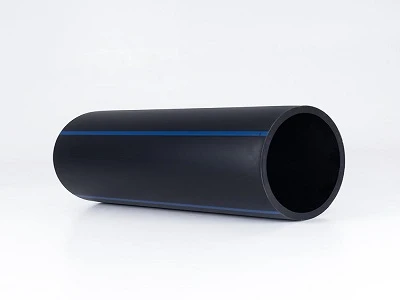
Wall thickness is one of the most important dimensional characteristics of an HDPE pipe.
For a pipe specified as 225 mm SDR11, for example, the theoretical wall thickness is approximately 20.45 mm.
But this value is not simply created by a formula.
The formula defines the target dimensional relationship. The actual pipe wall must then be produced and controlled through extrusion, die forming, material output, haul-off, and downstream processing.
For mining HDPE pipe, wall thickness control is particularly important because the pipe may be exposed to internal pressure, buried loads, equipment loads, and ground movement depending on the installation conditions.
1. How Is HDPE Pipe Wall Thickness Formed?
The wall is formed when the molten HDPE passes through the annular die.
The amount of polymer delivered through the die per unit time is closely related to the material distribution in the pipe wall.
Several variables influence this distribution.
The most important include:
extrusion output
die geometry
melt temperature
melt pressure
haul-off speed
cooling conditions
A change in any one of these variables can influence the final dimensions.
2. Why Does Haul-Off Speed Affect Wall Thickness?
Consider a simplified situation in which extrusion output remains constant.
If the pipe moves through the production line at a higher speed, the same amount of polymer is distributed over a greater length.
If the line speed decreases, more material is distributed over each unit length.
However, actual HDPE behavior is more complicated because the material is still hot and viscoelastic during forming.
Therefore, haul-off speed should not be treated as a simple "wall thickness switch."
Instead, it is one of the key variables used to balance material output and line speed.
Stable production requires these variables to remain coordinated.
3. What Is the Relationship Between Wall Thickness and SDR?
SDR is calculated as:
SDR = Outside Diameter / Wall Thickness
Therefore:
Wall Thickness = Outside Diameter / SDR
For example:
|
Outside Diameter |
SDR |
Theoretical Wall Thickness |
|
110 mm |
SDR11 |
10.00 mm |
|
160 mm |
SDR11 |
14.55 mm |
|
225 mm |
SDR11 |
20.45 mm |
|
315 mm |
SDR11 |
28.64 mm |
|
450 mm |
SDR11 |
40.91 mm |
These values represent the dimensional relationship. Actual product dimensions must be checked against the applicable manufacturing standard and dimensional tolerances.
4. Why Is Average Wall Thickness Not Enough?
A pipe can have an acceptable average wall thickness while still showing significant variation around its circumference.
For example, one side of the pipe could be thicker while another side is thinner.
This is why dimensional inspection should consider more than one value.
Important measurements include:
average wall thickness
minimum wall thickness
maximum wall thickness
wall thickness distribution around the circumference
The minimum wall thickness is particularly important because the thinnest section can become the critical dimensional location.
5. What Causes Circumferential Wall Thickness Variation?
One possible cause is uneven melt distribution through the die.
Other contributing factors may include die alignment, melt temperature distribution, melt pressure stability, and equipment condition.
A simplified relationship is:
Die alignment + melt distribution + process stability → wall thickness uniformity
If the die is not properly aligned, the annular gap may not be uniform.
The result can be a pipe with a thicker wall on one side and a thinner wall on the other.
For large-diameter pipe, this type of variation deserves particular attention.
6. Why Does Wall Thickness Matter for Mining Applications?
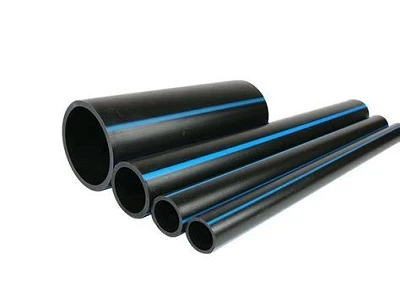
Mining HDPE pipe may be installed underground or above ground depending on the project.
For buried pipe, the loading environment can include:
soil pressure
vehicle loads
backfill compaction
ground settlement
strata movement
The pipe therefore needs an appropriate structural configuration for its actual installation conditions.
However, selecting a thicker wall simply because "thicker is safer" is not necessarily the best engineering approach.
A larger wall thickness also means more material, greater weight, and potentially higher installation cost.
The appropriate SDR should be selected according to the operating pressure, installation conditions, external loads, temperature, and applicable design requirements.
7. How Is Wall Thickness Checked?
During production, wall thickness can be checked at different locations around the pipe circumference.
The purpose is to verify that the pipe remains within the specified dimensional range.
For buyers, useful dimensional information includes:
|
Item |
Why it matters |
|
Nominal wall thickness |
Defines the target section |
|
Minimum wall thickness |
Identifies the thinnest location |
|
Maximum wall thickness |
Indicates material distribution |
|
Wall thickness tolerance |
Shows allowable dimensional variation |
|
SDR |
Defines the OD-to-wall relationship |
These measurements provide more useful information than simply stating that the pipe has a "thick wall."
FAQ
Does SDR11 mean that the wall thickness is always the same?
No. SDR11 defines a ratio between outside diameter and wall thickness. Different outside diameters therefore have different wall thicknesses.
Does a smaller SDR mean a thicker pipe?
Yes. For the same outside diameter, a smaller SDR corresponds to a greater theoretical wall thickness.
Is wall thickness controlled only by the extrusion die?
No. Extrusion output, die geometry, melt condition, haul-off speed, and cooling all influence the final wall dimensions.
Is thicker HDPE pipe always better for mining?
No. The pipe should be selected according to pressure, installation depth, external loading, ground conditions, temperature, and other project requirements.
Conclusion
HDPE wall thickness control is a continuous process rather than a single machine adjustment.
SDR defines the dimensional relationship between outside diameter and wall thickness, while extrusion output, die conditions, melt behavior, haul-off speed, and cooling determine whether the manufactured pipe consistently reaches that target.
For mining applications, the important question is not simply whether the pipe has a thick wall.
The more useful question is whether the wall thickness is appropriate for the operating and installation conditions and whether that thickness remains consistent around the entire pipe.
Request an HDPE Pipe Quotation
|
Step |
Process |
Details |
|
1 |
Send Requirements |
DN, pressure, medium, working temperature and application |
|
2 |
Specification Confirmation |
Pipe type, material grade, pressure rating, wall thickness/SDR and connection |
|
3 |
Quotation |
Price, lead time, packing and shipping terms |
|
4 |
Order & Production |
Contract, payment and production |
|
5 |
Inspection & Delivery |
Quality inspection and shipment |
For HDPE Mining Pipe, Send Us:
DN + PN/SDR + Medium + Working Temperature + Installation Method + Pipeline Length + Quantity
For mine drainage and dewatering applications, please also provide:
Application + Working Pressure + Installation Environment
For mineral-containing mine water, if available:
Water Chemistry / pH + Temperature + Suspended Solids
Luoyang Zhengju New Materials Technology Co., Ltd.
WhatsApp: +86 19937270645
Email: baibaili456@gmail.com
WeChat: +86 19937270645
Get Best Price for Your HDPE Mining Pipe.