Introduction
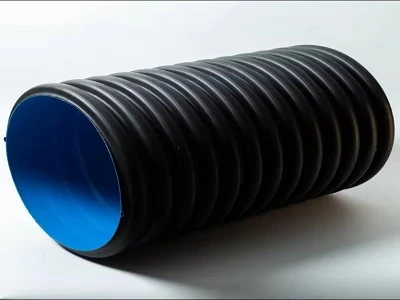
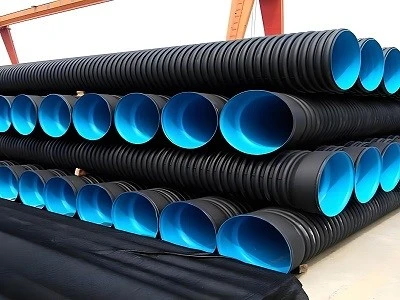
The corrugated profile is the most recognizable feature of a double wall corrugated HDPE pipe, but the waves are not simply pressed into a finished pipe.
The geometry is created dynamically while the HDPE is still molten or sufficiently softened to flow into a moving corrugation mold.
The forming process determines the height, pitch, depth and continuity of the corrugations.
These geometric features are important because the corrugated outer wall is responsible for much of the pipe's resistance to external deformation.
In other words, the wave pattern is not decoration.
It is structural geometry.
1. Why Add Corrugations to the Outer Wall?
A flat or solid wall has a relatively simple cross-sectional geometry.
A corrugated wall creates additional structural depth without requiring the entire cross-section to be filled with solid polymer.
The result is a more efficient structural configuration.
The basic principle can be understood as:
Flat Geometry → Limited Structural Depth
Corrugated Geometry → Increased Structural Depth
The actual performance depends on material properties, wall geometry, dimensions, support conditions and the applicable standard.
2. The Corrugation Mold Defines the Profile
The outer wall passes through a corrugation-forming mold or mold blocks.
The mold contains repeated cavities corresponding to the desired wave pattern.
As the hot HDPE enters this region, the polymer is pulled or pressed into the cavities.
The mold therefore defines parameters such as:
|
Geometric Parameter |
Meaning |
|
Corrugation height |
Radial depth of the wave |
|
Pitch |
Distance between repeating wave features |
|
Peak radius |
Shape of the crest |
|
Valley radius |
Shape of the trough |
|
Profile thickness |
Material distribution within the corrugation |
Changing the mold geometry changes the resulting pipe structure.
3. Vacuum Pulls the Polymer Into the Mold
The softened HDPE does not automatically fill every part of a corrugation cavity.
Vacuum can create a pressure difference that helps draw the polymer toward the mold surface.
This is particularly important at deeper sections of the corrugation.
The simplified process is:
Hot Polymer → Pressure Difference → Mold Contact → Corrugated Profile
The stability of this pressure difference influences how consistently the wave geometry is reproduced.
4. Corrugation Height Is Not Just a Visual Dimension
Consider two pipes with the same nominal diameter but different corrugation heights.
The external profiles are structurally different.
A greater corrugation depth can increase the structural depth of the pipe section, but it also changes material distribution, forming requirements and local deformation behavior.
Therefore, corrugation height cannot be considered independently.
It interacts with:
Pitch
Wall Thickness
Peak/Valley Geometry
Material Distribution
Fusion Structure
The complete profile determines the structural response.
5. Corrugation Pitch Controls Repetition
Corrugation pitch is the distance between corresponding points of adjacent waves.
If the pitch is too large, the pipe has fewer structural repetitions over a given length.
If it is smaller, more corrugations are formed along the same length.
For example, consider a simplified section:
Peak - Valley - Peak - Valley - Peak
The distance from one peak to the next represents the pitch.
Pitch influences how the external wall distributes deformation along the pipe.
Therefore, it is an important geometric parameter rather than simply a manufacturing convenience.
6. Peak and Valley Geometry Matter
A corrugated profile does not consist only of sharp triangular waves.
The shape of the peak and valley affects how stress and deformation develop within the structure.
A rounded peak distributes deformation differently from a sharp corner.
Similarly, the valley region is important because it connects adjacent corrugations and transfers structural effects through the profile.
This is why mold geometry must control not only the height and pitch but also the shape of the transition between peaks and valleys.
7. The Outer Wall Must Remain Connected to the Inner Wall
A corrugated outer wall cannot provide the intended structural behavior if it simply floats around an independent inner tube.
The two walls need controlled fusion at the appropriate interface.
The fusion region connects the smooth inner wall to the corrugated external structure.
This creates a composite cross-section:
Inner Wall + Fusion Region + Corrugated Outer Wall
Loads acting on the outside can therefore be transferred through the structural system rather than being carried by the outer corrugation alone.
8. Forming Speed Changes the Wave Profile
The corrugation mold moves continuously with the pipe.
Therefore, production speed has to match the ability of the hot polymer to fill and reproduce the mold geometry.
If the forming speed is too high relative to the material condition, the polymer may not completely reproduce the profile.
If the thermal condition is not stable, the same mold can produce different geometric results during different stages of production.
This is why:
Mold Speed + Melt Temperature + Vacuum + Polymer Flow
must remain coordinated.
9. What Happens When the Corrugation Is Not Fully Formed?
An incomplete corrugation profile may appear as a reduced wave height, distorted peak or poorly defined valley.
Potential causes include:
|
Symptom |
Possible Cause |
|
Shallow corrugation |
Insufficient forming |
|
Uneven wave height |
Unstable vacuum or melt condition |
|
Distorted profile |
Thermal or mechanical instability |
|
Irregular pitch |
Mold/line synchronization |
|
Poor wall fusion |
Incorrect thermal/contact condition |
These are process symptoms rather than simply "appearance defects."
Because the corrugation geometry contributes to structural behavior, profile consistency matters.
10. Corrugation and Ring Stiffness
The corrugated geometry is closely related to the structural behavior of the pipe under external loading.
For buried drainage pipe, ring stiffness is influenced by several factors, including material modulus, wall geometry and the second moment of area of the cross-section.
The important point is that geometry changes structural behavior.
A corrugated profile places material farther from the neutral axis of the section compared with a simple flat-wall configuration.
This can increase the section's resistance to deformation.
The exact ring-stiffness classification, however, depends on the complete pipe design and applicable test standard.
11. Why Corrugation Quality Matters for Mine Drainage
Mine drainage pipes may be installed below ground where external soil pressure, backfill compaction and ground movement can act on the pipe.
In these conditions, the external corrugated structure is not merely a surface pattern.
Its geometry contributes to how the pipe responds to external loading.
Therefore, consistent corrugation height, pitch, profile shape and wall fusion are important parts of the finished pipe structure.
FAQ
Is the corrugated pattern mainly for appearance?
No. The corrugated geometry is a structural feature that changes the mechanical behavior of the pipe.
What controls corrugation height?
Primarily the forming mold geometry, together with polymer temperature, vacuum conditions, material flow and forming speed.
Why is vacuum used during corrugation forming?
It helps pull the softened HDPE into the mold cavities so the required profile can be reproduced.
Does a deeper corrugation automatically mean a stronger pipe?
Not necessarily. Structural performance depends on the complete profile, material, wall distribution, pitch, fusion structure, installation conditions and applicable standard.
Conclusion
The corrugated structure of a double wall HDPE pipe is created through controlled deformation of hot polymer inside a moving forming mold.
Vacuum helps the material conform to the mold, while mold geometry determines corrugation height, pitch and profile shape. Thermal conditions and forming speed determine whether the polymer can reproduce that geometry consistently.
The resulting corrugated outer wall works together with the smooth inner wall through the fusion structure between them.
For buried drainage applications, this geometry is important because it provides the structural configuration needed to resist external deformation while maintaining a smooth internal flow passage.
Primary Keyword
HDPE double wall corrugated pipe corrugation forming
Secondary Keywords
HDPE corrugation forming
double wall corrugated pipe structure
HDPE corrugated pipe manufacturing
corrugated pipe mold
HDPE pipe corrugation height
HDPE corrugated drainage pipe
HDPE ring stiffness
Request an HDPE Pipe Quotation
|
Step |
Process |
Details |
|
1 |
Send Requirements |
DN, pressure, medium, working temperature and application |
|
2 |
Specification Confirmation |
Pipe type, material grade, pressure rating, wall thickness/SDR and connection |
|
3 |
Quotation |
Price, lead time, packing and shipping terms |
|
4 |
Order & Production |
Contract, payment and production |
|
5 |
Inspection & Delivery |
Quality inspection and shipment |
For HDPE Mining Pipe, Send Us:
DN + PN/SDR + Medium + Working Temperature + Installation Method + Pipeline Length + Quantity
For mine drainage and dewatering applications, please also provide:
Application + Working Pressure + Installation Environment
For mineral-containing mine water, if available:
Water Chemistry / pH + Temperature + Suspended Solids
Luoyang Zhengju New Materials Technology Co., Ltd.
WhatsApp: +86 19937270645
Email: baibaili456@gmail.com
WeChat: +86 19937270645
Get Best Price for Your HDPE Mining Pipe.