Introduction
A buried HDPE pipe can be installed at the correct elevation and still end up with poor support. The problem is not always visible once the trench has been closed. A hard spot beneath the pipe, an unfilled space beside its lower wall or a section of backfill that settles later can change how the pipe carries external loads.
This matters in mine drainage systems, where pipelines may cross excavated ground, access roads and areas repeatedly disturbed by construction equipment. Installation quality depends on what happens beneath and around the pipe, not just on the dimensions of the pipe itself.
The sequence of trench preparation, bedding, pipe placement and backfilling determines whether the buried pipeline receives the support assumed in its design.
1. A Trench Bottom Can Look Level Without Providing Uniform Support
After excavation, the trench bottom should be checked for more than its elevation. Its condition determines how the pipe will be supported along its length.
A trench cut through weathered rock may contain hard projections next to softer soil. A trench in disturbed ground may have loose sections left by excavation. If the pipe rests directly on these irregularities, its weight and subsequent external loads may be transferred through a limited number of contact points.
This is different from having a continuous, suitable bearing surface. Localized contact can concentrate loads, while gaps elsewhere leave parts of the pipe inadequately supported.
The specified bedding layer is intended to provide a suitable foundation and allow adjustment of the pipe's line and grade. Its thickness and material should follow the project design. Simply spreading a thin layer over an unsuitable trench bottom does not necessarily correct unstable or weak ground beneath it.
Where soft soil, groundwater or unstable excavation surfaces are encountered, the construction team should assess the condition before placing the pipe. Foundation treatment or replacement material may be necessary, depending on the approved design.
2. Lowering the Pipe Is Not the End of Alignment Control
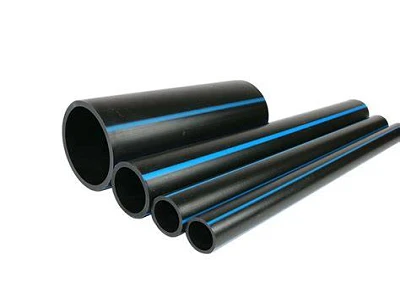
HDPE pipe is lighter than many metal alternatives, which can make handling easier. However, dragging pipe across sharp surfaces or allowing it to strike the trench wall can cause damage that becomes difficult to inspect after burial.
Before lowering, the pipe should be checked for cuts, crushed areas and other damage against the manufacturer's acceptance criteria. The lifting arrangement should suit the pipe dimensions and installation conditions.
Alignment must then be maintained while the pipe is positioned and connected. A section that sits correctly before jointing may move during subsequent handling or backfilling.
For gravity drainage, the installation team must preserve the designed gradient. A local low point can retain sediment or reduce the effective drainage performance even when the pipe itself is undamaged. For pressurized drainage, line and level remain important for joint assembly, support and avoiding unnecessary bending.
The pipe should not be forced into position to compensate for a poorly prepared trench. Correcting the foundation and support arrangement is preferable to leaving unwanted stress in the installed line.
3. The Lower Sides of the Pipe Are Easy to Overlook
One of the most important areas during installation is the haunch zone: the space beneath the pipe's horizontal centerline and along its lower sides.
A flexible pipe responds to external loading partly through interaction with the surrounding soil. Properly placed embedment material provides lateral support that helps limit changes in the pipe's cross-sectional shape.
If the material is placed only beneath the pipe and over its crown, voids may remain in the haunch zones. These voids can be hidden from view once backfilling continues.
The solution is not simply to use more material. The specified embedment needs to be placed in a way that fills the required spaces and provides the intended support without displacing or damaging the pipe.
The placement and compaction method should be suitable for the trench width, pipe diameter and material being used. Where access is restricted, the construction sequence may need to be adjusted so that the lower sides can be filled adequately.
4. Backfill Should Be Controlled in Layers
Placing a large volume of soil into the trench in one operation can leave inconsistent compaction. The upper part may appear firm while material lower down remains loose.
Backfill should therefore be placed in the specified layers, with compaction carried out using appropriate equipment and procedures. The required lift thickness and compaction criteria depend on the material, equipment and project specification.
Too little compaction may allow subsequent settlement, changing the support around the pipe. In contrast, unsuitable compaction equipment or operation too close to a pipe with insufficient cover can impose damaging loads.
The construction team must coordinate three things: the material being used, the thickness of each layer and the method used to compact it. A density target alone does not describe how to achieve a suitable installation.
The initial backfill around the pipe and the final backfill above it may also require different handling methods. The approved procedure should define where heavier equipment may be used and how much cover must be present before that equipment operates.
5. Why Mine Access Roads Need Separate Attention
A pipeline installed beneath an access road does not experience the same service conditions as one beneath an area with little traffic.
Vehicle loads are transmitted through the ground, and the distribution of those loads at pipe level depends on the cover, soil properties, road structure and vehicle loading. During construction, the final road layers may not yet be in place, so temporary traffic can create a different loading condition from the completed road.
The installation plan should identify whether haul trucks, excavators or other heavy equipment will cross the route before final cover is achieved. If such movements are not permitted by the design, access restrictions or an approved protective arrangement may be required.
The permanent pipe design should not be assumed to cover every temporary construction situation. Construction sequencing is part of the installation plan.
6. Inspect the Work Before It Disappears Underground
The most useful time to identify an installation defect is before it is covered.
Checks should be carried out at the stages specified by the project quality plan. These may include the trench foundation, bedding material, pipe condition, line and grade, joint assembly, haunch filling and backfill compaction.
Records should identify the relevant inspection results and any corrective action. If the project requires deformation measurements, the location, timing and acceptance criteria should be established before construction.
A final surface inspection alone cannot confirm that the pipe received proper support throughout the trench.
HDPE Pipe Specifications for Mine Drainage
| Parameter | SDR 11 | SDR 17 |
|---|---|---|
| Material | PE100 | PE100 |
| Standard | ISO 4427 series | ISO 4427 series |
| Nominal pressure at 20°C | PN 16 | PN 10 |
| DN/OD 110 mm wall thickness | 10.0 mm | 6.6 mm |
| DN/OD 200 mm wall thickness | 18.2 mm | 11.9 mm |
| DN/OD 315 mm wall thickness | 28.6 mm | 18.7 mm |
| DN/OD 400 mm wall thickness | 36.3 mm | 23.7 mm |
| DN/OD 630 mm wall thickness | 57.2 mm | 37.4 mm |
| Common connection method | Butt fusion | Butt fusion |
Note: Dimensions are typical reference values for PE100 pipes. Confirm actual dimensions, pressure ratings and applicable standards against the manufacturer's datasheet before ordering. Burial suitability depends on soil conditions, groundwater, installation quality and external loads.
FAQ: HDPE Pipe Installation for Mine Drainage
1. Why is bedding important when installing buried HDPE pipes?
Bedding provides support beneath the pipe and helps distribute external loads. Uneven support, hard contact points or voids can cause localized deformation. Bedding material and thickness should follow the project design and site conditions.
2. How deep can HDPE pipes be buried?
There is no universal maximum burial depth. It depends on pipe dimensions, stiffness, soil properties, groundwater conditions, backfill compaction and surface loads. Deep installations should be assessed using an appropriate buried-pipe design method.
3. Does a thicker HDPE pipe always perform better underground?
Not necessarily. A thicker wall can increase pressure capacity, but buried performance also depends on soil support, pipe stiffness, installation quality and external loading. SDR and pressure class alone cannot determine suitability for a particular site.
4. What backfill material should be used around HDPE pipes?
Use backfill specified by the project design and applicable installation requirements. It should provide suitable support and should not contain objects that could damage the pipe. Placement and compaction should follow the approved procedure.
5. Can HDPE pipes withstand ground settlement in mining areas?
HDPE flexibility helps it accommodate certain ground movements, but it is not immune to damage. Differential settlement, unsupported spans and concentrated loads can affect the pipe and joints. Expected ground movement should be considered during design and installation.
6. What information should buyers provide when requesting HDPE pipes for mine drainage?
Provide the required outside diameter, SDR or wall thickness, operating pressure, drainage medium, burial depth, soil and groundwater conditions, surface traffic loads, pipe length and applicable standard. This helps the manufacturer assess a suitable pipe configuration.
Conclusion
HDPE buried pipe installation is a sequence of connected operations. An irregular trench bottom can create uneven support; poor placement around the lower sides can leave voids; and uncontrolled backfilling can lead to settlement or excessive deformation.
For mine drainage pipelines, construction quality should be checked before each stage becomes inaccessible. The aim is not simply to bury the pipe, but to create the ground conditions required for the installed system to perform as designed.
Keywords
Primary Keyword
HDPE buried pipe installation
Secondary Keywords
HDPE pipe trench preparation, HDPE pipe bedding installation, HDPE pipe haunch support, HDPE buried pipe backfill, mine drainage pipe installation, HDPE pipe construction quality