Introduction
Mining slurry pipelines rarely deal with only one problem.
The slurry may contain hard mineral particles that continuously rub against the pipe wall, while the liquid phase may contain acidic, alkaline, saline or chemical components. When abrasion and corrosion occur at the same time, selecting a pipe based on only one property can create problems later in operation.
This is why many mining buyers compare conventional HDPE with UHMWPE when selecting pipe for abrasive slurry transportation.
HDPE offers excellent corrosion resistance, flexibility and low weight. But when the slurry contains a high concentration of hard particles, the main concern may shift from chemical resistance to internal wear.
UHMWPE combines chemical resistance with a highly wear-resistant internal surface, making it suitable for mining applications where both abrasive particles and aggressive slurry media are present.
When Corrosion and Abrasion Occur Together
Mining slurry can be chemically aggressive for several reasons.
The transported medium may contain dissolved salts, acidic components, alkaline substances or flotation-related chemicals. Tailings and mineral-processing slurry can also contain fine particles that continuously contact the pipe wall during transportation.
A pipe may therefore face two different forms of attack.
The first is mechanical wear caused by mineral particles.
The second is chemical exposure caused by the slurry itself.
These two conditions can appear at the same time. A pipe selected only for corrosion resistance may still experience significant internal wear if the slurry contains hard and angular particles.
This is where UHMWPE becomes interesting for mining applications.
Why Internal Surface Matters
The inside surface of a slurry pipe has a direct influence on how mineral particles move through the pipeline.
UHMWPE has a smooth, low-friction internal surface. Mineral particles are less likely to encounter a rough internal wall compared with many conventional rigid pipe surfaces.
This characteristic is useful in long slurry pipelines, concentrate transportation and tailings systems where continuous particle movement occurs.
The smooth surface also helps reduce the tendency of mineral deposits and scaling to remain attached to the pipe wall.
For mining buyers, the benefit is not simply that UHMWPE is "smooth."
The combination of abrasion resistance, low friction and chemical resistance is what makes the material attractive for demanding slurry conditions.
HDPE Is Still Useful - But the Application Matters

HDPE is widely used in mining because it offers several practical advantages.
It is lightweight, flexible and resistant to many corrosive media. It can be useful for mine drainage, water transportation, industrial fluid systems and applications where flexibility is more important than extreme abrasion resistance.
The question is not whether HDPE can be used in mining.
The more useful question is:
What is inside the pipeline?
If the medium is mainly water or relatively low-abrasion fluid, HDPE can be a practical choice.
If the medium contains a large amount of hard mineral particles and continuous abrasion becomes the dominant concern, a more wear-focused material such as UHMWPE deserves consideration.
Where UHMWPE Can Be Used
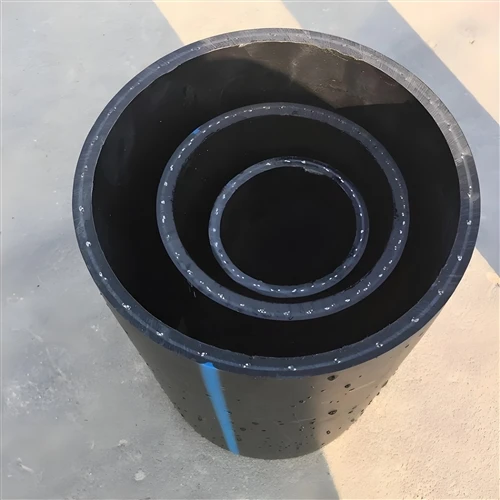
UHMWPE mining pipe can be considered for tailings, mineral slurry, concentrate transportation, flotation-related slurry and other abrasive mining media.
Special attention should be given to elbows, tees, reducers and pump discharge sections.
Straight pipe often experiences relatively uniform flow. Fittings can experience changes in flow direction, turbulence and particle impact, which may increase local wear.
This is why pipe material selection should not focus only on the straight pipeline.
Product Features
High abrasion resistance
UHMWPE is designed for applications where continuous contact with abrasive mineral particles is a major operating condition.
Chemical resistance
The material has good resistance to many acidic, alkaline and saline media encountered in mining environments.
Smooth internal surface
The low-friction inner wall supports smooth slurry flow and helps reduce particle accumulation.
Impact resistance
UHMWPE can absorb repeated impact from mineral particles, making it useful in demanding slurry transportation conditions.
Lightweight construction
Compared with many steel-based pipe systems, UHMWPE pipe is relatively lightweight, which can simplify handling during installation and replacement.
Non-metallic internal surface
The UHMWPE working layer does not rust like an exposed steel surface and can provide a non-metallic barrier between the slurry and the supporting pipe structure when a lined configuration is used.

Product Parameters
|
Parameter |
Typical Specification |
|
Material |
UHMWPE |
|
Molecular Weight |
>1.5 million g/mol |
|
Nominal Diameter |
DN50–DN1200 |
|
Pressure Rating |
PN1.0–PN10 |
|
Standard Length |
9 m / 12 m |
|
Working Temperature |
-269°C to +80°C |
|
Applications |
Tailings, concentrate, mineral slurry, flotation slurry |
|
Medium |
Abrasive, acidic, alkaline or saline slurry |
|
Connection |
Flange, mechanical or customized connection |
Actual pipe specifications should be selected according to pressure, slurry concentration, particle characteristics, pipeline layout and installation conditions.
Comparison: UHMWPE vs HDPE
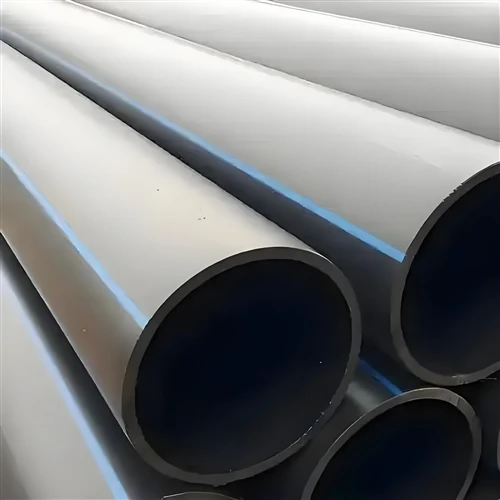
HDPE has a strong position in mining because of its flexibility, corrosion resistance and relatively low weight. It is particularly useful for mine drainage, water transportation and general-purpose fluid systems.
UHMWPE takes a different position.
When the transported medium contains hard mineral particles and continuous abrasion becomes a major concern, the internal wear resistance of the pipe becomes much more important.
|
Property |
HDPE |
UHMWPE |
|
Flexibility |
Excellent |
Good |
|
Corrosion Resistance |
Excellent |
Excellent |
|
Abrasion Resistance |
Good |
Very High |
|
Impact Resistance |
Good |
High |
|
Internal Friction |
Low |
Very Low |
|
Typical Mining Use |
Drainage, water, general fluids |
Abrasive slurry, tailings, concentrate |
|
Main Advantage |
Flexibility and corrosion resistance |
Wear resistance + low friction + chemical resistance |
The advantage of UHMWPE is not that it replaces HDPE in every mining application.
Its advantage becomes more apparent when abrasion is one of the main purchasing concerns.
FAQ
Can UHMWPE pipe be used for acidic mining slurry?
UHMWPE has good resistance to many acidic, alkaline and saline media. The actual suitability should be checked against the specific chemical composition, concentration and operating temperature.
Is UHMWPE suitable for tailings transportation?
Yes. UHMWPE can be considered for tailings pipelines where abrasive mineral particles create continuous wear on the internal pipe surface.
Is UHMWPE better than HDPE for every mining pipeline?
No. HDPE remains useful where flexibility, corrosion resistance and general fluid transportation are the main requirements. UHMWPE becomes particularly attractive when severe internal abrasion is a major concern.
Request a UHMWPE Pipe Quotation
|
Step |
Process |
|
1 |
Send Requirements - DN, pressure, quantity and application |
|
2 |
Specification Confirmation - Pipe type, size, wall thickness and connection |
|
3 |
Quotation - Price, lead time, packing and shipping terms |
|
4 |
Order & Production - Contract, payment and production |
|
5 |
Inspection & Delivery - Quality inspection and shipment |
For UHMWPE mining pipe, UHMWPE lined steel pipe, UHMWPE elbows and link flanges, send us:
DN + PN + Slurry Type + Solid Concentration + Particle Size + Flow Rate + Pipeline Length + Quantity
Luoyang Zhengju New Materials Technology Co., Ltd.
WhatsApp:+86 19937270645
Email: baibaili456@gmail.com
Wechat: +86 19937270645
Get Best Price for Your Grinding Slurry Pipeline