Introduction
Copper ore does not travel through a mine as one uniform material. Before copper can be recovered, the ore may pass through crushing, grinding, flotation and dewatering. Each stage produces materials with different particle sizes, mineral compositions and handling requirements. For pipeline engineers, those differences can matter more than the name of the ore itself.
Chile provides a useful setting for examining this issue. Copper mining is a major part of the country's mineral industry, and long-distance pipelines are used to transport both concentrate and tailings. At Minera Los Pelambres, for example, a published technical paper describes a copper concentrate pipeline running approximately 120 km from the Andes to the coast, alongside two tailings pipelines. A separate university study examines the screening equipment used to remove oversized solids from the mine's tailings before transport. These are real examples of the engineering challenges involved in slurry transportation, although they do not establish that UHMWPE pipe is used in those systems. [Sources: Andritz technical paper; University of Concepción study.]
For mining buyers, the question is not simply whether a pipe is marketed as wear-resistant. The more useful question is whether its material properties and design suit the specific slurry, pressure conditions and pipeline arrangement.
UHMWPE (ultra-high-molecular-weight polyethylene) is one option worth evaluating for suitable abrasive slurry duties. Its performance, however, must be considered against the actual operating conditions rather than assumed from the material name alone.
1. Copper Ore Is Not the Same as Copper Tailings
Copper deposits contain different minerals, and the processing route depends on the ore type. Many copper operations process sulphide ores containing minerals such as chalcopyrite, while some deposits contain significant oxide minerals. The mineral composition affects how the ore is processed and what materials ultimately enter the pipeline.
During crushing and grinding, large rock fragments are reduced to smaller particles to help liberate the valuable minerals. In a flotation plant, the ground material is mixed with water and reagents so that copper-bearing minerals can be separated from much of the unwanted material.
The resulting process streams are not interchangeable.
Copper concentrate contains an enriched proportion of valuable copper-bearing minerals. Tailings consist mainly of the material remaining after valuable minerals have been recovered, together with process water and potentially residual reagents. Their particle distributions, chemical compositions and solids concentrations can differ substantially.
That distinction matters when choosing pipe.
A pipeline transporting concentrate may have different operating requirements from one carrying tailings. Even two tailings streams from different processing plants may behave differently because their mineralogy, particle size distribution and water chemistry are not identical.
The presence of copper does not automatically make a slurry highly abrasive. Abrasion depends on the solid particles and their movement against the pipe wall. Likewise, the term tailings does not specify one universal particle size, concentration or viscosity.
A technical assessment should therefore begin by identifying the exact stream the pipe will carry.
2. What Makes Copper-Mining Slurry Difficult to Transport?
Three interacting factors deserve particular attention: the particles themselves, the way they move through the pipeline and the chemistry of the liquid.
Particle size, shape and hardness
Grinding produces a distribution of particle sizes rather than a single uniform size. The resulting slurry may contain fine particles together with larger mineral fragments.
Larger or angular particles can create different contact and impact conditions from those produced by fine particles. Particle hardness also influences the potential for abrasive damage. The actual effect depends on the material, concentration, flow conditions and pipe surface.
For this reason, a pipeline handling relatively fine tailings should not automatically be assigned the same wear assumptions as a line carrying coarser mineral slurry.
Flow velocity and pipeline geometry
Particles do not always follow changes in liquid flow immediately. At bends or changes in diameter, their trajectories may differ from the surrounding liquid. Depending on the operating conditions, this can create localised impacts or uneven wear.
Velocity also presents a practical balance. Higher velocity may increase particle impacts and abrasion, while insufficient velocity can allow solids to settle under some operating conditions.
There is no single velocity suitable for every copper slurry. The appropriate operating range depends on the particle distribution, solids concentration, slurry rheology, pipe diameter and pipeline layout.
Water chemistry and corrosion
The liquid phase may contain dissolved minerals, salts, process reagents and other chemical species. These can affect material compatibility and, in metallic pipelines, may contribute to corrosion.
A 2017 study published in Tribology International investigated erosion-corrosion of X65 carbon steel in simulated copper tailings slurry. The researchers found that dissolved copper ions influenced the combined corrosion and erosion damage to the steel under the test conditions. This finding applies to the tested steel and simulated slurry; it does not prove that every copper tailings pipeline experiences the same effect. [Source: Aguirre and Walczak, 2017.]
For a polymer pipe, the relevant questions are different but equally specific: Is the material compatible with the liquid chemistry? What temperature will it encounter? Does the proposed pipe design satisfy the pressure requirements?
These questions need answers based on the actual application.
3. Why UHMWPE May Be Worth Evaluating
UHMWPE has an exceptionally high molecular weight and is used in applications where wear resistance is important. For a copper mine considering a new pipeline or replacing a worn section, several material characteristics may be relevant.
Abrasion resistance
UHMWPE can be a candidate for transporting certain abrasive slurries. Its suitability should be assessed using product data and, where available, wear-test results relevant to the intended application.
A laboratory abrasion result cannot be converted directly into a guaranteed number of years in service. Laboratory tests use defined materials and conditions, while an operating pipeline may experience changing particle characteristics, flow rates, pressure and temperature.
The most useful evidence is a test report that identifies the method, test conditions and measured result. Any comparison with steel or another polymer should use comparable test conditions and clearly identify the materials being compared.
Low-friction surface
UHMWPE has a relatively low-friction surface, which can be beneficial in material-conveying applications. However, the pressure loss of a slurry pipeline depends on more than the pipe material.
Internal diameter, length, elevation changes, flow rate, solids concentration and slurry rheology all influence the pumping requirements. A claim of lower energy consumption should therefore be supported by a suitable hydraulic calculation or comparable operating evidence.
Chemical resistance
UHMWPE resists many chemicals, but it is not universally compatible with every chemical or temperature. Where process water contains acidic components, dissolved salts or reagents, compatibility should be assessed against the actual composition and exposure conditions.
Mechanical and installation requirements
UHMWPE does not behave exactly like steel. The pipe dimensions, support arrangements, joining method, allowable pressure and installation procedure must be appropriate for the supplied product.
A material's abrasion resistance does not establish its pressure capability. Both requirements must be satisfied.
4. UHMWPE Pipe Versus Steel and Lined-Steel Pipe
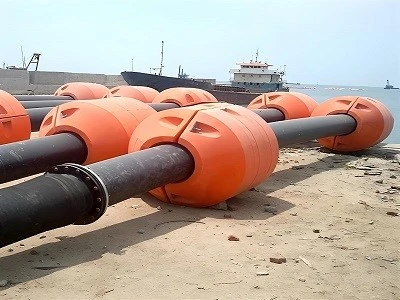
Copper-mine buyers may encounter several pipeline constructions, including carbon steel, lined steel and solid-wall polymer pipe. These options should not be compared on a single property.
Steel has structural characteristics that may suit demanding pressure requirements, but metallic pipelines can experience corrosion and erosion-corrosion depending on the slurry and water chemistry. Linings can provide a protective internal surface, although their performance depends on the lining material, attachment method, condition and operating environment.
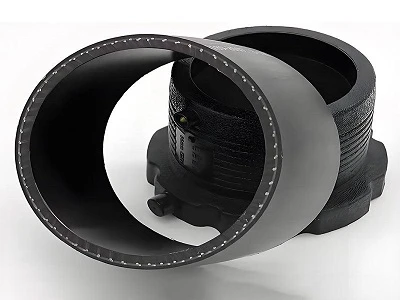
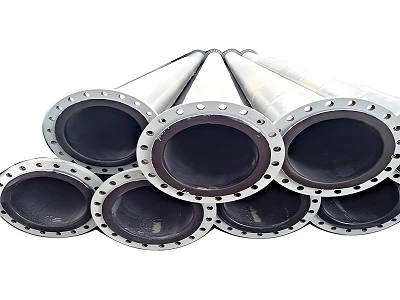
Solid-wall UHMWPE pipe is a different construction. UHMWPE forms the pipe wall rather than serving only as an internal lining over steel.
The distinction affects how the system must be assessed.
|
Parameter |
Specification |
|
Material |
Ultra-High Molecular Weight Polyethylene (UHMWPE) |
|
Pipe Diameter |
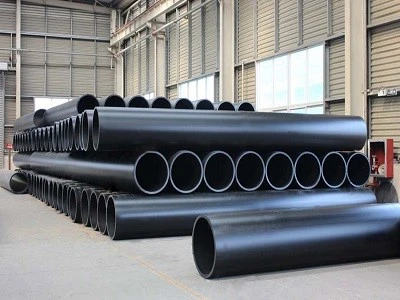
DN50–DN800 mm |
|
Wall Thickness |
5–30 mm |
|
Working Pressure |
0.6–2.5 MPa |
|
Standard Length |
6 m; customized lengths available |
|
Material Density |
≥ 0.93 g/cm³ |
|
Tensile Strength |
≥ 21 MPa |
|
Elongation at Break |
≥ 350% |
|
Vicat Softening Temperature |
≥ 120°C |
|
Abrasion Test Result |
≤ 0.05 g/1.61 km |
|
Connection Method |
Flange connection |
|
Applications |
Mining slurry, mineral concentrates, tailings and other suitable abrasive-material transport applications |
If a mine is replacing a steel pipeline, it should not assume that a solid-wall UHMWPE pipe can be substituted directly while retaining the same diameter, pressure rating, supports and connections. The proposed design needs an engineering review.
Likewise, if corrosion is the primary cause of failure, abrasion resistance alone may not be the deciding factor. The material and construction must address the actual failure mechanism.
5. A Real Chilean Example: Why Tailings Preparation Matters
The Los Pelambres tailings system illustrates why pipeline performance cannot be separated from upstream processing.
A 2024 University of Concepción thesis describes a tailings transport system that conveys material hydraulically under pressure through two pipelines, 28 inches and 36 inches in diameter. The study examines the screening station used to remove oversized solids before the tailings enter the transport system.
The reason is straightforward: oversized solids can contribute to excessive wear, pressure losses and blockages. Screening helps condition the slurry before it reaches the pipeline.
The thesis focuses on the reliability of the screening equipment and maintenance improvements. It does not establish that the pipeline material was responsible for the problems, nor does it evaluate UHMWPE as a replacement material. [Source: University of Concepción, 2024.]
For another copper operation, the practical lesson is to investigate the entire process before changing pipe materials.
If the incoming slurry contains particles outside the intended design range, replacing a pipe with a more wear-resistant material may not remove the underlying cause. If the wear is associated with the normal particle distribution and operating conditions, material selection may be an important part of the solution.
The distinction should be established through operating data and inspection rather than assumption.
6. What to Check Before Specifying UHMWPE for a Copper Mine
A useful technical review begins with the information available from the processing plant and the existing pipeline.
|
Required information |
How it supports the assessment |
|
Process stream |
Establishes whether the pipe carries concentrate, tailings or another material |
|
Mineral composition |
Helps identify the solids and potential chemical exposure |
|
Particle size distribution |
Shows the range of particle sizes present |
|
Solids concentration |
Helps characterise the slurry and its transport behaviour |
|
Flow rate and velocity |
Supports hydraulic and wear assessment |
|
Operating and maximum pressure |
Establishes the required pressure conditions |
|
Temperature range |
Supports material and chemical compatibility checks |
|
Pipe dimensions and route |
Defines the geometry and installation requirements |
|
Existing damage records |
Helps identify the failure mechanism and locations requiring attention |
|
Connection method |
Determines how the pipe sections will be joined and maintained |
If the existing pipeline has suffered repeated wear, inspection records are especially valuable. Photographs, wall-thickness measurements and information about the location of each damaged section can help distinguish localised wear from broader deterioration.
Where the system has experienced blockages, the investigation should also examine the slurry's transport behaviour and the condition of upstream screening or classification equipment.
A manufacturer should confirm the proposed pipe's available dimensions, documented pressure limitations, connection options and relevant test reports. Missing process information should be identified clearly rather than replaced with assumed values.
The objective is to determine whether the product is suitable for the documented duty-not simply whether it belongs to a category marketed for mining.
Conclusion
Copper-mine pipelines handle materials that vary in mineral composition, particle size, solids concentration and water chemistry. Those differences influence wear, corrosion, pressure loss and the behaviour of the slurry during transport.
UHMWPE pipe may be worth evaluating for suitable abrasive slurry applications, but its performance cannot be established from a general wear-resistance claim. The proposed product must meet the actual pressure, temperature, dimensional and installation requirements.
The Chilean examples discussed here also show why upstream process conditions matter. Screening, slurry properties and pressure management can influence pipeline reliability alongside the pipe material itself.
For mining operators, the starting point should be the actual stream and the observed failure mechanism. For manufacturers, the responsibility is to provide product data and recommendations that can be checked against those conditions.
A good material selection is not based on the name of the ore alone. It is based on what the pipeline must carry, how it must operate and what the verified product can withstand.
FAQRequest a UHMWPE Pipe Quotation
|
Step |
Process |
|
1 |
Send Requirements - DN, pressure, quantity and application |
|
2 |
Specification Confirmation - Pipe type, size, wall thickness and connection |
|
3 |
Quotation - Price, lead time, packing and shipping terms |
|
4 |
Order & Production - Contract, payment and production |
|
5 |
Inspection & Delivery - Quality inspection and shipment |
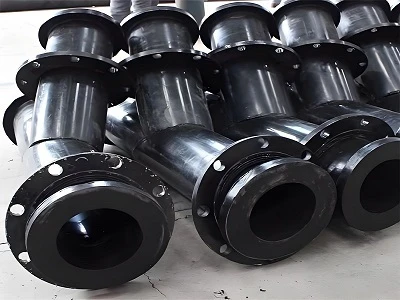
For UHMWPE mining pipe, UHMWPE lined steel pipe, UHMWPE elbows and link flanges, send us:
DN + PN + Slurry Type + Solid Concentration + Particle Size + Flow Rate + Pipeline Length + Quantity
Luoyang Zhengju New Materials Technology Co., Ltd.
WhatsApp:+86 19937270645
Email: baibaili456@gmail.com
Wechat: +86 19937270645
Get Best Price for Your Grinding Slurry Pipeline.
Is UHMWPE pipe suitable for copper concentrate and tailings?
It may be suitable for certain applications, but concentrate and tailings can differ in particle characteristics, solids concentration and chemistry. Each duty should be assessed separately.
Does copper tailings slurry always cause severe pipe wear?
No. Wear depends on particle size, shape, hardness, concentration, velocity, pipe material and other operating conditions. The presence of copper alone does not determine the wear rate.
Can UHMWPE replace a steel slurry pipeline directly?
Not without an engineering review. The pipe dimensions, pressure requirements, connection method, supports and installation conditions must be checked for the proposed construction.
Can laboratory wear tests predict the life of a mining pipeline?
Not by themselves. Results depend on the test method and conditions. Reliable service-life estimates require evidence relevant to the actual application, such as operating history, inspection measurements or representative testing.
Primary Keyword
UHMWPE pipe for copper mining
Secondary Keywords
UHMWPE mining slurry pipe
Copper tailings pipeline
Copper concentrate pipeline
Wear-resistant mining pipe
Copper slurry transport
Mining pipeline material selection
Request a UHMWPE Pipe Quotation
|
Step |
Process |
|
1 |
Send Requirements - DN, pressure, quantity and application |
|
2 |
Specification Confirmation - Pipe type, size, wall thickness and connection |
|
3 |
Quotation - Price, lead time, packing and shipping terms |
|
4 |
Order & Production - Contract, payment and production |
|
5 |
Inspection & Delivery - Quality inspection and shipment |
For UHMWPE mining pipe, UHMWPE lined steel pipe, UHMWPE elbows and link flanges, send us:
DN + PN + Slurry Type + Solid Concentration + Particle Size + Flow Rate + Pipeline Length + Quantity
Luoyang Zhengju New Materials Technology Co., Ltd.
WhatsApp:+86 19937270645
Email: baibaili456@gmail.com
Wechat: +86 19937270645
Get Best Price for Your Grinding Slurry Pipeline.